
The due diligence checklist for buyers and sellers
On this page
- The checklist as a trust instrument
- The seven workstreams, and where each one bites
- From folders to files, and the two that reward extra care
- Two lists, read from opposite ends
- Everyone has a folder, and someone owns the room
- Running the process from checklist to memo
- Red flags as questions, not impressions
- The room is the machine that makes the list work
- What it costs, and how the deal shapes the choice
Every deal reaches a moment when the romance ends and the reading begins. The letter of intent is signed, the handshake photo is taken, and someone on the buyer’s team opens a folder to check, line by line, whether the company on sale is the company that was described.
That reading is due diligence, and the checklist is what keeps it honest. It is an unglamorous artifact: a long list of things to request and questions to answer.
Yet it is the single instrument that decides whether a deal closes cleanly, closes at a discount, or quietly dies in the final fortnight. This guide treats the checklist as what it really is, a shared map that buyer and seller read from opposite ends, and that a virtual data room turns from a static list into a working process.
Why does it deserve this much attention? Because deals rarely fail on the numbers everyone scrutinises. They fail on the thing nobody thought to check.
A change-of-control clause folded into a supplier contract. A line of core code written years ago by a contractor who never signed an assignment. A customer that turns out to supply forty percent of revenue behind a reassuring growth chart.
None of these are exotic. All of them are catchable. The only thing standing between a buyer and an unpriced liability is a list disciplined enough to force attention onto the boring folders where surprises hide.
Are the stakes abstract? Not at all. Studies of merger outcomes have long put the failure rate at somewhere between seventy and ninety percent of acquisitions falling short of their expected value, a figure documented in the Harvard Business Review, and incomplete diligence recurs in the post-mortems as a cause rather than a footnote.
Set against advisory and legal bills that routinely run into six figures, a thorough checklist is the cheapest insurance in the entire transaction.
The checklist as a trust instrument
What does the checklist actually do? Two jobs at once, one technical and one political.
The technical job is obvious. It lists documents, tracks whether they have arrived, and records the risk each one is meant to answer.
The political job is quieter, and on competitive deals it is often more decisive.
What happens when a seller hands over a room that mirrors a recognised checklist, with files sitting exactly where an experienced reviewer expects them? The buyer relaxes. The unspoken message is that this is a well-run business with nothing to hide and nothing lost.
And when the room is a disorganised dump, or gaps appear where a signed minute or a current contract should be? The buyer does the opposite. They assume carelessness in the room reflects carelessness in the company, widen their questions, and start pricing in the risk of what they cannot see.
So the checklist is as much a signalling device as a verification tool. That is why sellers who close well treat assembling it as the first real task of the sale, not a chore triggered once a bidder appears.
That dual character reveals a structural truth: the buyer’s list and the seller’s room are the same object seen from two sides. The diagram below is the mental model worth carrying through the rest of this guide. One structure, read forwards by the seller who discloses and backwards by the buyer who verifies, resolving into the same seven workstreams.
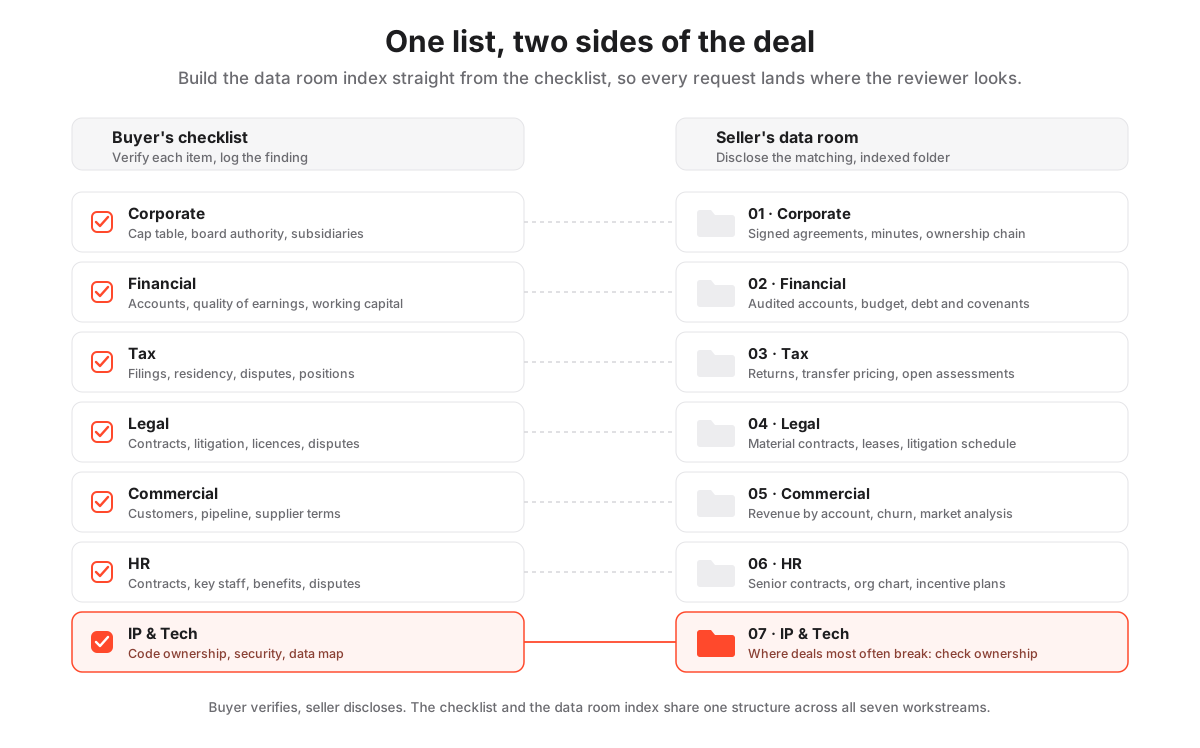
Hold that mirror image in mind and much of the confusion around diligence dissolves. The seller is not preparing for a different process than the buyer is running. They are preparing for the same process, from the front.
Every hour a seller spends anticipating the checklist is an hour subtracted from the frantic, credibility-eroding scramble that otherwise happens once a bidder starts asking. And every request a buyer ties to a real decision is a request the seller can satisfy quickly, because it points at a document that genuinely exists rather than at an anxious hunch.
The seven workstreams, and where each one bites
How does diligence divide up? Into a handful of workstreams, each answering a different question about the business.
The seven that appear in almost every deal are corporate, financial, tax, legal, commercial, human resources, and intellectual property or technology. Larger or regulated targets bolt on environmental, insurance and data-protection reviews, but the core set is remarkably stable across sectors and geographies.
What changes, then? The weighting. A life sciences company lives or dies on its patents and regulatory files, so IP and legal swell to dominate the review. A real estate deal turns on title, leases and environmental reports, and the commercial workstream that matters so much for a software business barely registers.
The list stays the same; the emphasis follows the value.
Read the table below less as a taxonomy than as a preview of where deals actually break. Each workstream carries a classic red flag that surfaces there more often than anywhere else.
The core due diligence workstreams and their common red flags
| Workstream | What the buyer verifies | Classic red flag |
|---|---|---|
| Corporate | Ownership, cap table, board authority, subsidiaries | Undocumented share transfers or option promises |
| Financial | Audited and management accounts, quality of earnings, working capital | Revenue that depends on one customer or one-off items |
| Tax | Filings, residency, VAT/sales tax, prior disputes | Aggressive positions that could unwind on audit |
| Legal | Material contracts, litigation, licences, disputes | Change-of-control clauses that let key contracts terminate |
| Commercial | Customers, pipeline, supplier terms, market position | Churn or margin trends hidden by headline growth |
| HR | Employment terms, key staff, benefits, disputes | Under-documented senior contracts or looming claims |
| IP & Tech | Registered IP, code ownership, security, data map | Core IP owned by a founder or a contractor, not the company |
Notice where those red flags do not live. Almost none of them sit in the financial statements everyone instinctively scrutinises first.
The accounts get audited, argued over and adjusted, and they rarely hide the thing that kills the deal. The killer sits one folder over, in the supplier agreement nobody read to the last clause, or in the contractor assignment that was never signed.
That is precisely the point of a checklist. It refuses to let the review gravitate only toward the interesting, well-lit documents, and drags equal attention onto the dull folders where the genuine surprises wait.
A workstream you skip is not a workstream you avoid. It is a liability you have agreed to inherit without pricing it.
From folders to files, and the two that reward extra care
Is naming workstreams enough? No. A checklist that stops there is only half-built.
“Corporate documents” is a folder, not a request. “The signed shareholders’ agreement and the current option ledger” is something a seller can actually produce, or fail to produce.
The usefulness of the whole exercise lives at that level of granularity. The spine of a standard room resolves into concrete sets of files that a companion guide on what documents go in a data room expands further. Descend one level from folder names and each workstream turns into a defined set of documents:
- Corporate and governance: the certificate of incorporation, the articles, an up-to-date cap table, shareholders’ and voting agreements, board and shareholder minutes, and a list of subsidiaries with their ownership chain.
- Financial: three years of audited accounts, recent management accounts, a quality-of-earnings analysis, working-capital detail, the current budget, and any debt facilities with their covenants.
- Legal: the material customer and supplier contracts, leases, licences, insurance policies, and a litigation schedule that covers live, threatened and recently settled matters alike.
- Commercial: the customer list with revenue by account, churn and retention data, the sales pipeline, key supplier terms, and whatever market analysis the company genuinely relies on.
- HR: senior employment contracts, the full org chart, benefit and pension schemes, incentive plans, and any disputes or grievances.
- IP and technology: registered patents and trademarks, a software and open-source inventory, code-ownership and contractor assignment agreements, the data map, and security-testing results.
- Tax: filed returns across the main jurisdictions, correspondence with the authorities, transfer-pricing documentation, and any open assessments.
Which folders reward extra discipline? Two of them, and both are about restraint rather than completeness.
The first is genuinely sensitive material: the unredacted customer names and detailed employee data that only an exclusive bidder should ever see. That material belongs in a staging area you release by phase, held back from the opening set so a field of competitors gets the broad picture while only the party that has earned exclusivity reaches the crown jewels.
The second is redaction. Anything containing personal data needs to be redacted at the point of upload, not gated afterwards with a permission setting that treats a legal obligation as a configuration choice.
Why does that distinction matter? A permission can be misconfigured. A redacted document cannot be un-redacted by a wrong click.
Two lists, read from opposite ends
What is the buyer’s version of the checklist? A request list and a verification log fused into one artifact. It enumerates every document the team expects to see, tracks whether each has arrived, and records the question each document is meant to answer.
The difference between a sharp buy-side process and a box-ticking one shows up entirely in that third column. A weak checklist says “collect the material contracts” and marks them received. A strong one says “confirm that no material contract terminates or reprices on a change of control” and does not rest until that question has a yes or a no beside it.
Three habits, more than any template, separate the two:
- Tie every request to a decision. If a document could not move the price, the structure, or the walk-away line, it does not belong on the critical path. Diligence that sprawls beyond that principle exhausts both teams and buries the findings that matter under a landslide of the ones that do not.
- Log conclusions, not receipts. Record what each document proved, not merely that it arrived, so the final report almost writes itself and no insight evaporates in the handover between reviewers.
- Escalate red flags the moment they surface. Feed a genuine risk straight into the pricing conversation rather than banking it for a dramatic reveal in the last week, which wastes everyone’s investment and poisons the negotiation exactly when goodwill is scarcest.
The discipline compounds. A buyer who runs the checklist as a live verification log finishes with a findings memo already drafted. One who treats it as a receipt tracker faces a frantic reconstruction of conclusions from a pile of downloaded files in the days before signing.
How does the seller read the same list? Backwards, and the job is anticipation. It means assembling final, dated versions of every document a buyer will eventually ask for, redacting anything outside the deal’s scope, and indexing the whole set so a reviewer lands on files where instinct tells them to look.
The highest-value move available to any seller is deceptively simple and almost never done well: build the data room’s folder structure directly from a standard diligence checklist, so the index and the request list are the same shape. Our data room index best practices and a ready folder-structure template show what that looks like in practice.
The payoff is measured in the questions that never get asked, because the answer was already sitting, correctly labelled, where the buyer expected it.
Where do sellers most often slip? The failures are predictable enough to name plainly:
- Dumping files in without an index invites a flood of avoidable clarifying questions and squanders the trust the room was supposed to build.
- Leaving an obvious gap, a missing contract or an unsigned minute, invites the buyer to assume the hole is hiding something worse than it is.
- Uploading unredacted personal data creates a compliance problem that no permission setting can retroactively fix. Where EU personal data sits inside the documents, that is not a courtesy but a legal duty: the GDPR governs how you store and share that data, and a diligence process claims no exemption from it.
- Opening the room before a final internal review lets your own errors reach bidders first, which is the one mistake entirely within your power to prevent.
Our guides to data room permissions and to GDPR and virtual data rooms cover how to gate the sensitive folders you cannot strip out entirely.
Everyone has a folder, and someone owns the room
Due diligence is a team sport played across a table. The checklist earns its keep partly by naming an owner for every workstream, so nothing falls into the gap between the buyer, the seller and their advisers.
Who owns what? The rough division is that buyers verify while their specialist advisers do the deep technical work, and sellers disclose while their lawyers run the room.
In practice, the financial and quality-of-earnings workstream sits with a financial adviser who reviews what the seller supplies. Tax runs the same way, with legal counsel supporting. The legal and contracts review belongs to counsel on both sides.
Commercial and market work usually stays with the buyer’s own deal team, because it is judgement about the business rather than a specialist audit. HR and employment leans on legal counsel, and IP and technology is led by the buyer’s team with legal support on the assignment questions.
Does scale change the principle? Not really. On a lean deal a single buy-side team may cover several columns itself, while on a large cross-border transaction each cell can be a separate firm with its own engagement letter. The principle holds regardless.
Which row do people forget to staff? The one that matters most. Someone has to own the room itself: fielding bidder questions, releasing documents in the right phase, keeping the audit trail intact, and, where the deal is sensitive enough to require a clean team behind a ring fence, drawing up and policing that arrangement.
On most private deals the seller’s legal counsel takes this on. It is a genuine job with daily obligations, not a title handed out at the kickoff and then ignored.
A room without a named steward drifts into inconsistency within days. Permissions get set inconsistently, questions pile up unanswered, and the disclosure record develops the kind of holes a disgruntled buyer’s lawyer will find with pleasure eighteen months later.
The deals that close cleanly are not the ones with the fewest problems. They are the ones where every problem had an owner and a folder before the buyer went looking.
That single line is worth pinning above the process, because it reframes what good diligence is trying to achieve. The goal was never a company with no flaws. Such a company does not exist and, if it did, would not be for sale at a price worth paying.
The goal is a deal in which every flaw has already been surfaced, assigned, priced and documented, so nothing the buyer discovers is a discovery. A known problem is a negotiation. An unknown problem, sprung late, is a crisis, and the entire apparatus of the checklist exists to convert the second kind into the first.
Running the process from checklist to memo
Once the checklist exists, what does running the process look like? A repeatable sequence, and the order matters because each stage quietly assumes the last is finished.
Finalising the request list before indexing the room, for example, saves a scramble to re-file documents after a folder structure has already been built around the wrong assumptions. The steps below trace the path a deal team walks from a blank checklist to a signed closing memo.
How to run a due diligence process from the checklist
The sequence a deal team follows from checklist to closing memo.
Estimated time: p42d
-
Agree the checklist and scope
Start from a standard checklist, then cut or add items so every request ties to a pricing or structuring decision. Circulate it to advisers before the room opens.
-
Build and index the data room
Recreate the checklist as the folder index, upload final documents, run full-text search and OCR, and redact out-of-scope or personal data before anyone is invited.
-
Grant phased, group-level access
Set folder permissions by group and hold sensitive folders back for later phases, so early bidders see the broad set and only the exclusive party reaches the crown jewels.
-
Work the request list and Q&A
Reviewers tick items as documents arrive and log findings beside each. Route all questions through the room's Q&A module so the record stays complete and auditable.
-
Escalate red flags and reprice
As workstreams surface risks, feed them into price, warranties or structure immediately rather than banking them for the end.
-
Write the diligence report
Consolidate each workstream's findings into a single memo that supports the final decision, with the audit trail as evidence of what was disclosed.
Is the forty-two-day total a promise? No, it is a placeholder for a six-week window. Real timelines stretch from a fortnight for a small fundraising round to several months for a contested, cross-border acquisition.
What moves them? Not the number of documents, but the quality of the preparation. A seller who has indexed the room to the checklist can answer in a couple of hours a question an unprepared counterpart takes a fortnight to locate.
That is why our closer look at how long due diligence takes keeps returning to preparation rather than deal size as the thing that compresses a schedule. The review does not become fast because the reviewers hurry. It becomes fast because the answers were ready before the questions arrived.
Red flags as questions, not impressions
What is the most useful shift a diligence team can make? Stop treating red flags as a feeling and start treating them as specific, answerable questions.
A vague sense that “the customer base looks concentrated” is worth nothing in a negotiation. The finding that “our largest customer is forty-one percent of revenue on a contract that renews annually and terminates on change of control” is worth a clause and a number.
Granularity is what separates diligence from an impressionistic reading of the files, and it is the reason a checklist must descend to the level of questions rather than resting at the level of folder names.
The recurring killers translate cleanly into this form, one sharp question per workstream:
- Commercial: does any single customer exceed twenty percent of revenue, and are the top ten contracts on renewable terms?
- Legal: does any material contract terminate, or reprice, on a change of control?
- IP: is every line of core code assigned to the company, including work done by contractors who left years ago?
- Financial: does reported EBITDA survive once one-off items and owner add-backs are stripped away?
- Tax: would each filed position actually survive an audit in its home jurisdiction?
Framed that way, a red flag stops being something a reviewer carries around in their head. It becomes a piece of the deal that has to be resolved before signing.
When the answer comes back “no” or “unclear”, it does not sit in a reviewer’s memory waiting to be forgotten. It moves directly into the conversation about price, warranties and structure, which is exactly where a risk belongs.
That is the whole argument for a granular checklist in a sentence: it turns worry into a list of yes-or-no questions, and a list of yes-or-no questions is something a deal team can actually finish.
The room is the machine that makes the list work
What makes a checklist workable at the scale of a real transaction? A virtual data room, because it maps one-to-one onto the request list and records every interaction against it.
The folder index is the checklist made navigable. The permission system is what turns “release this only in phase two” from an intention into an enforced rule.
And the audit trail is the seller’s evidence, the record of who opened which document and when, that answers a buyer’s later claim that something was never disclosed with a timestamp rather than a memory.
Three features carry most of the diligence load:
- Full-text search and OCR let a reviewer find a single clause buried in thousands of pages without asking the seller to go hunting for it.
- A structured Q&A module keeps bidder questions organised, attributed and auditable instead of scattered across a dozen email threads, a workflow we walk through in running data room Q&A.
- Granular, group-level permissions are what make phased disclosure real, so a competitive field sees the broad set while only the exclusive bidder reaches the sensitive folders.
Do providers differ? Yes, and the differences show up under load rather than in the demo. Some platforms let you save a folder-and-permission template, so a firm running diligence repeatedly can rebuild a prior room’s entire structure in minutes rather than reconstructing it by hand, a convenience Ellty offers among others.
Our guide to setting up a virtual data room walks the build from an empty room to a ready one, and the security features checklist itemises the controls worth confirming before you invite the first outsider through the door.
The room does not replace the checklist. It is the machine that runs it, and the seller who understands that spends their setup time reproducing the list in folders and permissions rather than treating the software as a filing cabinet with a login.
What it costs, and how the deal shapes the choice
Do timelines and budgets scale with the deal? Both do, and it helps to hold the two together rather than pretending the room is a fixed line item.
Diligence windows run from roughly two weeks for a lean fundraising round to several months for a large, contested or cross-border transaction, with mid-market private deals commonly landing somewhere in the four-to-twelve-week band.
The room itself is a small figure inside a large budget. Indicative entry pricing starts around ninety-nine dollars a month, mid-market rooms commonly sit in the low hundreds, and enterprise deployments are usually quoted per engagement rather than off a published rate card.
Treat every one of those numbers as a starting point and confirm it in current dollars with the provider, because plans, storage caps and user limits change more often than the marketing pages that describe them. The table below lines up deal type against timeline against the demands each places on the room, which is the comparison that actually matters when you are choosing.
How diligence scope shapes the timeline and the room you need
| Deal type | Typical diligence window | What the room must handle |
|---|---|---|
| Seed / early fundraising | 1-3 weeks | A curated set for many investors, light permissions |
| Small M&A | 3-6 weeks | Full checklist, phased access, structured Q&A |
| Mid-market M&A | 6-12 weeks | Deep folders, several bidder groups, heavy Q&A |
| Large / cross-border | 3-6 months | High document volume, data residency, tight audit needs |
Read down that table and the right provider becomes less a question of price than of fit. A seed round barely stresses any platform on the market, so paying for enterprise features there is money spent on capacity you will never touch.
A cross-border acquisition with data-residency obligations and a heavy audit burden narrows the field quickly, and the wrong choice there is not merely expensive but a genuine risk to the deal.
For worked pricing scenarios that put numbers to these bands, see how much a virtual data room costs, and the iDeals review and Datasite review show how two of the heavier platforms handle processes at diligence scale.
Prefer to start from the outcome and work back? Our ranking of the best data rooms for due diligence and, for acquisition-specific needs, the best rooms for mergers and acquisitions lay out the reasoning behind each pick, while the live comparison and pricing pages let you weigh certifications, Q&A workflow and current rates side by side.
None of that machinery matters, though, without the discipline it exists to serve. The room is only as good as the checklist you pour into it, and the checklist is only as good as the honesty with which both sides read it.
Build the list before the buyer arrives. Index the room to match it. Name an owner for every workstream and the room itself. Turn every red flag into a question you can answer yes or no.
Do that, and diligence stops being the anxious phase where deals go to die. It becomes what it was always meant to be: the orderly reading that lets both sides sign knowing exactly what they are signing.
