
Virtual data room pricing in 2026: what you will actually pay
On this page
- How much does a virtual data room cost in 2026?
- What are the four ways VDRs charge?
- Which billing model is actually cheapest?
- Why does per-page pricing catch people out?
- What do the common pricing tiers include?
- Which tier do I actually need?
- What hidden costs should you budget for?
- How does pricing scale with deal size?
- How long should I keep a room open?
- Is an annual plan worth it for a short deal?
- Can you negotiate virtual data room pricing?
- How do you cut VDR costs without weakening security?
- Is there a genuinely cheap data room worth using?
- Is a free trial enough to judge a data room?
- Do security certifications change the price?
- What is the true total cost of a data room?
- Which pricing model fits your deal?
Virtual data room pricing looks simple until a real deal starts. The landing-page number is almost never the invoice.
So this guide runs as a list of plain questions, the ones people actually type before they buy a room. Each gets a few sentences you can lift straight into a budget.
Before you read any price, settle three things. What unit you are billed on, how many of that unit your deal generates at its busiest point, and how many months you keep paying. Get those wrong and the sticker number tells you almost nothing.
How much does a virtual data room cost in 2026?
Most virtual data rooms cost between $99 and $1,000 or more per month. The median mid-market room sits around $400 to $600 per month.
Lean rooms for a single fundraising round can run under $150 per month. Banking-grade platforms that host months-long M&A processes with hundreds of users are usually quoted per engagement, and can reach five figures.
The biggest driver of your final number is not the brand on the door. It is the billing model, and how many months the room stays open.
So the honest first question is not “how much.” It is “priced on what unit, and for how long.” The side-by-side pricing view normalises every provider we score to a monthly USD figure. Buying from New Zealand and want those numbers in NZD, plus a read on which providers bill locally? The companion guide to virtual data room pricing in New Zealand runs the local figures.
What are the four ways VDRs charge?
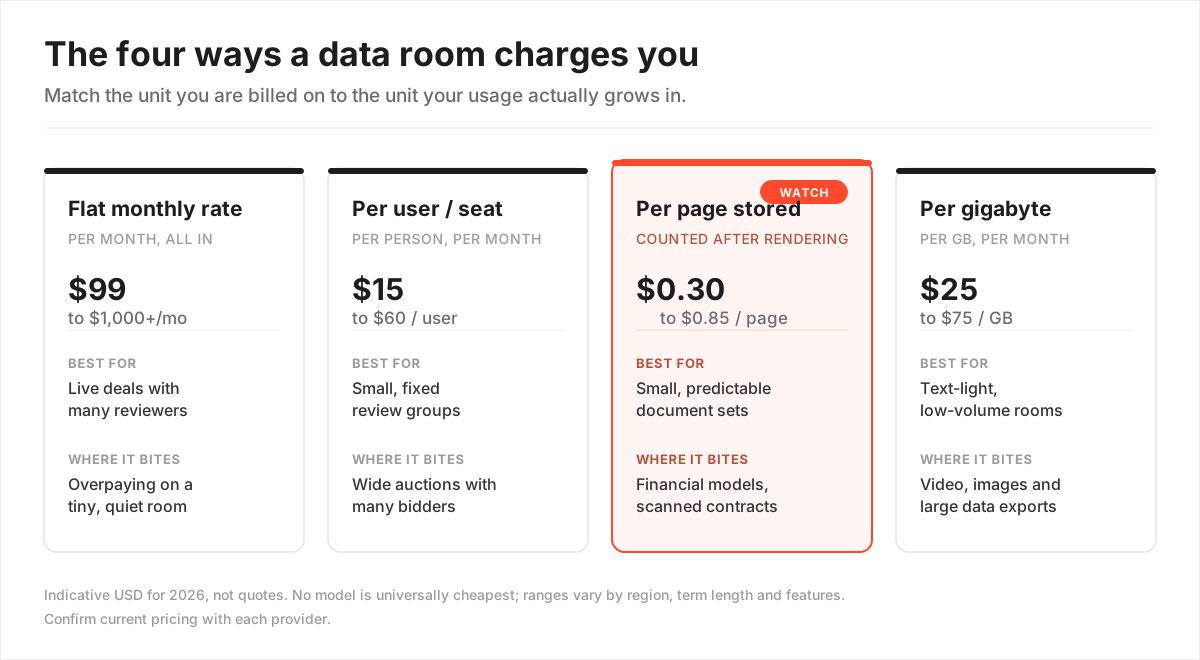
Every room bills on one of four units. A flat rate per month, per user, per page of stored documents, or per gigabyte of storage.
The same room can look cheap or expensive depending only on which unit your usage stacks up in.
| Billing model | Indicative range | Best for | Where it bites |
|---|---|---|---|
| Flat monthly rate | $99 to $1,000+/mo | Live deals with many reviewers | Overpaying on a tiny, quiet room |
| Per user / seat | $15 to $60 per user/mo | Small, fixed review groups | Wide auctions with many bidders |
| Per page stored | $0.30 to $0.85 per page | Small, predictable document sets | Financial models and scanned contracts |
| Per gigabyte | $25 to $75 per GB/mo | Text-light, low-volume rooms | Video, images and large data exports |
Ranges are indicative snapshots for 2026 and vary by region, term length and included features. Confirm current pricing directly with each provider.
Which billing model is actually cheapest?
None of them, universally. That is the whole point.
A flat rate wins a busy auction with fifty reviewers, because adding people costs nothing. Per-user wins a quiet room with three people, because you pay for exactly those three.
Per-page and per-gigabyte only stay cheap while your document set stays small and text-based. Match the unit you are billed on to the unit your usage grows in, and the cheapest model reveals itself.
The guide on per-page versus flat-rate pricing works the maths through on a real document set.
Why does per-page pricing catch people out?
Because “pages” are counted after the platform renders your files, not as they sit on your desktop.
A 200-tab Excel model, a folder of scanned PDF contracts, or a set of engineering drawings can each explode into thousands of billable pages once converted. At $0.50 per page, a set that felt modest becomes a four-figure line item.
The trap with per-page pricing is not the rate. It is that you agree to it before you know how many pages your own documents will become once the platform renders them.
The safe rule is narrow: per-page pricing only works when your document set is small, final, and mostly ordinary text.
The moment a deal involves financial models, large scanned archives, or frequent re-uploads, a flat-rate room with unlimited pages takes the risk off the table. Ellty prices its rooms flat with unlimited pages for that reason.
Per-gigabyte pricing has the mirror-image flaw. It stays cheap on many pages of light text, then bites on a few heavy files.
Video walkthroughs or large data exports weigh a lot in gigabytes but count as almost nothing in pages. Look at what your data set is mostly made of before you accept either unit.
What do the common pricing tiers include?
Providers almost always sell in three or four tiers. The gaps are defined by security depth, user limits and administrative control, not by storage.
The pattern holds even when the tier names differ:
- Starter / entry: a basic room. Granular folder permissions, limited or no watermarking, a basic activity log. Fine for sharing a deck with a few investors.
- Business / mid: the diligence workhorse. Dynamic watermarking, a full audit trail, a Q&A workflow module, and higher user allowances. This is the true cost of most real deals.
- Enterprise / top: governance and support. Single sign-on, IP restrictions, a choice of data residency, extended retention, and a dedicated onboarding manager.
Which tier do I actually need?
Read the tier list as a checklist against your counterparty, not against your budget.
If a buyer’s counsel will demand watermarking, a genuine audit trail and a structured Q&A process, the Starter tier is a false economy. Your real price is the Business tier.
If you are sharing a seed deck with three angels, enterprise governance is money set on fire. Buy the lowest tier that clears your deal’s actual security bar.
What hidden costs should you budget for?
Beyond the plan fee, most rooms carry add-ons that lift the real cost 20 to 40 percent above the sticker price. None of them are unreasonable. They are just easy to miss when you compare landing pages.
- Overage fees: charges for pages, users or gigabytes beyond your included allowance. Usually the largest single surprise.
- Extra admin seats: entry tiers often cap administrators, and additional full-control seats are billed separately.
- Premium security: single sign-on, IP allow-listing and custom retention are commonly add-ons rather than defaults.
- Data residency: hosting in a specific region to satisfy privacy law can carry a premium. For EU counterparties this is frequently a compliance requirement, not a nicety.
- Onboarding and support: guided setup, bulk upload help and a dedicated manager may live only in the top tier or cost extra.
The fix is one habit. Price the room you will actually run at peak, with every reviewer and document loaded, rather than the empty room you sign up for.
Watch for setup and onboarding fees too, common on enterprise engagements where a manager bulk-imports your files. The hidden costs of virtual data rooms breakdown itemises each with typical dollar impact.
How does pricing scale with deal size?
Cost scales with three things at once: reviewers, document volume, and the length of the process. A large deal is not just a bigger room. It is a different billing conversation.
As a rough frame: a seed round with under 200 documents runs about $99 to $250 per month. A Series A or B diligence with 500 to 2,000 documents runs $300 to $700. A mid-market M&A process with thousands of documents climbs to $700 to $2,500. An enterprise or banking auction is custom, often north of $5,000.
These are planning ranges, not quotes. The M&A pricing patterns and the startup fundraising guides cover the usage each scenario tends to hit.
How long should I keep a room open?
Exactly as long as the deal needs it, and not a billing cycle longer.
Every extra month a room stays live is another charge, and a forgotten open room is one of the most common sources of wasted VDR spend.
A three-week raise is a month-to-month decision. A diligence process that drags across a quarter, or a room you keep for ongoing board and investor reporting, is where an annual plan starts to pay off.
Is an annual plan worth it for a short deal?
Usually not for a short deal, usually yes for a long one.
An annual term almost always lowers the effective monthly rate, commonly by the equivalent of one or two months free. But it trades that saving for flexibility.
Close the room after a six-week raise while paying for eleven more months, and the discount becomes wasted spend. A longer commitment also gives up leverage to switch providers, and it usually means an upfront cash outlay.
Here is the test. If the deal or the reason for the room will plausibly outlast six months, price the annual term. If not, keep month-to-month and close the room the day the deal completes.
One caveat: an annual plan still sets your allowances for the year, so a usage spike can still trigger overage.
Can you negotiate virtual data room pricing?
More than most people assume, particularly above the entry tier.
Term length and upfront payment are the obvious levers. But onboarding fees, extra admin seats, additional storage and even trial extensions are commonly negotiable, especially near the end of a provider’s quarter.
If you cannot move the headline rate, negotiate the add-ons into the deal instead.
How do you cut VDR costs without weakening security?
You can usually trim 20 to 30 percent off a bill without touching the controls that matter. The savings come from billing structure and housekeeping, not from dropping the security features you are actually paying for.
How to reduce virtual data room costs
A practical sequence to lower your bill while keeping deal-grade security intact.
Estimated time: 45min
-
Forecast peak usage
Estimate the maximum reviewers and documents your room will hold at the busiest point of the deal, then price that peak, not the empty starting room.
-
Match the billing model
Pick flat-rate for wide, document-heavy deals and per-user only for small, fixed groups, so your usage stacks up in the cheapest unit.
-
Right-size the tier
Buy the lowest tier that still includes watermarking, a full audit trail and Q&A if your deal needs them, rather than defaulting to enterprise.
-
Negotiate the term
Trade a longer commitment or upfront payment for a lower effective monthly rate on any deal that will run more than a couple of months.
-
Close idle rooms
Archive and downgrade or cancel once a deal closes, since a forgotten open room is one of the most common sources of wasted VDR spend.
Two habits do most of the work. Pricing the peak instead of the empty room, and closing rooms the moment a deal completes. Both are free, and both are routinely missed.
Is there a genuinely cheap data room worth using?
Yes, if you read “cheap” as low headline price with the security still intact, rather than the cheapest possible unit at any cost.
The value options tend to win by pricing flat with generous allowances, so a small team gets predictable billing without per-page exposure.
What you want to avoid is a room that is cheap because it strips out watermarking, audit trails or certified security. Our roundup of the cheapest virtual data rooms ranks the value tier without dropping the controls a deal needs.
Is a free trial enough to judge a data room?
Enough to test the interface and the permission model. Not always enough to judge behaviour under a full deal load.
Most reputable providers offer a free trial, and Ellty’s runs for 14 days. That is ample time to check how granular the permissions are, whether watermarking and view-only rendering work as claimed, and how clean the audit trail reads.
What a trial cannot always show is performance with thousands of documents and dozens of concurrent reviewers. The free trial versus paid rooms guide sets out what a trial proves, and the provider reviews note trial length for each one.
Do security certifications change the price?
Baseline certified security is largely table stakes at the Business tier and above, so it rarely appears as a separate line item. The depth of certification does track with price, though.
The controls regulated buyers expect, such as SOC 2 and ISO/IEC 27001, are usually bundled once you are past the entry tier.
Where cost creeps in is the governance extras layered on top: single sign-on, custom data residency, extended retention and detailed compliance reporting.
If your counterparties are regulated, treat certified security as a minimum you filter for, not a premium, and read the security certifications guide before comparing claims.
What is the true total cost of a data room?
The subscription, plus the add-ons, plus the time your team spends running it. The last of those is the one budgets ignore.
A cheap room that needs constant manual permission fixes, or that reviewers struggle to navigate, quietly costs more than a slightly pricier room that sets up cleanly.
When you compare quotes, hold the deal constant and cost the whole engagement. A room that is 20 percent cheaper on paper but doubles your admin time is not the cheaper room.
Which pricing model fits your deal?
The right model follows directly from the shape of your process. Flat-rate for busy or document-heavy deals. Per-user for small, fixed groups. Per-page or per-gigabyte only when your data set is genuinely small and stable.
Get the unit right and most pricing surprises disappear before they happen.
If you are still shortlisting, the best data rooms for M&A and best rooms for startup fundraising hubs rank providers by scenario, and the guide to what a virtual data room is covers the controls those prices are buying.
Frequently asked questions
How much does a virtual data room cost per month?
Indicative monthly pricing runs from about $99 for a lean fundraising room to $1,000 or more for an enterprise deal platform, with most mid-market rooms between $300 and $700 per month. The final figure depends on the billing model, the number of users and documents, and the length of the deal. Confirm current pricing with the provider, as plans change often.
Is per-page or flat-rate VDR pricing cheaper?
It depends on your document volume. Per-page pricing is cheaper for small, stable, text-based document sets, but it can become expensive fast once financial models, scanned files or large archives inflate the rendered page count. For a busy, document-heavy deal, a flat monthly rate with unlimited pages is usually both cheaper and more predictable.
What hidden costs come with a data room?
The common extras are storage overage fees, charges for additional administrator seats, premium security such as single sign-on and data residency, and professional onboarding or migration help. Together these can lift the real cost 20 to 40 percent above the advertised plan price, so price the room at peak usage rather than at sign-up.
Do virtual data rooms offer a free trial?
Many providers offer a free trial so you can test the interface and security controls before committing, and Ellty's free trial runs for 14 days. Trial length and included features vary, so check current terms with each provider and use the trial to verify permissions, watermarking and the audit trail.
