Virtual data room security: the complete checklist
On this page
- What a single log line can and cannot tell you
- Why the folder link was never an option
- The stack, not the toggle
- The certificate Marcus asked for first
- The number that set the budget
- The encryption conversation nobody enjoys
- When Meridian reached for the strongest lock
- The controls that actually stop leaks
- Back to the log
- The dry run they ran before anyone real arrived
- The laws that followed the data, not the company
- What the weak room down the hall got wrong
- The complete checklist, in one pass
Eleven forty at night, on a Tuesday in March, one new line appeared in a log. Priya Anand read it and felt her stomach drop.
She was CFO of Meridian Therapeutics, a clinical-stage biotech in the middle of being acquired. Three bidders were circling. The room held everything that mattered: unpublished trial data, the cap table, the manufacturing agreements. And the one thing no rival was supposed to see, the interim readout from a Phase II study that had not yet been announced.
The log line said a user tied to the most aggressive bidder had just opened that exact document. Not the summary. The full readout.
For about ninety seconds, Priya assumed the worst. Then she read the rest of the line, and the fear turned into something closer to relief.
What a single log line can and cannot tell you
The entry named the user. It timestamped the session to the second, recorded the IP address, and showed the file had opened in a view-only window with a watermark burned across every page, carrying that user’s email.
Download was disabled on that folder, so nothing left as a file. The viewer had spent four minutes on page nine, the safety table, and eleven seconds on everything else.
And because Meridian’s counsel had negotiated a strict confidentiality undertaking covering exactly this material, the four-minute session was not a leak at all. It was a permitted review, logged, watermarked, and provable.
That is the whole argument for a virtual data room, compressed into one night. A shared drive could have stored the same file. It could not have named who opened it, stopped them from saving a copy, stamped their identity across the page to deter a screenshot, or cut them off in a single click.
Security is not a feature a data room happens to have. It is the entire reason the category exists instead of a folder link.
This guide is the checklist Priya’s team worked through, weeks before that log line appeared, verified control by control before a single confidential file went near the room.
Why the folder link was never an option
Rewind six weeks. Meridian’s first instinct was the cheap one almost every team considers: a locked cloud folder, a few shared links, done by Friday.
Marcus, the general counsel, killed it in a sentence. “If a rival sees the readout and we cannot prove exactly who, when, and under what terms, we do not have a deal, we have a lawsuit we cannot win.”
He was right, and the reason is structural. Consumer file sharing is built for convenience, not for adversarial disclosure to parties who are simultaneously your counterpart and your competitor.
It lacks document-level permissions, dynamic watermarking, view-only rendering, and above all a full audit trail that survives the deal. The gap stays invisible right up until the moment you need to prove who saw a file or revoke access instantly. By then it is too late to switch tools.
The guide on virtual data room features explained walks through what a purpose-built room adds. Meridian moved to evaluating real rooms the same afternoon.
The stack, not the toggle
Here is the mental model that made the rest of the evaluation coherent. Security is a stack of layers, not a single switch you flip to “on.”
Each layer answers a different question, and each fails independently. Encryption answers what happens if the data is intercepted or stolen. Permissions answer what a person is allowed to do once inside. Watermarking and audit trails answer whether a leak can be traced and proven after the fact.
Certification answers the question underneath all of them: why believe the first three are real?
A room can market a long feature list and still be weak if one layer is missing. Or, far more commonly, present but misconfigured.
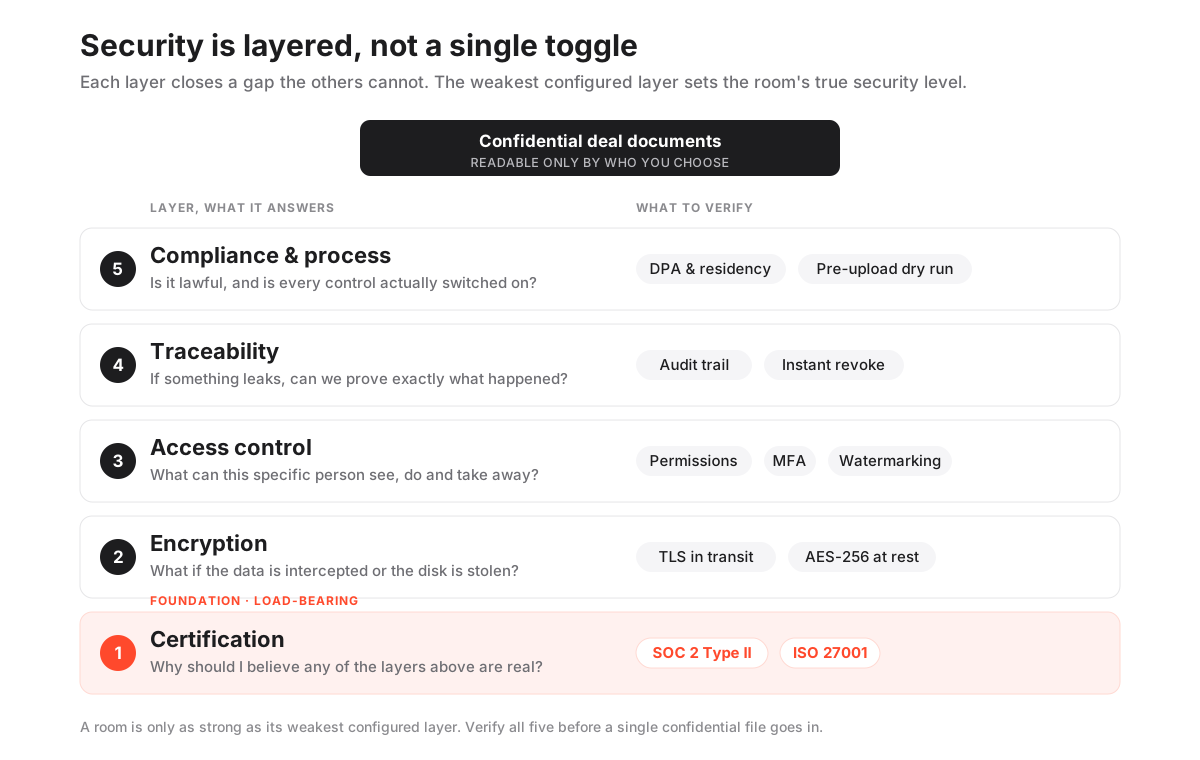
Read from the bottom up, the picture is an argument about load-bearing order. Certification sits at the foundation because it is the only layer an outsider tested. Everything above it, the encryption, the access model, the traceability, the compliance posture, is a claim until an auditor has checked it.
That is why Meridian started diligence not with the flashiest feature but with the least glamorous document in the process: the certification report.
The certificate Marcus asked for first
Marcus did not ask the shortlisted vendors whether they were secure. Every vendor says yes.
He asked each to send the current SOC 2 Type II report and the ISO 27001 certificate. Then he did the thing most buyers forget: he checked the scope and the date.
SOC 2 is an attestation against the AICPA Trust Services Criteria, covering the security, availability and confidentiality of a service, signed by an independent CPA firm. ISO 27001 is the international standard for an information security management system, certified by an accredited body against the specification maintained by ISO.
Neither is a logo you buy from a marketing team. Both are an outside party testing controls and putting their name to the result.
The glossary defines SOC 2 and ISO 27001 on their own, and the certifications explained guide unpacks the rest of the alphabet.
Here is the reference set Marcus worked from. For each row the discipline was identical: get the document, confirm the scope covers the product you will use, and check the date. Certifications lapse, and scopes routinely exclude the exact module you were counting on.
| Certification | What it proves | Issued or attested by | What to verify |
|---|---|---|---|
| SOC 2 Type II | Controls operated effectively over a period, not just at a single moment | Independent CPA firm, per AICPA criteria | Type II, not just Type I; report dated within the last 12 months |
| ISO 27001 | A certified information security management system is in place and maintained | Accredited ISO certification body | Certificate scope covers the data room product; current expiry |
| ISO 27017 / 27018 | Cloud-specific controls, and controls for personal data held in the cloud | Accredited certification body | Relevant when you handle personal data in the cloud |
| HIPAA readiness | Safeguards for protected health information, plus a signed BAA | Vendor self-attestation plus a BAA | A signed Business Associate Agreement, not just a claim |
| GDPR alignment | Lawful handling and transfer of EU personal data | Vendor, backed by a DPA and a transfer mechanism | A Data Processing Agreement and data residency options |
One vendor tripped on the first hurdle. Their deck listed “SOC 2,” and when Marcus asked for the report, what arrived was a Type I.
The distinction is not pedantry. A SOC 2 Type I only describes controls as designed at a single point in time. A Type II tests that those controls actually operated over a period of months. For a live transaction, Type II is the one that counts.
Marcus did not treat the Type I as a fail outright. He treated it as an open question, and an open question in the certification layer is enough to move a vendor down the list.
A badge is a claim. A dated, in-scope report is evidence.
The number that set the budget
Priya framed the whole exercise around one figure, placed at the top of the evaluation spreadsheet where the board would see it.
The average total cost of a data breach reached USD 4.88 million in 2024, according to IBM’s annual Cost of a Data Breach Report, the most widely cited benchmark for breach economics. Each control you verify buys down a slice of that exposure.
But for a biotech mid-acquisition, the clean-up cost was almost beside the point. If the unpublished readout reached a rival, the damage was not a remediation invoice. It was a bidder walking into the next negotiation already knowing Meridian’s weakest data, and a valuation that would never recover.
In a competitive process the strategic cost of a leak dwarfs even that four-and-a-half-million-dollar average. “It looks secure” versus “it is audited to be secure” is exactly the gap Priya refused to bet the exit on.
The encryption conversation nobody enjoys
Encryption is the layer everyone assumes and few interrogate. Meridian assumed it too, until their head of engineering asked the question that actually varies between vendors.
The baseline is not controversial. Encryption in transit, almost always TLS, protects files moving between a browser and the server. Encryption at rest, commonly AES-256, protects the stored copy on disk.
AES is the block cipher standardised by the US NIST in FIPS 197, and 256-bit keys are the current expectation for confidential data. Every serious provider does both. So if a vendor cannot confirm TLS in transit and AES-256 at rest, the conversation is over.
Encryption is table stakes, not a differentiator. Assume every serious provider encrypts in transit and at rest, then spend your diligence on the questions that actually vary: who holds the keys, who can see plaintext, and how fast can you revoke.
The real questions live one level down, in key management. Who holds the keys? Are they rotated, and how often? Can the vendor’s own staff read unencrypted content?
A room where employees can see your files sits in a completely different risk category from one with strict key separation. The only way to know which you are buying is to ask in those exact words and write the answer down.
When Meridian reached for the strongest lock
For most deals the standard baseline is plenty. Reaching for the strongest possible encryption costs you useful features for a threat you do not face. Meridian was the exception, and knowing why is more instructive than the default.
Zero-knowledge encryption means the provider structures its keys so that its own staff, and anyone who compromises the provider, cannot read your plaintext at all. It removes the vendor’s employees from your threat model entirely.
The trade-off is real. Server-side features such as full-text search, in-browser rendering and certain account-recovery flows become harder or impossible when the platform genuinely cannot see the content. For a typical fundraising or M&A room, AES-256 at rest with disciplined key management and a tight access model is enough, and the convenience usually wins.
Meridian’s clinical readout was the case where it did not. Unreleased trial results are genuinely existential, and Marcus wanted the vendor to be technically unable to comply with a third-party data request touching that one folder.
So they split the decision, a way most teams never consider: zero-knowledge treatment for the single most sensitive folder, standard AES-256 with strong key management for everything else.
The lesson generalises. Decide where you sit on this spectrum before you shortlist, because the requirement narrows the field sharply and often pushes you toward higher plan tiers.
The controls that actually stop leaks
Here is the uncomfortable truth Priya’s team internalised early. The biggest risk was never a broken cipher. It was a file reaching the wrong person, through an over-broad permission, a forwarded screenshot, or an account nobody switched off.
Access control is where real-world leaks are won or lost, and no single control covers the whole board.
Consider the four things that go wrong and what stops each. A stolen password is defused by multi-factor authentication, which turns a leaked credential into a dead end. But MFA does nothing about an authorised bidder photographing a page.
Dynamic watermarking deters that screenshot by stamping the viewer’s identity across the page, yet it cannot revoke access when a party drops out. View-only rendering with download disabled keeps a document from ever leaving as a file, which is why Meridian’s readout was never downloadable, but it does nothing if a permission was scoped too broadly.
Granular document permissions fix the scope, and instant revoke or remote shred handle the departed bidder still holding a live invitation. IP and time-based limits add a further ring, blocking sessions from unexpected places or outside the review window.
Every control closes a different gap, and every gap is one an accident or an attacker will use if you leave it open. That is why “turn on all of them” is the only correct answer, not a shopping list you pick from.
The guide on dynamic watermarking and fence view covers how the identity stamp and the pixelated fence behave in practice.
Back to the log
Which brings us back to that line at eleven forty at night, and the layer that turned Priya’s panic into proof.
The audit trail converts “we think it was secure” into “we can show exactly what happened.” A serious room logs every view, download, print and permission change against a named user, a timestamp and, ideally, an IP address. And it keeps that record long after the deal closes.
When a counterparty later disputes what was disclosed, the log is what stands between Meridian and a he-said-she-said it cannot win.
Depth varies more than vendors admit, so Priya’s team verified three things by hand rather than trusting the datasheet.
First, granularity. Did the log capture page-level views and time-on-document, or only the blunt fact that a file was opened? The four minutes on page nine came from a room that captured the former.
Second, integrity. Could an administrator quietly edit or delete an entry, and could the log be exported to a tamper-evident format for the deal file? A log an admin can rewrite is not evidence.
Third, usability. An engagement heatmap showing which bidder studied which schedule is a diligence signal in its own right, and it told Meridian’s advisers which bidder was serious weeks before the bids came in.
The audit trails explained guide goes deeper. The practical rule is blunt: a log you have never opened is an assumption, not a control.
The dry run they ran before anyone real arrived
None of the layers above matter if a control exists in the product but was never switched on for your room. That is the failure mode that produces most breaches, and it is entirely preventable with a rehearsal.
Weeks before the first bidder was invited, Meridian ran a pre-upload pass with a throwaway account. It is the same order of operations any team can follow.
How to audit a virtual data room's security before you upload
A pre-upload verification pass that confirms each control is present and correctly configured.
Estimated time: 2h
-
Request the certification reports
Ask for the current SOC 2 Type II report and ISO 27001 certificate, then confirm the scope covers the exact product and the dates are current.
-
Confirm the encryption baseline
Verify TLS in transit and AES-256 at rest, and ask who holds the keys and whether vendor staff can access plaintext content.
-
Design permissions before people
Build user groups (bidders, legal, internal) and set folder-level rights on the group, so no individual is edited by hand and inheritance is deliberate.
-
Turn on the deterrents
Enable dynamic watermarking, view-only rendering and, where offered, disabled download for sensitive folders before any external invite goes out.
-
Enforce strong authentication
Require multi-factor authentication for every external user, and add IP or time-based restrictions for the most sensitive groups.
-
Test the audit trail and revoke
Invite a test account, perform views and downloads, confirm every action appears in the log, then revoke the account and verify access is gone instantly.
The last step is the one teams skip and later regret. A log nobody has read and a revoke button nobody has pressed are assumptions wearing the costume of controls.
Priya’s team invited a dummy account, opened files, tried to download the locked ones, watched every action land in the log, then revoked the account and confirmed the session died on the spot. It took an afternoon.
Most providers offer a free trial that makes the rehearsal possible without commitment. When the real reviewers arrived, nothing surprised anyone, which is exactly how a data room is supposed to feel.
The laws that followed the data, not the company
Meridian is a US company, and for a while the team assumed US rules were the whole story. The data disagreed.
Which regime applies depends on whose information sits in the room, not on where your headquarters is. Meridian’s Phase II study had enrolled patients across three EU countries, so the files held personal data of people in the EU. So the GDPR applied whether Meridian liked it or not.
Article 32 sets an explicit expectation of “appropriate technical and organisational measures,” encryption named among them, so the encryption work doubled as a compliance obligation. And because the readout also contained protected health information and a US entity was in scope, HIPAA’s Security Rule governed the safeguards and required a signed Business Associate Agreement, not a vague promise of “HIPAA readiness.”
That became three concrete checklist items. A signed Data Processing Agreement. A lawful basis for the cross-border transfer of the EU patient data. And data residency options, so the sensitive files could be pinned to a specific region rather than landing wherever the vendor’s default happened to be.
The default region is rarely the right one for regulated personal data, so Meridian confirmed residency against where the trial patients actually lived. The guides on GDPR and virtual data rooms and data residency in virtual data rooms cover the transfer mechanisms in full. When the personal data belongs to New Zealanders, the local duties shift again under the Privacy Act 2020; the controls to demand for a New Zealand deal are set out in virtual data room security for a New Zealand deal.
What the weak room down the hall got wrong
A year earlier, Meridian’s advisers had watched a different deal nearly come apart. The post-mortem was a catalogue of failures with nothing to do with cryptography.
The platform had been perfectly capable. The failures were all configuration and process.
Permissions had been edited person by person instead of on groups, so one fat-fingered change exposed a whole folder branch. Download had been left on for files that only ever needed viewing. A bidder who dropped out in week two still held a live invitation in week six, because nobody reviewed access between stages.
Someone had accepted a SOC 2 Type I in place of a Type II and never noticed the scope excluded the module they used most. And, tellingly, the team had chosen the pricing tier first, then discovered the access controls a regulated deal needed lived on a plan they had not budgeted for.
That last one is commercial as much as technical. The controls a regulated deal needs, customer-managed keys, advanced access limits, deeper audit retention, often sit on higher plans, so security requirements should drive the tier rather than the reverse.
Working out how much a virtual data room costs and how the VDR pricing models explained map controls to tiers is part of the security exercise. Where a lean, security-first setup is genuinely enough, options such as Ellty belong on the shortlist alongside the enterprise incumbents, and you can weigh the specifics on the pricing page rather than in the middle of a story.
The complete checklist, in one pass
Strip the narrative away and Meridian’s whole diligence collapses into a single pass across five layers. If every item below has a verified answer before you upload, the room is as secure as its configuration allows. And configuration is the only security that counts.
- Certification: a SOC 2 Type II report that is in scope and current; a current ISO 27001 certificate; additional standards such as ISO 27017/27018 or a HIPAA BAA where the data demands them.
- Encryption: TLS in transit; AES-256 at rest; a clear answer on key management, on whether staff can reach plaintext, and on whether zero-knowledge or customer-managed keys are available for the folders that need them.
- Access control: granular folder-level permissions built on groups; dynamic watermarking; view-only and no-download where warranted; multi-factor authentication for every external user; IP or time-based limits on the most sensitive groups.
- Traceability: a complete, monitored audit trail of every view, download and print; exportable, tamper-evident logs; instant revoke and, ideally, remote shred.
- Compliance: a signed DPA; a lawful cross-border transfer mechanism; data residency pinned to the correct region; a HIPAA BAA where health data is involved.
- Process: permissions designed before people are invited; a pre-upload dry run with a test account; access reviewed and stale accounts revoked at every stage.
The sharpest way to pressure-test the list is against a real deal type. A fast fundraising round shares less and forgives more. A full M&A process with regulated buyers, the kind Meridian ran, exercises every item above.
The roundup of the best data rooms for mergers and acquisitions and the individual provider reviews show how real platforms score against this checklist rather than their own marketing.
Frequently asked questions
What is the single most important data room security feature?
Independent certification, specifically a current SOC 2 Type II report and ISO 27001. It is the one item that verifies every other control was tested by an outside auditor rather than merely claimed by the vendor. Without it, the rest of the feature list is unaudited marketing.
What is the difference between SOC 2 Type I and Type II?
Type I describes whether controls are suitably designed at a single point in time, while Type II tests whether those controls actually operated effectively over a period, usually several months. For a live transaction, insist on Type II, because it is evidence the controls work in practice, not just on paper.
Does encryption alone make a data room secure?
No. Encryption protects data from interception and theft, but it does nothing about an authorised user who forwards a screenshot, an over-broad permission, or an account that was never revoked. Security is the combination of encryption, granular permissions, watermarking, authentication and logging working together.
Do I need zero-knowledge encryption for my data room?
Usually not. For most fundraising and M&A rooms, AES-256 at rest with strong key management and a tight access model is enough, and it keeps useful features like full-text search working. Reach for zero-knowledge or customer-managed keys only when the data is existential and your counsel requires the vendor to be technically unable to read it.
Priya kept the log from that Tuesday night. Not because anything went wrong, but because it is the cleanest illustration she has of what security actually buys you: not the comfort of a feature list, but the ability to reconstruct exactly what happened and prove it to a room full of lawyers.
Security is the part of a data room decision easiest to take on faith and most expensive to get wrong. Work the checklist as verified answers rather than vendor assurances. Let the controls a specific deal genuinely needs decide the tier instead of the reverse. And treat any pricing you gather as indicative until the provider confirms current USD figures.
The room that lets you sleep at eleven forty at night is the one you audited before you trusted it, not the one that simply looked the part.
