
Audit trails: what a data room logs and why it matters
On this page
- The memory underneath the deal
- Anatomy of a single row
- Why the record outranks the features around it
- Three windows onto the same data
- What the log can prove, scenario by scenario
- How long it lasts, and whether it can be changed
- Reading the log while the deal is live
- The questions that separate a claim from a record
- Why the standards insist on it
- The closed loop with permissions and watermarking
Eleven months after Larkspur Diagnostics changed hands, a letter arrived from the buyer’s counsel.
The claim was serious. Vantor Health, the strategic acquirer that had beaten two private-equity bidders to buy the medical-devices maker, now alleged that a material supply contract had been buried in the data room and never properly disclosed. The contract carried a termination clause that would cost the combined group a great deal of money.
The seller’s advisors at Aldergate Partners read the letter twice. Then they did the one thing that turned a frightening allegation into a short conversation.
They opened the audit trail.
There it was, exported and archived on the day the room closed, unaltered since. On 14 August, at 14:32 UTC, a lawyer named Priya Menon had logged in from Vantor’s outside counsel with the email p.menon@acquirer-legal.com and opened the supply agreement.
She had reached pages three through five, the pages carrying the termination clause, and spent just under two minutes on them. A dynamic watermark bearing her name had been stamped across every page as she read. Two days later, a colleague on the same team opened the file again and downloaded a watermarked copy.
The record did not editorialise. It showed, in plain rows, that the document had been in the room, in the correct folder, fully accessible, and that the buyer’s own advisors had read the exact pages now said to have been hidden.
The letter went away.
That is what an audit trail is for. It is worth dwelling on how quietly it did its work.
Nobody at Aldergate had been thinking about that supply contract during the deal. No one flagged Priya Menon’s two minutes as significant at the time. The room recorded it anyway, without anyone asking it to.
Eleven months later, that unremarkable row of data was the difference between a clean defence and an expensive argument with no evidence on either side. Most people picture a data room as a safe place to keep documents. The more accurate picture is a place that remembers.
The memory underneath the deal
A data room audit trail is a chronological, tamper-resistant log of every action performed inside the room. Each entry ties to a specific person, a precise timestamp and a source device or IP address.
A shared drive might tell you a file was modified last Tuesday. A virtual data room tells you that a named reviewer at a named firm opened page seven of a specific contract at a specific second, lingered there, and left without downloading it.
That gap is the entire point. An audit trail turns document access from something invisible into something provable.
It is the mechanism that lets a seller hand deeply confidential files to competing bidders, some of them direct competitors, and still walk away with a defensible account of precisely who was shown what, in what order, and when. If you want the wider picture of how logging sits alongside encryption and permissions, our explainer on how a virtual data room works follows a single document from upload to audited view.
Back in the Larkspur room, the log had been doing far more than tracking that one supply agreement. It recorded the full lifecycle of every document and every user, so that any action a person could take left a trace.
When Vantor’s deal team logged in from London and its PE rivals from New York and Singapore, the room noted each session, its origin and its duration. When Aldergate raised a bidder’s access level to unlock the second phase of diligence, the change was logged with the old level, the new level, and the administrator who made it. And when a junior analyst at one of the PE firms tried to open a folder they had no rights to, the denial was recorded too, quietly, without alerting the analyst that the wall had been tested.
Strip it down and a capable room logs seven kinds of thing:
- Views, with the user, the document, the page reached, the time on that page, and the timestamp. This is what proves exposure and shows, page by page, how carefully someone actually read.
- Downloads, with the user, the file, whether it left in protected or original form, and when. This matters enormously if the file later leaks.
- Prints, with the page range and the watermark applied, because a physical copy is still a copy and the log ties it to a name.
- Uploads and replacements, which build a version history so everyone can see which draft was live at any moment.
- Permission changes, which explain why a party could or could not see a file at a given point in time.
- Logins and logouts, with IP, device and location, which is what surfaces access from an unexpected country or a credential being shared.
- Failed or denied access, the probing that a lighter tool would never notice at all.
Notice how little of this the user ever sees. Good logging is silent by design, so that reviewers behave naturally while the room builds a complete account of the process behind their backs.
Depth varies, though, and it varies more than the marketing suggests. Page-level view tracking, failed-access logging and full session detail are standard in security-led rooms and simply absent in lighter ones. That is precisely why logging depth deserves a place on your shortlist criteria rather than being taken on faith.
Anatomy of a single row
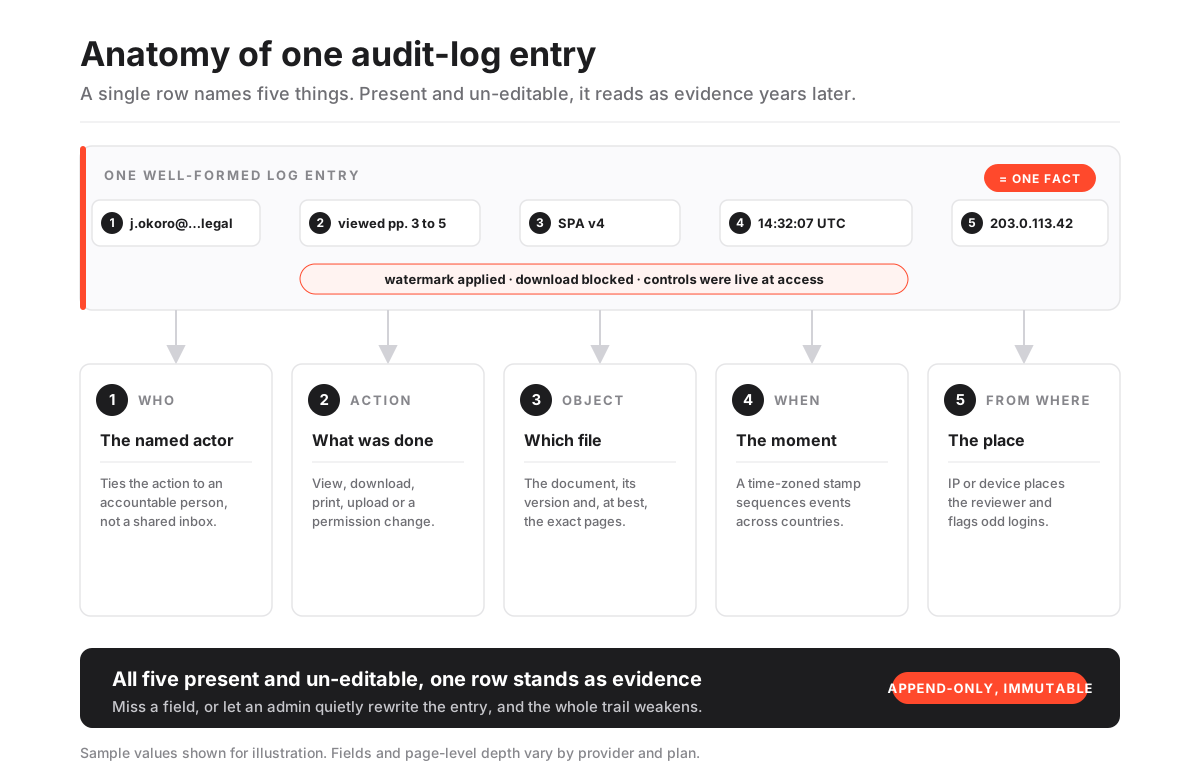
Zoom all the way in, past the dashboards and the charts, and you reach the atom of the whole system: one log entry.
A well-formed entry is a self-contained fact. It names an actor, an action, an object, a moment and a place, so that read on its own, years later, with no context around it, it still makes complete sense.
Read the Larkspur row aloud and it is essentially a sentence a court could accept: user p.menon@acquirer-legal.com viewed pages 3 to 5 of Share Purchase Agreement Schedule 9, from 203.0.113.42, at 2026-08-14 14:32:07 UTC, watermark applied, no download.
Every field in that sentence is doing a job.
The named actor ties the action to an accountable person, not a shared inbox that three people log into. The precise, time-zoned timestamp lets you sequence events across parties sitting in different countries, which matters when you need to show every bidder got the same file at the same instant.
The object identifies not just the file but the version and, in the best rooms, the exact pages. The source IP or device places the reviewer somewhere in the world, which is what catches a login from a country nobody on the deal has any business being in. And the modifiers, watermark applied or download blocked, show that the room’s controls were actually live at the moment of access rather than switched off in the background.
When all five of those are present, and none of them can be edited afterward, a single row stands as evidence. When fields are missing or vague, the whole trail weakens, because a chain is only as strong as its least specific link.
This is exactly why a vendor’s cheerful assurance that “we log everything” should always draw a follow-up question: which fields, at what granularity, and can any of them be changed later.
Why the record outranks the features around it
Here is the claim, stated plainly, and it is worth stating plainly because it is easy to miss on a feature comparison sheet. The audit trail is the only capability in a data room that produces evidence.
Dynamic watermarking deters leaks. Granular permissions prevent oversharing. Both are essential and neither one proves anything after the fact.
The audit trail is what lets you demonstrate, later, that those controls did their job at the moment it mattered. In a transaction where a single document set can move the value of an entire company, the ability to reconstruct exactly who saw what and when is not a convenience feature. It is a form of insurance you pay for in advance and hope never to claim.
Three concrete needs sit behind that insurance.
The first is disputes, the Larkspur situation: a buyer claims they were never shown a liability, and the log settles it without a fight. The second is process integrity, which matters most in a competitive auction, where a seller has to be able to show that every bidder received the same information at the same time and that no one got an early look. The third is breach response. If confidential data does escape the room, the log is where a forensic investigation begins, and that last point is anything but hypothetical.
IBM’s Cost of a Data Breach Report 2024 found that organisations took 258 days on average simply to identify and contain a breach. In a live deal, a complete audit trail is what compresses that window from months to an afternoon.
Instead of guessing how a file escaped, an administrator exports the log and reads the exact chain of access: who opened it, from where, whether they downloaded a protected or an original copy, and who touched it after them. The record you never expect to need is the one that saves the deal when something finally goes wrong.
A watermark tells a leaker they can be traced. The audit trail is what actually traces them. One is a deterrent; the other is the evidence.
Three windows onto the same data
People sometimes ask how an audit trail differs from an activity report or an engagement heatmap. The honest answer is that they are not three different things at all. They are three windows onto the same underlying data, each cut for a different job.
The raw audit trail is the complete, legally-oriented ledger, built for defensibility and for export. It is what Aldergate reached for when the letter arrived. An activity report is a summarised, human-readable roll-up of the same events, built for a quick read of where the week stood. And an engagement heatmap is a visual layer over the identical data, built to turn access into intelligence.
The heatmap is where the log stops being defensive and starts being strategic. By aggregating time-on-page and repeat visits across a bidder group, it shows which parties are genuinely grinding through the material, which have gone quiet, and which folders are pulling the most attention.
During the Larkspur auction, the heatmap told Aldergate more than any status call. Vantor’s lawyers kept returning to the material-contracts folder, night after night, reading deeply. One PE bidder opened the financials once and never came back. The other spread its attention evenly and asked sharp questions.
Long before anyone submitted a price, the room had already suggested who was serious. The same events that would one day sit in a dispute file were, in the moment, a live read on intent. Our guide to virtual data room features explained sets reporting in the context of the rest of the toolset.
What the log can prove, scenario by scenario
An audit trail earns its keep in more than one situation, and the parts of the log that carry the weight shift depending on the situation.
In a dispute, page-level views and permission history do the heavy lifting. In a leak investigation, download records and login locations matter most. A regulator cares about a slightly different slice again. The table below maps common logging capabilities against the situations where each one tends to become the deciding evidence.
| Logging capability | M&A dispute | Data leak | Regulatory audit | Bidder analysis |
|---|---|---|---|---|
| Page-level view tracking | Decisive | Decisive | Supporting | Decisive |
| Download and print records | Decisive | Decisive | Decisive | Rarely needed |
| Permission-change history | Decisive | Supporting | Decisive | Rarely needed |
| Login IP and location | Supporting | Decisive | Decisive | Rarely needed |
| Time-on-page and heatmap | Supporting | Supporting | Rarely needed | Decisive |
| Tamper-evident, exportable record | Decisive | Decisive | Decisive | Supporting |
Look hardest at the bottom row. In every scenario except pure bidder analysis, what matters is not only that events were recorded but that the record cannot be quietly edited after the fact and can be exported in a form a third party will actually accept. A log you cannot trust, or cannot hand over, is barely a log at all.
That single property is why logging depth belongs on a shortlist in its own right, and why the difference between providers shows up most sharply in transaction-heavy use cases such as the ranked picks on our best VDRs for mergers and acquisitions and best VDRs for due diligence pages.
How long it lasts, and whether it can be changed
Two properties decide whether a convenient record becomes admissible evidence: how long it is kept, and whether it can be altered.
Retention varies by provider and plan, commonly running from the life of the deal to several years beyond it. Immutability is the property most buyers forget to check, and it is the more important of the two by some distance.
Think about it from the other side. An audit trail that an administrator could quietly rewrite would prove nothing at all, because the first question any opposing lawyer would ask is whether the seller edited it.
So serious platforms write entries to append-only storage, and the strongest implementations protect the sequence cryptographically, so that any tampering becomes detectable rather than invisible. That is what let Aldergate say, with a straight face, that the log they exported eleven months earlier was the log as it was written on the day.
Retention then determines how far back you can reach. A live deal needs the full log available for export at close. A regulated seller may be required to hold records for years afterward, well past the point where the room itself is archived and everyone has moved on.
Before you sign, confirm three things: how long logs are retained, whether they are truly immutable, and in what format they export. Our guide to VDR security features to check puts these alongside the other controls worth confirming, and it is a short conversation that prevents a long one later.
Reading the log while the deal is live
The mistake that would have cost Aldergate is easy to name, because plenty of teams make it: treating the audit trail as something you look at once, at the end.
The log is far more useful read as a habit than as a post-mortem, and the difference is not effort so much as timing.
During the busiest stretch of the Larkspur auction, the deal lead read the log daily. In slower processes weekly is fine; the point is that nothing unusual should sit unnoticed for long.
Each pass, she pulled the activity for one bidder group at a time, which showed both coverage and intent and confirmed that no group was seeing folders it had no right to. She scanned for anomalies, the tells that a lighter tool would never surface: a login from a country nobody on the deal was in, access at three in the morning local time, a run of failed attempts, or a single credential appearing from two cities at once.
When a party’s access had changed, she read the permission-change log beside the view log, so the record explained itself rather than leaving a gap someone could later exploit. And she used the heatmap for signal, not just for defence, feeding what it showed back to the deal team while there was still time to act on it.
Then, at close, she did the step people skip and later regret. Before the room was archived, she exported the full, immutable log in a portable format and stored it with the deal file.
That export is the copy that answered the buyer’s letter eleven months later. A room eventually gets archived or shut down, and reconstructing the record afterward is far harder, sometimes impossible, than exporting it while everything is still live. Treat the export as part of closing the deal, not an afterthought to it.
The questions that separate a claim from a record
Vendors rarely volunteer the limits of their own logging, so a short, specific checklist run during a trial is worth more than any spec sheet. These are the questions to put to a live test room before you commit, not after.
- Granularity. Does the log capture page-level views and time-on-page, or only that a file was opened? Are failed and denied access attempts recorded at all?
- Immutability. Is the log append-only, and can any administrator edit or delete entries? Ask specifically how tampering would be detected.
- Identity detail. Does each entry carry the named user, the IP or device, and the location, and does it survive when that user is later removed from the room?
- Retention. How long are logs held, do they persist after the room is archived, and can retention be set to match a regulatory obligation you are under?
- Export. In what formats can you export the full trail, whether CSV, PDF or a signed report, and can you do it yourself without filing a support ticket?
- Scope by plan. Which of the above are gated to higher tiers? Logging depth is a common place where an entry-level plan quietly falls short of the marketing.
Treat any vague answer as a finding, not a footnote. The whole premise of the audit trail is that a third party will one day trust it, and a capability you cannot demonstrate during the trial is one you should not assume you will have in the deal. Our walkthrough of how to choose a virtual data room folds these questions into a wider shortlisting process.
Why the standards insist on it
None of this is only prudent practice. Audit logging is a written requirement of the security standards and privacy laws that serious counterparties expect a data room to meet, which is why any VDR marketed for regulated deals treats the audit trail as core rather than optional.
The specifics line up cleanly.
ISO 27001 names logging as a distinct control, requiring that user activities, exceptions and security events be recorded and retained, which maps directly onto the ISO 27001 scope buyers ask about. A SOC 2 report, built on the AICPA Trust Services Criteria, tests whether a system monitors access and retains the evidence to prove it, which is the substance behind a SOC 2 attestation rather than the badge itself. And under the GDPR, Article 30 requires organisations to maintain records of processing activities, as the UK’s ICO documentation guidance spells out, which for a data room handling personal data means being able to show who accessed what.
The connection worth holding onto is this: the logging features described throughout this guide are the visible, product-level proof that a vendor can actually satisfy those frameworks.
A certification with no genuine audit trail behind it is worth very little, because the certificate describes a capability the product has to demonstrate in practice. Our explainer on virtual data room certifications covers how to read those claims without being dazzled by them, and the guide to GDPR and virtual data rooms goes deeper on the privacy side.
The closed loop with permissions and watermarking
Come back, finally, to how the Larkspur letter was actually answered, because it was not the audit trail alone that did it. It was three controls working as a set.
Permissions decided what Priya Menon was allowed to do: view-only access to a defined slice of the room. A dynamic watermark stamped her identity across every page she opened, so a photographed page would carry her name. And the audit trail recorded that she opened it, tying the on-screen watermark back to a timestamped, immutable row.
Permissions govern, watermarking deters, and the log proves. None of the three is complete without the other two. Our guide to data room permissions and access controls breaks down the levels and how to set them without leaving a gap.
Provider depth on logging varies more than the marketing lets on, so it pays to compare directly rather than assume. Security-led rooms such as iDeals and Datasite publish granular, page-level trails of the kind that answered Vantor’s letter, while modern, full-featured rooms like Ellty also log activity within a clean interface built for M&A, due diligence and fundraising. Match the logging depth to what your particular deal might one day need to prove, and treat any pricing you see as indicative until you confirm it with the provider.
Which brings the story back to where it started.
The people at Aldergate who set up the Larkspur room did not know, when they chose it, that a supply contract would be the thing under dispute a year later. Nobody ever does. That is the strange nature of an audit trail as a purchase: you are buying an account of events that have not happened yet, for a question no one has asked, to be read by people you may never meet.
The room remembered so that the deal team did not have to. When the letter came, the memory was there, complete and unaltered, and it spoke for itself.
That is the quiet argument for taking logging seriously long before you have any reason to. The best audit trail is the one you never need, right up until the single day you do.
Frequently asked questions
Can a data room audit log be edited or deleted?
In a well-built virtual data room, no. Serious platforms write log entries to append-only storage so that even an administrator cannot quietly alter or remove them, and the strongest implementations protect the record cryptographically so any tampering is detectable. That immutability is exactly what makes the log usable as evidence, so it is worth confirming with a provider rather than assuming. A log that can be rewritten proves nothing.
Does a data room track which pages someone actually read?
Capable rooms do. Page-level view tracking records not just that a document was opened but which pages were reached and how long the reader spent on each, which is what powers engagement heatmaps and gives a genuine read on how carefully a party reviewed a file. This depth is common in security-led rooms and thinner in lighter ones, so confirm page-level logging if it matters to your process.
How long are virtual data room audit logs kept?
Retention varies by provider and plan, commonly ranging from the life of the deal to several years afterward. A live deal needs the full log available to export at close, while a regulated seller may be required to hold records well beyond the point where the room is archived. Ask each provider how long logs are retained, whether they survive archiving, and in what format they export.
Can audit trails be used as evidence in a dispute?
Yes, and that is much of the point. A complete, immutable, exportable log of every view, download, print and permission change gives a defensible account of who saw what and when, which is central evidence if a deal is later challenged. It is strongest when paired with a documented permission structure and a consistent review routine, so the record shows access was controlled and intentional throughout, not merely recorded.
