
Cheapest virtual data rooms that do not cut security
On this page
- The cheapest room hides the fewest problems
- Cheap is relative to the deal, not the sticker
- The four controls a cheap room can never drop
- What getting it wrong actually costs
- The billing model decides whether a room is cheap for you
- Does the cheapest tier actually clear the floor?
- Why certification is a floor, never a premium
- How Dana got the price down without touching the floor
- The rooms that stay cheap without crossing the line
- Test before you trust: the trial as cheap insurance
- What Dana would tell you now
Dana Whitlock had run Meridian Freight for nineteen years. Now she was selling it.
A regional buyer had made an offer. The lawyers were circling. And her advisor had told her, almost in passing, to “stand up a data room by Friday.”
So Dana priced a few. The first quote came back at more than a thousand dollars a month. The second was a quarter of that. The third, from a tool she found in an afternoon of searching, was thirty-nine dollars, unlimited everything, sign up now.
She very nearly took the thirty-nine dollar one. From the outside, it looked identical.
That is the trap. This is a story about not falling into it, and about the unglamorous questions Dana learned to ask before she paid anyone a cent.
The cheapest room hides the fewest problems
“Cheapest” is the most dangerous word in data room shopping. The fastest way to lower a VDR’s price is to quietly strip out the controls that make it a data room in the first place.
A folder-sharing tool with a login screen can undercut a real room by half and still call itself one. It will not tell you what it removed. It will simply be cheaper, and the missing pieces are exactly the pieces a buyer’s counsel checks first.
So the real question is never “what is the cheapest room.” It is “what is the cheapest room that still does the job.” Those are wildly different numbers, and the gap between them is where deals get lost.
Dana’s thirty-nine dollar option had no dynamic watermarking. It logged who signed in, but not who opened, downloaded, or printed which file.
Picture a copy of Meridian’s customer contracts surfacing in a competitor’s hands mid-negotiation. She would have had no way to prove where it came from, and no way to prove it had not come from her own carelessness. The saving was real on the invoice and imaginary everywhere else.
Here is the good news. A low price and real security are not enemies. Plenty of rooms are cheap because they run lean, not because they cut corners. The whole skill is telling one kind of cheap from the other.
Cheap is relative to the deal, not the sticker
Here is the first thing Dana got wrong, then got right. She was comparing sticker prices as though a hundred and fifty dollars meant the same thing to every seller.
It does not. A hundred and fifty dollar room is superb value on a live, months-long sale with a dozen people reading documents. The same room is pure waste sitting nearly empty, opened twice a year for a formality.
The number that matters is cost per useful month of a room that clears the security floor. Frame it that way and the “cheapest room” stops being a single answer. It becomes a match between a plan and a transaction.
Meridian’s sale was a small-business deal: one serious buyer, a moderate stack of documents, a few months of diligence that would probably drag past its promised end. For that shape, a flat monthly rate wins, because it keeps the bill predictable while the timeline slips.
A wide auction with forty bidders would want the same flat rate for a different reason, that per-user pricing explodes the moment the room fills up. And an early-stage founder raising a small round from a handful of investors might do fine on a tight per-user plan, because the group is small and fixed and the room closes fast.
The best value shortlist exists precisely to sort rooms by this fit rather than by headline price. Founders raising capital can start from the fundraising picks instead, since that is a different budget entirely.
Dana’s advisor put it more bluntly than any guide would: pay for the deal you are actually running, not the deal you are afraid of.
The four controls a cheap room can never drop
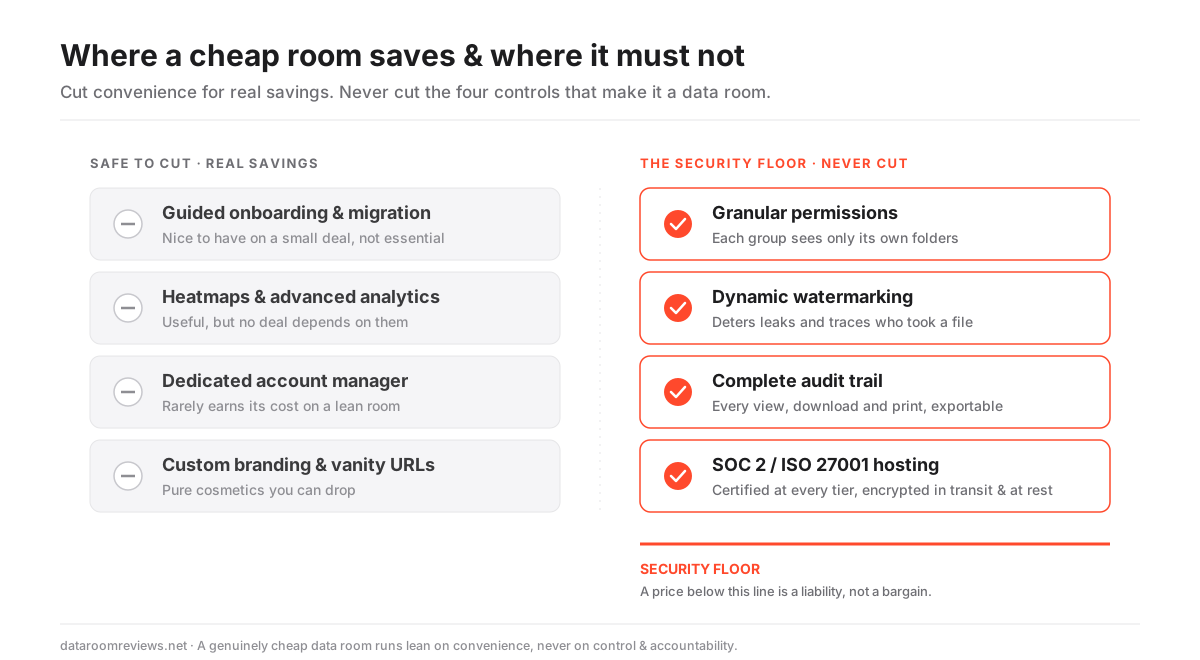
A cheap room can shed a great deal without anyone getting hurt. Guided onboarding, migration help, engagement heatmaps, a dedicated account manager, custom branding, vanity URLs.
All of that is convenience. Paying for it is how a modest transaction ends up on an enterprise invoice.
What a cheap room can never shed is control and accountability. There are four such controls, worth stating plainly because they are the exact four a discount tempts a vendor to remove.
- Granular, document-level permissions, so each group of readers sees only its own folders and nothing else. The buyer’s lawyers should never stumble into the board’s private correspondence.
- Dynamic watermarking and view-only rendering, which stamp each viewed page with the reader’s identity and deter the casual screenshot, while making a leaked copy traceable back to a person.
- A complete, exportable audit trail, recording every view, download and print with a name and a timestamp, so you can prove exactly who saw what and when.
- SOC 2 or ISO 27001 certified hosting, encrypted in transit and at rest, so the infrastructure underneath has been checked by someone other than the vendor’s marketing team.
Notice what these share. They are invisible until the moment they matter, and then they are the only things that matter.
A room that saves you forty dollars a month by switching off dynamic watermarking has saved you nothing the day a document walks out the door and you cannot say whose copy it was. The audit trail is the same kind of promise: cheap to carry, priceless to have needed.
This is the line Dana had to draw before she looked at a single price again. Everything above the line is negotiable. Everything below it is not.
If a room gates one of the four behind a higher tier, the cheap tier is not really the same product. Comparing its price to a room that includes all four is comparing a lock to a picture of a lock.
What getting it wrong actually costs
It is tempting to treat the security floor as paranoia, an expensive habit for people with more caution than sense. So it helps to put the two numbers side by side.
On one side, the money you save by dropping a control: a few dollars to a few hundred a month, a couple thousand across a whole deal at the very top end.
On the other, the cost of the event those controls prevent. The global average cost of a data breach reached about 4.4 million dollars in 2025, according to IBM’s Cost of a Data Breach Report.
And that figure does not even capture the specific disaster of a confidential deal document surfacing at the wrong moment, which can collapse a transaction outright. A buyer who learned that Meridian’s supplier terms had leaked would not sue Dana. He would simply lower his offer, or walk.
Against a number with six zeros in it, the delta between a real room and a stripped-down imitation is a rounding error. You are not paying for features, you are pricing a downside, and the downside is enormous.
If you want the threat model laid out properly, are virtual data rooms secure walks through what a cheap room still has to survive.
Dana did the arithmetic on the back of a printout. Thirty-nine dollars looked a lot less clever afterward.
The billing model decides whether a room is cheap for you
Once the floor is set, price becomes a question of structure, and structure mostly means the billing model. Each model bills a different unit, and each rewards a different shape of deal.
Pick the wrong one and a “cheap” plan quietly reprices itself halfway through your transaction, usually right when you are too busy to switch.
There are four common models. The trick to all of them is the same: choose the one whose billable unit stays flat while your deal grows.
| Billing model | Indicative range | Cheapest when | Turns costly when |
|---|---|---|---|
| Flat monthly rate | $99 to $150/mo entry | A live deal with many reviewers and documents | The room sits nearly empty for months |
| Per user / seat | $15 to $60 per user/mo | A small, fixed review group of a few people | A wide auction adds dozens of bidders |
| Per page stored | $0.30 to $0.85 per page | A tiny, final, mostly text document set | Financial models and scans inflate page counts |
| Per gigabyte | $25 to $75 per GB/mo | Low-volume, text-heavy rooms | Video, images or large exports pile up |
Ranges are indicative 2026 snapshots and vary by region, term length and included features. Confirm current pricing directly with each provider.
Per-page pricing deserves a special warning, because it looks cheapest on the landing page and burns the most sellers.
Thirty cents a page sounds like nothing until you remember a data room bills after conversion, not before. A single financial model rendered out of a spreadsheet can become dozens of pages. A folder of scanned contracts, signed and stamped and photographed, can become hundreds. Re-upload a corrected version and the meter runs again.
Meridian’s document set, which felt small in a filing cabinet, would have crossed a thousand rendered pages without much trouble. The per-page versus flat-rate comparison shows how that compounds, and the fuller breakdown of virtual data room pricing covers every model in turn.
For a busy or document-heavy process, a flat rate with unlimited users and pages is almost always the cheapest safe choice. It removes the two variables most likely to blow up a budget mid-deal: how many people show up, and how many pages you end up with.
Neither is easy to predict on the day you sign. A flat rate means you do not have to.
Does the cheapest tier actually clear the floor?
This is the question that separates people who read the pricing page from people who read the feature table underneath it. A room can advertise a genuinely low entry price and still be a bad deal, because the entry price buys a version of the product that would fail diligence.
Some entry tiers bundle the full floor. Others gate watermarking, audit depth, or single sign-on behind a mid tier, so the advertised number buys a room missing exactly the controls a serious buyer checks.
The common market pattern runs roughly like this. Under a hundred and fifty dollars a month, you can usually count on granular folder permissions and certified hosting, but watermarking is only sometimes present and the audit trail is often the basic version, which logs less than you want.
Step into the hundred-and-fifty to four-hundred band and watermarking and a full exportable audit trail become reliable. Q&A modules, single sign-on and IP restrictions tend to sit above even that, as add-ons, and whether you need them depends entirely on the deal.
Read that as a filter, not a menu. If your transaction needs watermarking and a real audit trail, and most do, the honest cheapest option is the lowest tier that ships both, which frequently lands in that middle band rather than at the headline entry price.
The rooms genuinely worth shortlisting keep watermarking and audit at the entry tier, so that for you the cheap plan and the secure plan are the same plan. That overlap is the sweet spot, and rarer than the marketing suggests.
One control, though, should never move. Certification belongs at every tier, and the reason is worth its own moment.
Why certification is a floor, never a premium
Certified security is table stakes because it is the one claim a vendor cannot make about itself and be believed.
SOC 2, defined by the AICPA Trust Services Criteria, reports on how a provider actually handles security and confidentiality. ISO/IEC 27001 certifies that the provider runs a formal information security management system rather than a folder of good intentions.
Both are audits by outsiders. That is the entire point of them.
A provider that has done this work has done it to its infrastructure, not to a pricing tier. The certification covers the servers, the processes, the people. There is no coherent reason it should apply to the four-hundred dollar plan and not the ninety-nine dollar plan; they run on the same certified infrastructure or they do not.
If a vendor treats independent certification as a premium add-on rather than a baseline, that tells you more about the vendor than the price does.
So when a room advertises a rock-bottom price and lists SOC 2 or ISO 27001 only on its top tier, read it the way you would read a cheap flight that charges extra for a seatbelt. The message is that the cheap tier runs on infrastructure the vendor itself will not stand behind.
That is the exact false economy this whole guide exists to flag. If you want to tell a real audit report from a marketing badge, certifications explained covers what each one actually attests to.
How Dana got the price down without touching the floor
Here is what Dana did next, and it is the part most sellers skip because it feels like negotiation and negotiation feels uncomfortable. In practice it was four unglamorous decisions, and together they took roughly a quarter off her bill without weakening a single control.
She set the floor first, before she looked at price at all. She wrote the four non-negotiables on the printout and crossed off any room that gated one of them behind a higher tier.
That single move eliminated the thirty-nine dollar option and two others in about ten minutes. And it meant every price she compared afterward was a price for the same real product.
Then she forecast the peak, not the average. The temptation is to price the room as it looks on day one, quiet and half-empty. But rooms fill up.
The buyer brings his lawyers, then his accountants, then a technical reviewer nobody mentioned, and late in the process someone dumps a hundred new documents into the room overnight. Dana estimated the busiest the room would ever get and priced that, so a late surge could not resize her invoice.
With the peak in mind, matching the billing model was almost automatic. Meridian’s sale was document-heavy with an unpredictable headcount, which is the textbook case for a flat rate. She was not going to gamble on per-page pricing with a filing cabinet’s worth of scanned contracts waiting to be rendered.
She bought the lowest qualifying tier, and no higher. The enterprise plan glittered with Q&A automation, single sign-on and analytics dashboards, none of which a single small-business sale would ever use. She left all of it on the shelf.
And she negotiated the term, then promised herself she would close the room on time. On a multi-month deal, most providers will trade a longer commitment for a lower effective monthly rate, so she asked, and got a better number for signing up for the length she expected to need anyway.
The last habit is the one everyone forgets. A forgotten open room is one of the most common sources of wasted VDR spend, quietly billing for months after a deal has closed and everyone has moved on. Dana put a reminder in her calendar to archive the room the day the sale completed.
Both of those last two moves cost nothing. The hidden costs guide lists the overage lines that reprice a bargain plan when nobody is watching, and most of them are avoidable with exactly this kind of housekeeping.
The rooms that stay cheap without crossing the line
Which rooms actually pull this off? The ones that survive a cost-cut without dropping the floor tend to be the leaner, deal-focused platforms rather than the heavyweight banking suites, because they carry less enterprise overhead in the base price.
A room built to serve investment banks on billion-dollar transactions is not your cheapest option, and it is not trying to be.
Rather than trust any single sticker, look at how each provider prices its entry tier against what that tier actually includes, which is what every provider review on this site normalises to a monthly USD figure.
A few sensible starting points for a price-sensitive shortlist: iDeals and SecureDocs for rooms that tend to keep watermarking and audit at accessible tiers, Firmex for flat-rate, unlimited-user pricing aimed at teams that run deals regularly, and Ellty for the entry-tier controls and trial terms we tested first-hand.
A head-to-head usually teaches more than a single page. The comparison hub puts entry prices and security floors side by side, and a pairing like iDeals vs Datasite shows how a leaner room and a premium platform diverge on both price and included controls.
Whatever you shortlist, verify the current plan against the four-control floor yourself, because tiers and inclusions change more often than the headline price does.
Test before you trust: the trial as cheap insurance
Before Dana committed, she did the one thing that costs nothing and settles almost everything. She opened a trial and tried to break it.
Most reputable providers offer a free trial, and Ellty’s runs for fourteen days, enough time to confirm the controls that matter rather than just admire the interface.
She set granular permissions, then logged in as a test buyer to check she genuinely could not reach the folders she had walled off. She uploaded a document and watched whether the watermark rendered with the reader’s identity on it. She opened the audit log and confirmed every action she had just taken, every view and download, showed up with a name and a time.
What a trial cannot always show you is how a room behaves under load, thousands of documents and dozens of concurrent reviewers at once. So use the window to stress the controls rather than fall for the interface.
The free trial versus paid rooms guide covers what a trial can and cannot prove, and each provider review notes trial length and what the entry tier includes. For a seller staring at a decision worth years of work, a fortnight of poking at the security floor is the cheapest insurance you will ever buy.
What Dana would tell you now
Meridian Freight sold. The room stayed open a little longer than predicted, closed cleanly, and got archived the day the money moved, on schedule, because of a calendar reminder.
Looking back, the thing that stays with Dana is how close she came to the thirty-nine dollar room, and how completely its cheapness was an illusion.
It was not cheap because the vendor ran lean. It was cheap because it had removed the parts of a data room that only reveal their worth on the worst day of a transaction, and it was betting she would never have that day. Most sellers never do, which is exactly why the bet is profitable and dangerous at once.
The clean test she uses now is a single question: what makes this room cheaper than the next one?
If the answer is less onboarding, no dedicated manager, fewer cosmetic extras, the saving is real and you should take it happily. If the answer is weaker permissions, no watermarking, a thinner audit trail, or infrastructure the vendor will not certify, the saving is fiction and the room does not belong on your list, no matter how good the number looks.
The cheapest room worth having is the cheapest one that still clears the floor. The whole difference between a bargain and a liability is knowing where that floor sits before anyone quotes you a price.
If you have never had to think about why those four controls exist, what a virtual data room is is where that story starts.
Frequently asked questions
What is the cheapest virtual data room?
The cheapest defensible virtual data rooms start at roughly $99 to $150 per month on their entry tier, provided that tier still includes granular permissions, watermarking, a full audit trail and SOC 2 or ISO 27001 certified hosting. Rooms priced below that usually reach the number by dropping one of those controls, which turns a low price into a liability. Treat every figure as indicative and confirm current pricing with the provider.
Can a cheap data room still be secure?
Yes, but only if the low price comes from running lean rather than from cutting controls. A genuinely cheap secure room keeps document-level permissions, dynamic watermarking, a complete audit trail and certified infrastructure, and saves money elsewhere, for example on onboarding help, analytics or a dedicated manager. If a discount is achieved by removing any of the four core controls, the room is cheap in price and expensive in risk.
Is per-page pricing cheaper than a flat monthly rate?
Only for a small, final, mostly text-based document set. Per-page pricing looks cheap on a landing page but bills after conversion, so financial models, scanned contracts and re-uploads can inflate the rendered page count into thousands of billable pages. For a busy or document-heavy deal, a flat monthly rate with unlimited pages is usually both cheaper and far more predictable.
Should certification cost extra on a cheap plan?
No. SOC 2 and ISO 27001 certification reflect the provider's underlying infrastructure and controls, so a certified provider should apply them across every tier, including the cheapest paid plan. If a room lists certification only on its top tier, treat that as a warning that the entry tier runs on infrastructure the vendor will not stand behind.
