
How to run data room Q&A without losing control
On this page
- First principles: what Q&A actually is
- Q&A is a structured channel, not a chat
- Every answer is a disclosure
- Volume is the enemy of control
- The three things controls protect
- The lifecycle of a single question
- Nobody answers a bidder directly
- The two steps that carry the whole process
- Context beats speed
- One question, one thread
- Setup: decisions to lock before bidders arrive
- 1. Categories and routing
- 2. The approval gate
- 3. The publication rule
- 4. The turnaround target
- 5. Deadlines and cut-offs
- A quick pre-open sanity check
- Who does what: separating the roles
- The coordinator owns the queue
- The expert drafts but never publishes
- The reviewer is the single gate
- Bidders submit and read, nothing more
- Pick your operating model
- Open queue: fast, but exposing
- Moderated and routed: the default
- Staged by phase: for sensitive late material
- Expert-panel routing: for complex, multi-workstream deals
- The one choice that shapes competitiveness most
- Keeping competing bidders on an even footing
- Broadcast material answers to everyone
- Reserve asker-only replies for narrow clarifications
- Use a clean team for the truly sensitive
- Release phases in a fixed order
- Consistency and defensibility
- Keep an internal answer bank
- Route everything through one reviewer
- Correct with a follow-up, never a silent edit
- The stakes are not abstract
- Warning signs Q&A is slipping
- The side channel is the first crack
- The fix is boring and repeated
- Two experts, two answers
- The backlog that nobody owns
- Answers that keep getting longer
- How Q&A connects to the audit trail
- The log must be immutable
- The log must be complete
- It should match the standard you already expect
- Export it into the deal bible
- Handling sensitive and out-of-scope questions
- Agree the no-go categories up front
- Personal data needs special care
- Privileged material: decline, then move it offline
- Fishing expeditions get a polite no
- Declining is not stonewalling
- Habits that carry Q&A to close
- One coordinator who owns the queue
- A reviewer who never waves an answer through
- A rule that all questions live in the module
- Read the reporting daily
- Pair Q&A with document engagement
- Stress-test the module before you commit
- The one-screen checklist
Q&A is where a data room stops being a filing cabinet and becomes a conversation. Buyers read, form questions, and expect fast, accurate answers. The seller, meanwhile, is trying not to leak strategy, contradict itself, or hand a rival an edge.
This guide is a working checklist. The rules, the roles, the models and the tells, in the order you actually meet them. Skim the subheads, stop where it matters to your deal, move on.
First principles: what Q&A actually is
Q&A is a structured channel, not a chat
Data room Q&A is the audited channel where reviewers ask about the documents and the seller answers, all inside the room. Not over email. Not on a call. The Q&A module exists to keep that channel orderly.
Every answer is a disclosure
This is the mental shift that changes everything. A document tells a bidder what you have. An answer tells them what you think.
An answer often reveals more than the file it refers to. And it can be quoted back at you months later.
Volume is the enemy of control
A single mid-size deal can generate hundreds of questions across finance, legal, tax and commercial topics during due diligence. Run it loosely and the questions scatter across inboxes, two people give conflicting replies, and sensitive detail reaches a bidder who was never meant to see it.
The three things controls protect
- Consistency. Every answer should reflect one agreed position, not the personal view of whoever happened to reply.
- Confidentiality. An answer needs the same permission discipline as the files themselves, because it can disclose just as much.
- Defensibility. If a buyer later claims misrepresentation, a timestamped, approved log is your evidence of exactly what was said and when.
Lose the process and you lose all three at once, usually in the same bad week.
The lifecycle of a single question
Nobody answers a bidder directly
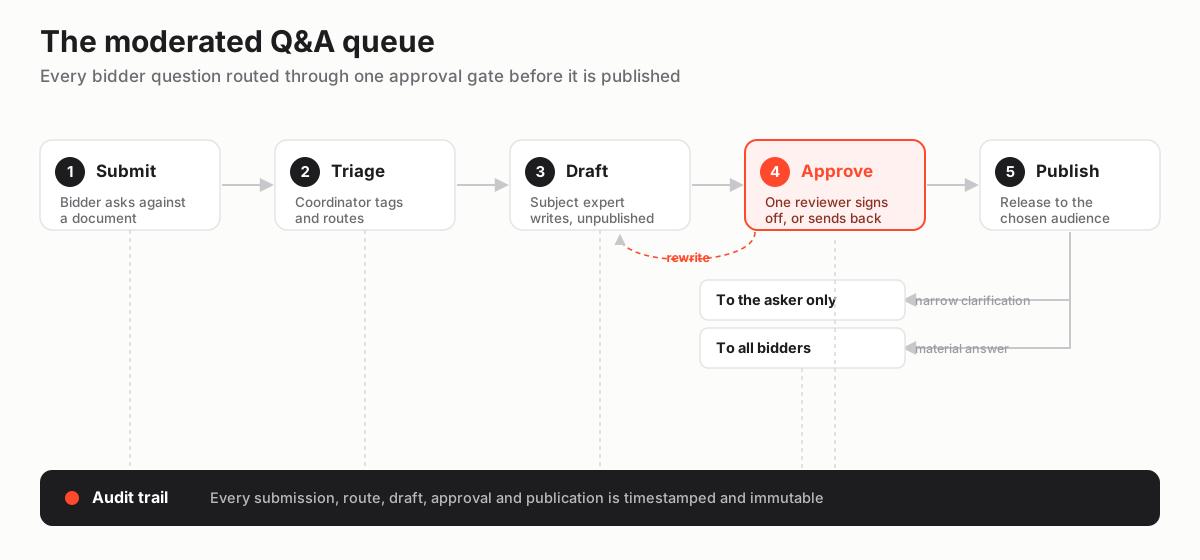
A well-run question follows a fixed path: submit, triage, route, draft, approve, publish. No shortcuts. No replying to a bidder off the cuff. Nothing goes live without sign-off.
The steps below trace one question from ask to answer.
How a data room question moves from submission to answer
The lifecycle of a single Q&A item in a well-controlled deal room.
Estimated time: 24h
-
Bidder submits against a document
The reviewer raises the question from inside the folder or file it relates to, so the coordinator sees the exact context rather than a vague reference.
-
Coordinator triages and categorises
A central coordinator screens the question, tags it by topic and priority, merges duplicates, and rejects anything outside the deal scope with a short note.
-
Route to the right subject expert
The question is assigned to the person who owns that area, finance, legal, tax or commercial, so the answer comes from the source, not a guess.
-
Expert drafts the answer
The assigned expert drafts a response and attaches any supporting document, but the draft stays internal and unpublished.
-
Reviewer approves or sends back
A single approver checks the draft for accuracy, consistency with earlier answers, and disclosure risk, then approves it or returns it for a rewrite.
-
Publish to the chosen audience
The module releases the answer to the asker alone or to all bidders, per your publication rule, and logs the full exchange with timestamps.
The two steps that carry the whole process
Triage and approval. That is where the discipline lives.
Triage stops the queue filling with duplicates and out-of-scope fishing. Approval stops a well-meaning expert from disclosing something the deal team wanted staged. Skip either one and, within days, either the volume or the risk gets away from you.
Context beats speed
A question raised from inside the relevant folder is worth far more than one typed into a blank box, because the coordinator can see what the bidder was looking at. Insist on it as a habit, not a nicety.
One question, one thread
Keep each question in its own thread. Don’t let several ride on a single submission.
A clean thread is easy to route, easy to approve, and easy to read back later. A bundled one splits between two experts and loses half its answer on the way.
Setup: decisions to lock before bidders arrive
Configure the module during room setup, not after the first questions land. Doing it cold, before any pressure, is what keeps the process calm when dozens of questions arrive in a day. Work through these in order.
1. Categories and routing
Create question categories that mirror your folder index: corporate, financial, legal, commercial, HR, IP. Name the expert who owns each. A question tagged on submission routes itself, which is the whole point.
2. The approval gate
Nominate one reviewer, or a small panel, whose sign-off is mandatory before any answer publishes. Make it a hard rule, not a courtesy. Courtesies get skipped when the queue is deep.
3. The publication rule
Set the default audience for published answers, asker-only or all-bidders, and note which categories, if any, override it. This single choice shapes how competitive the process feels; more on it below.
4. The turnaround target
Agree a service level. A first response within one business day works for most deals. Bidders should never be left guessing, and your team should never be firefighting a backlog they could have prevented.
5. Deadlines and cut-offs
Decide when Q&A closes relative to the bid deadline, so you are not fielding new questions hours before offers are due. A clean cut-off protects both the schedule and your team’s sanity.
A quick pre-open sanity check
- Do the categories match the folder tree exactly?
- Does every category have a named owner and a backup?
- Is there one, and only one, person who can publish?
- Does everyone know the default audience rule?
- Is the Q&A close date written down and shared?
Still shortlisting a platform? Weigh Q&A capability directly. Modules differ sharply in routing, bulk actions and reporting, and the comparison and pricing hubs let you line those features up side by side.
Who does what: separating the roles
Control comes from separation of duties. No single person should be able to both draft and publish an answer unchecked. The matrix shows a clean split for a competitive process.
Q&A permissions by role in a controlled deal
| Q&A action | Deal team / host | Subject expert | Bidder / investor |
|---|---|---|---|
| Submit a question | Rarely | No | Yes |
| Triage, tag and route | Yes | No | No |
| Draft an answer | Yes | Yes | No |
| Approve and publish | Reviewer only | No | No |
| See other groups' questions | Yes | Own topic | No |
| Export the full Q&A log | Yes | No | No |
The coordinator owns the queue
One person routes, tags, merges duplicates and redirects anything that arrives off-channel. When nobody owns triage, a backlog forms quietly and surfaces loudly.
The expert drafts but never publishes
A subject expert can draft, and can see only the questions in their own area. Your tax adviser has no business reading the commercial questions. Keeping topics apart limits leaks and stops cross-topic answers that say too much.
The reviewer is the single gate
Usually a lead adviser or the deal principal. Every answer passes through this one person, which is exactly what keeps the lines consistent across hundreds of questions. One set of eyes on everything is a feature, not a bottleneck.
Bidders submit and read, nothing more
They raise questions and see their own answers. That is the full extent of it. Their access to the Q&A channel maps onto the room’s granular permissions, and it should be configured with the same care as folder access.
Pick your operating model
There is no single correct way to run Q&A. The right model depends on how competitive the process is and how many bidders are live. Choose before the questions start arriving, not after.
Four Q&A operating models compared
| Model | How it works | Best suited to | Main watch-out |
|---|---|---|---|
| Open queue | Bidders ask freely; answers publish to all bidders by default | Friendly or single-party deals where transparency speeds things up | Competitors see each other's lines of enquiry |
| Moderated and routed | Every question is triaged, routed to an expert and approved before release | Most competitive M&A and fundraising processes | Needs a dedicated coordinator to avoid a backlog |
| Staged by phase | Q&A opens topic by topic as disclosure phases unlock | Large auctions with sensitive late-phase material | More setup; reviewers must track which phase is live |
| Expert-panel routing | Questions auto-assign to named topic owners with SLAs | Complex deals with many workstreams and advisers | Over-engineering a small deal slows it down |
Open queue: fast, but exposing
Good for friendly or single-party deals where transparency speeds things up. The cost is that competitors can read each other’s lines of enquiry. Rarely the right call in a real auction.
Moderated and routed: the default
Every question is triaged, routed and approved before release. It suits most competitive M&A and fundraising processes. It does need a dedicated coordinator, or the backlog builds.
Staged by phase: for sensitive late material
Q&A opens topic by topic as disclosure phases unlock. Ideal for large auctions with sensitive late-phase content. More setup, and reviewers must track which phase is currently live.
Expert-panel routing: for complex, multi-workstream deals
Questions auto-assign to named topic owners with service levels. Powerful on complex deals with many advisers. Overkill on a small one, where it just adds friction.
The one choice that shapes competitiveness most
Whether answers publish to the individual asker or to the whole bidder pool.
Publishing to all keeps everyone on equal footing and cuts repeat questions, but it tells every bidder what the others are worried about. Publishing to the asker alone protects that intelligence, but multiplies your workload and risks inconsistent answers. Decide the default before the room opens, and document every exception.
Keeping competing bidders on an even footing
In a competitive process you manage information symmetry deliberately. The aim is a fair, defensible auction, not identical access to everything.
Broadcast material answers to everyone
When one bidder’s sharp question surfaces something that materially changes the picture, a previously undisclosed liability, a customer concentration, a change-of-control clause, share that answer with all active bidders even though only one asked.
Fairness, and often the sale agreement, require it. Broadcasting material answers heads off a later claim of selective disclosure.
Reserve asker-only replies for narrow clarifications
Keep individual replies for the small stuff, where nobody’s position turns on the answer. A formatting query, a file location, a date confirmation. Nothing that moves price.
Use a clean team for the truly sensitive
Some answers are too sensitive for the general pool yet still necessary for serious bidders to price the deal. That is what a clean team is for. A ring-fenced group, often outside advisers bound by confidentiality, reviews the raw detail while the bidding principals see only an aggregated summary.
Configure clean-team folders and their Q&A visibility before the room opens. Lean on a provider whose permissioning is built for this.
Release phases in a fixed order
No group should get an accidental head start because a folder unlocked early. A defined sequence keeps the auction clean and keeps you out of an argument about who saw what first.
Our due diligence hub ranks the rooms that handle segmented, multi-group Q&A well, and the head-to-head on two heavyweight platforms, iDeals vs Ansarada, shows how their moderation and group controls differ in practice.
Consistency and defensibility
Consistency comes from a single source of truth and a single approver. Defensibility comes from never editing history. These two ideas run through everything below.
Keep an internal answer bank
Recurring questions should get the same agreed response every time. An answer bank is how you stop the fifth version of a question drifting from the first. Write the position once, reuse it deliberately.
Route everything through one reviewer
The approver who has seen the earlier threads is the one who catches the contradiction before it publishes. This is why separation of duties and consistency are really the same rule wearing two hats.
Correct with a follow-up, never a silent edit
When a published answer is wrong, publish a correction. Do not overwrite. The record should show what was said, when, and how it changed. A silent edit destroys the very defensibility the log exists to give you.
The stakes are not abstract
An answer often discloses more than the underlying file, and a careless one can create real exposure. The average data breach reached $4.88 million in 2024, and organisations took an average of 258 days to identify and contain one, according to IBM’s Cost of a Data Breach report.
A leaked or misjudged Q&A response is one of the quieter ways sensitive information escapes a deal, and it can surface long after the room has closed. Treat each published answer as a formal disclosure, because a court or a renegotiating buyer will treat it as exactly that.
A document tells a bidder what you have. An answer tells them what you think. Guard the second at least as carefully as the first.
Warning signs Q&A is slipping
Q&A that runs well feels quiet and orderly. Q&A that is slipping feels like a flood of email and contradictory replies. The tells are consistent across deals.
A controlled Q&A process versus one that is slipping
Pros
- Every question lives in the module, tagged, routed and timestamped
- One reviewer approves each answer, so lines stay consistent
- Duplicates are merged and out-of-scope questions are politely declined
- The team can pull a clean, exportable Q&A log at any moment
Cons
- Bidders start emailing advisers directly and answers bypass approval
- The same question gets two different answers from two experts
- A backlog builds because no one owns triage and routing
- Sensitive detail slips into an answer published to the whole bidder pool
The side channel is the first crack
The earliest warning sign is almost always a bidder catching an adviser on a call and getting an off-the-record answer that never enters the room. Once that happens, your log is incomplete and your consistency is gone.
The fix is boring and repeated
A firm, repeated instruction to every party: questions go through the module only. Plus a coordinator who redirects anything arriving elsewhere back into the queue. Say it at kickoff, say it again in week two, say it whenever it slips.
Two experts, two answers
If the same question gets different answers from two people, your single-approver rule has broken down somewhere. Trace it back and close the gap before a bidder notices it for you.
The backlog that nobody owns
A queue that grows without an owner is not a staffing problem you can defer. To a bidder, unanswered questions read as either disorganisation or evasion. Neither impression helps your price. If the backlog is building, the fix is a named coordinator today, not a review next week.
Answers that keep getting longer
Watch for answers that creep past the question. A one-line query that comes back as three paragraphs is usually an expert disclosing more than they were asked. Tighten it at the approval gate. Say exactly enough, and no more.
How Q&A connects to the audit trail
Every question, draft, approval and publication should land in the room’s audit trail automatically. That record is not housekeeping. It is the evidence a well-run process leaves behind.
The log must be immutable
Published answers are corrected by follow-up, never overwritten. History cannot be quietly rewritten. That is what makes the record hold up when someone leans on it later.
The log must be complete
No answer was ever given outside the module. If even one exchange happened on a call and never made it back into the room, the log is no longer the full story, and its value drops sharply.
It should match the standard you already expect
The integrity here is the same one an ISO 27001 audit tests for: controlled access, logged changes, evidence you can produce on demand. Providers whose Q&A is genuinely integrated with the audit trail, rather than bolted on, give you that by default, so confirm it during a trial.
Our guide to VDR audit trails covers what a strong log should capture. Some platforms, Ellty among them, timestamp the full question lifecycle so the exported log reconciles cleanly with the document activity record.
Export it into the deal bible
When you export the Q&A log at close, it becomes part of the deal record alongside the disclosed files. That is the moment all the discipline pays off, in a clean, defensible bundle you can hand over without caveats.
Handling sensitive and out-of-scope questions
Not every question deserves an answer. Knowing when to decline is part of keeping control.
Agree the no-go categories up front
A question can be out of scope, commercially dangerous, or legally sensitive. The right response is a brief, consistent decline, not an awkward improvisation. Decide which categories you will not answer before the room opens, so the coordinator declines them uniformly.
Personal data needs special care
If a bidder’s question would reveal individuals’ personal information, employee salaries, customer identifiers, health data, privacy law may override the deal’s convenience.
Where EU personal data is involved, disclosing it into a Q&A thread is a processing activity governed by the GDPR. Redact, aggregate or withhold rather than publish, and note the reason. The same redaction discipline you apply to documents applies to answers.
Privileged material: decline, then move it offline
For legally privileged material, the safe default is to decline. Where the exchange genuinely needs to happen, take it to a controlled call that is separately minuted, so privilege is not waived inside the room.
Fishing expeditions get a polite no
Some questions are speculative attempts to map your strategy rather than diligence on the assets. A short, uniform decline keeps the queue focused and gives away nothing about why you declined.
Declining is not stonewalling
A good decline still moves the deal forward. Point the bidder to what you can share, name the reason you cannot share the rest, and keep the tone consistent across every party. A curt no breeds suspicion; a clear, reasoned one does not. The record should show you declined for a principled reason, not to hide something.
Habits that carry Q&A to close
The tooling that matters is unglamorous: routing, bulk actions, reporting and an export. The habits are what actually carry a process across the line.
One coordinator who owns the queue
Not a rota, not “whoever is free”. One name. Ownership is what stops the backlog and keeps the redirects consistent.
A reviewer who never waves an answer through
The gate only works if it is real. An approver who rubber-stamps under time pressure is no approver at all.
A rule that all questions live in the module
Repeat it until it is muscle memory for every party in the deal. This one rule underwrites both the audit trail and the consistency.
Read the reporting daily
Reporting is the habit teams most often underuse. A daily glance at open questions by category, age and owner tells you where the deal is stuck and which workstream is drowning, long before a bidder complains.
Pair Q&A with document engagement
Cross the question data with the engagement signal from the document side and you get a genuine read on intent. A bidder asking sharp, detailed questions about the customer contracts is doing serious work. A quiet one may be drifting.
Stress-test the module before you commit
A free trial lets you test the module before committing, so build a sample workflow and run a few questions through it end to end. If you are still choosing on the strength of Q&A and reporting, the features guide and the individual reviews, such as our iDeals review, Ansarada review and Datasite review, show how each handles the workflow in practice.
The one-screen checklist
Keep this where the coordinator can see it.
- Every question submitted from inside the relevant folder or file.
- Coordinator triages, tags, merges duplicates, declines out-of-scope items.
- Expert drafts; draft stays internal until approved.
- One reviewer approves or returns; nobody else publishes.
- Publication follows the agreed audience rule; material answers go to all.
- Corrections are follow-ups, never silent edits.
- Sensitive, privileged or personal-data questions are declined or handled offline.
- The full log is exported at close and filed with the disclosed documents.
Run all eight and Q&A becomes a controlled disclosure channel rather than a liability.
Frequently asked questions
Should data room Q&A answers be visible to all bidders or just the asker?
It depends on how competitive the process is. Publishing to all bidders keeps everyone on equal footing and cuts repeat questions, but it reveals what each party is investigating. Publishing to the asker alone protects that intelligence at the cost of more work and a higher risk of inconsistent answers. As a rule, broadcast material answers to the whole pool and reserve asker-only replies for narrow clarifications. Set one default before the room opens and document any exceptions.
Who should approve answers before they are published?
A single reviewer, usually a lead adviser or the deal principal, should hold mandatory sign-off on every answer. Separating drafting from approval means no expert can disclose something the deal team wanted staged, and one person seeing all answers is what keeps the lines consistent across hundreds of questions.
How fast should you answer questions in a data room?
A first response within one business day is a realistic and reassuring target for most deals. What matters more than raw speed is predictability: agree a turnaround service level up front, staff the coordinator role to meet it, and tell bidders what to expect so no one is left guessing.
What is a clean team in the Q&A context?
A clean team is a ring-fenced group, usually outside advisers bound by confidentiality, that reviews commercially sensitive detail while the bidding principals see only an aggregated summary. It lets you answer a question honestly enough for serious diligence without handing a competitor pricing, customer or margin data they could misuse if the deal falls through.
Is the Q&A log part of the legal record of a deal?
Yes. A published answer is a disclosure, and a timestamped, approved Q&A log is evidence of exactly what was said and when. Keep it immutable by correcting answers with follow-ups rather than silent edits, and export the full log at close so it sits in the deal record alongside the disclosed documents.
