
Virtual data room vs physical data room: what changed
On this page
Picture a conference room in a law firm, 1998. Binders line the shelves. A receptionist keeps a sign-in sheet by the door. One bidder is inside, reading; another waits for a slot next week.
That room was the deal. For most of the 20th century, buying a company meant flying to it.
Today the same job happens in a browser. And the shift ran far deeper than swapping paper for PDFs.
The seller once gathered every contract, ledger and title deed into a guarded office. Bidders took turns reviewing under supervision. That office was the “data room”.
This guide is quick on purpose. What changed, where paper still hangs on, and what a modern room costs. For the long arc, the history of virtual data rooms traces it decade by decade.
The short version of the difference
A physical data room is a locked on-site location. Usually an office at the seller’s premises or a law firm, holding original paper documents, reviewed in person.
A virtual data room does the same job online. It is a permissioned, encrypted repository that adds controls paper never had: document-level permissions, dynamic watermarking, and a log of every view and download.
The purpose is identical. Controlled disclosure of confidential information. The mechanics are opposites.
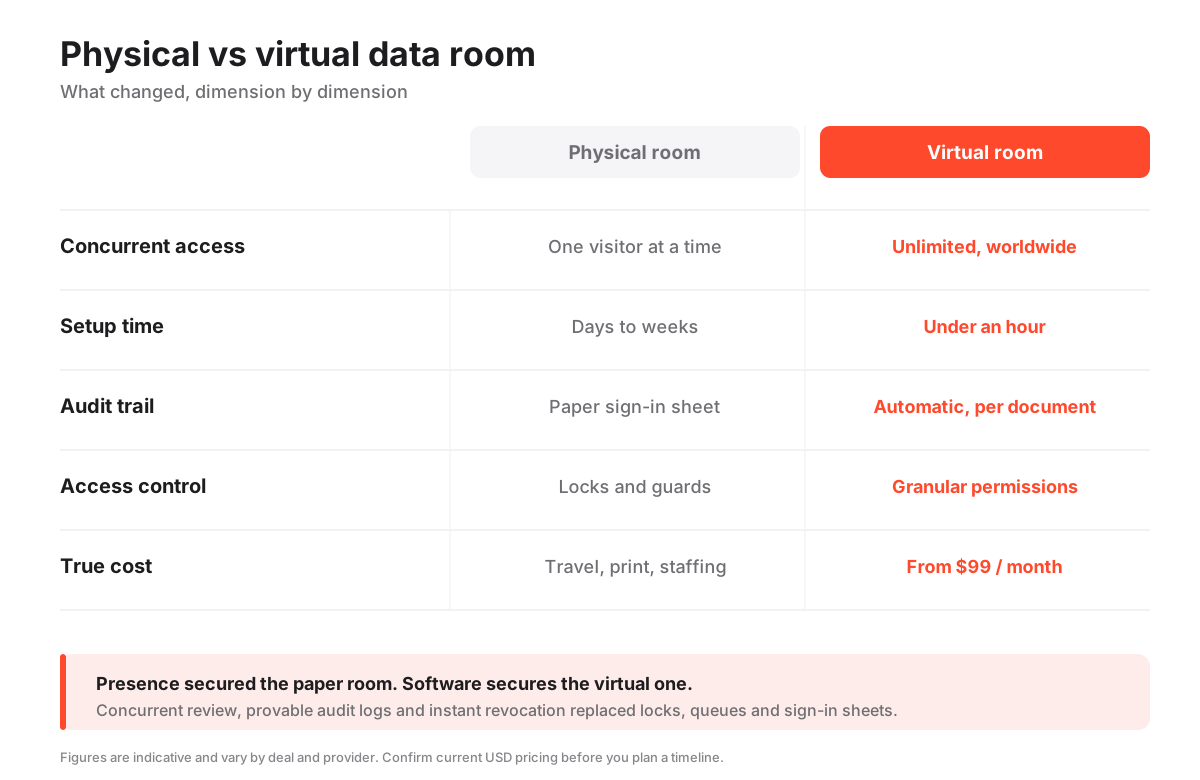
The paper room secures files by keeping them in one place and controlling who walks in. The virtual room secures them by controlling what each authenticated user can do with a file, wherever they open it.
Want the ground-level anatomy? The companion guide on what a virtual data room is covers it, and the glossary defines the deal vocabulary this article leans on.
Why paper rooms existed at all
Because there was no trustworthy alternative.
Before secure file transfer and the cloud, the only defensible way to let a buyer inspect your contracts without losing control was to keep the paper guarded and make people come to it.
Presence was the security model. A visitor could read a file but could not walk out with it. A receptionist’s sign-in sheet was the audit trail.
It worked. It was also slow and expensive by design.
Reviewers queued. Documents could be photographed or memorised. Two competing bidders could not comfortably share a room, so a real auction meant scheduling gymnastics that stretched diligence for weeks.
Advisers built whole logistics playbooks around booking rooms, shipping binders and staffing supervision. None of it added a cent of value to the deal.
When virtual rooms took over
They became the default for serious transactions in the 2000s and were effectively universal by the 2010s. Secure web infrastructure matured; buyers grew comfortable reviewing sensitive files online.
The tipping point was trust. Once encryption, granular permissions and independent audits were credible, the advantages of an online room were overwhelming.
Suddenly a sell-side adviser could open a room to twenty vetted bidders at once, in different time zones, and watch engagement in real time.
The security that made this possible is now formalised. More than 70,000 organisations hold a valid ISO/IEC 27001 certificate, per the annual ISO Survey, and reputable providers also undergo SOC 2 examinations.
That independently audited base is what lets regulated buyers and their counsel review documents they once insisted on seeing only in person.
Cost, speed and reach, side by side
On the measures that decide a timeline, the virtual room wins nearly every line.
| Dimension | Physical data room | Virtual data room |
|---|---|---|
| Setup time | Days to weeks | Under an hour once files are ready |
| Access | One visitor or team at a time, on-site | Concurrent, worldwide, around the clock |
| Travel and logistics | Flights, hotels, staff time | None |
| Audit trail | Manual sign-in sheet | Automatic, per document, per user |
| Updating documents | Reprint and refile | Upload replaces instantly for all users |
| Q&A with bidders | Email and phone, off the record | Structured, logged Q&A module |
| Revoking access | Change the locks, escort out | One click, retroactive on downloads |
Figures are indicative and vary by deal and provider. Confirm specifics before you plan a timeline.
Reach is the difference dealmakers feel first. A physical room forces a process into a queue. A virtual room lets a seller run a genuine parallel auction, which tends to sharpen pricing because more qualified buyers can look at once.
Speed compounds it. When a diligence question surfaces, a document can be corrected and re-shared to every reviewer in seconds. No reprint, no courier, no refile.
Our guide on how long due diligence takes shows how much of a timeline the old logistics used to absorb.
Which one is more secure
Neither is automatically safer. They fail in different ways. But a well run virtual room is now the stronger option for almost every deal.
A physical room has no network to attack. Its weakness is human presence: photography, memorisation, tailgating, and a paper trail that proves little.
A virtual room swaps physical barriers for cryptographic and permission controls. Stronger, and provable.
Consider what each can actually enforce. A paper room prevents removal only by escort and can offer a folder shelf, not document-level rights. No watermarking, no tamper-evident log, no instant revocation, no independent certification.
A virtual room delivers all of them. View-only rendering, dynamic watermarking, a complete audit log, one-click retroactive revocation, and ISO 27001 or SOC 2 attestation from reputable providers.
The old question was whether a bidder could carry a document out of the room. The new one is whether you can prove who opened it, watermark it to them, and revoke it the moment the deal turns. Paper never answered that.
The gap is widest on accountability. A sign-in sheet says someone entered a room. A virtual room says which user opened which page, for how long, on what date, and lets you pull access back after they have already downloaded the file.
For how those controls are built and audited, see virtual data room security.
Does paper ever still win?
Rarely, and almost always because of a legal or physical constraint, not a preference.
A few situations still call for on-site review. Original signed instruments that cannot legally leave a location. Physical assets that must be inspected in person. Classified defence or government material barred from networked storage.
Data residency law can matter too. Where a jurisdiction restricts moving personal data across borders, as the EU does under the GDPR rules on international transfers, parties may keep certain files local.
Even then, the usual answer is a VDR with in-region hosting, not a return to paper. If residency is your worry, the fix is picking a provider with the right footprint, which we cover in data residency in virtual data rooms.
For the vast majority of M&A, fundraising and diligence, the physical room is a museum piece.
What about a hybrid room?
Occasionally sensible. When it is, the paper element is a small annex, not the main event.
A hybrid keeps the virtual room as the backbone and reserves a short, supervised on-site session for the handful of items that genuinely cannot be digitised. Wet-ink originals a registry insists on verifying. Plant a buyer wants to walk. One folder a counterparty will only view in a controlled setting.
The mistake is treating hybrid as a reason to stall.
Stand up the VDR first. Run all standard diligence through it. Schedule the physical component as a narrow, time-boxed exception.
Done this way, the deal moves at software speed and the on-site session covers minutes of content rather than weeks.
Moving from paper to a virtual process
Migrating is mostly discipline, not technology. If your diligence has run on binders and courier packets, the path is short and repeatable.
How to move a paper diligence process into a virtual data room
A first pass for teams shifting from binders to a permissioned online room.
Estimated time: 2h
-
Digitise and index the paper
Scan physical originals to searchable PDF and name files to a consistent convention, so the index mirrors your diligence checklist instead of a filing cabinet.
-
Map folders to the deal, not the office
Build the folder tree around how buyers review (corporate, financial, legal, commercial), not around how your internal teams happen to store things.
-
Recreate access rules as permission groups
Translate who was allowed in which physical binder into user groups with folder-level rights, granting the least access each party needs.
-
Turn on the controls paper never had
Enable dynamic watermarking, view-only rendering and two-factor authentication before a single external reviewer is invited.
-
Invite, then watch engagement
Send invitations in waves and use the activity log and heatmap to see who is active and where attention concentrates, a signal you never had in a locked room.
Teams that struggle usually treat the software as a filing cabinet. A room organised around the buyer’s review, with clean permissions, does in an afternoon what a physical room took a fortnight to schedule.
Starting from scratch rather than migrating? The step-by-step in how to set up a virtual data room and the due diligence checklist save a first-timer hours.
What it costs, honestly
A virtual room has a visible subscription price. A physical room hides most of its cost in travel, staffing and time.
Indicative VDR entry pricing starts around $99 per month for lean fundraising rooms. Mid-market rooms sit in the low hundreds. Enterprise deployments are quoted per engagement. Treat every figure as indicative and confirm current pricing with the provider, since plans and storage change often. See the pricing overview for the current lay of the land.
Against that, a paper process carries flights, hotel nights, printing, secure courier fees, on-site supervision, and the harder-to-price cost of a timeline stretched by weeks.
For all but the smallest deals, the virtual room is not just faster. It is cheaper once the full logistics bill is counted.
One caveat: pricing models differ widely, from per-page and per-user legacy structures to flat monthly rooms. For a document-heavy deal, the model can matter more than the sticker price. Read VDR pricing models before you shortlist so you compare like with like.
How diligence itself changed
The shift is more than convenience.
Concurrent access lets a seller run a true competitive auction rather than a sequential one, which tends to improve price and speed together.
Engagement analytics tell an adviser which buyer is working the room and which has gone quiet. That read was impossible with a sign-in sheet.
The structured Q&A module keeps bidder questions on the record and out of scattered email threads.
Instant revocation means a deal that collapses on Friday does not leave a former counterparty holding live access all weekend.
Diligence became less a logistics exercise and more an information one. Choosing for a specific scenario? Provider reviews like our iDeals review and Datasite review go deep, our iDeals vs Datasite comparison pits two head to head, and the best VDR for due diligence shortlist narrows the field.
Frequently asked questions
Is a physical data room more secure than a virtual one?
Not for most deals. A physical room removes network exposure but relies on human oversight and a paper sign-in sheet, which cannot prove who read what. A reputable virtual room adds encryption, document-level permissions, watermarking and a complete audit trail, backed by ISO 27001 and SOC 2, which is stronger and provable.
Do any deals still use physical data rooms?
A small minority, and almost always for a specific reason: original documents that legally cannot leave a site, physical assets that must be inspected in person, classified material barred from networked storage, or strict data-residency rules. Even then, most parties use a virtual room with in-region hosting rather than reverting fully to paper.
Is a virtual data room cheaper than a physical one?
Usually, once you count the full cost. A virtual room has a visible subscription starting around $99 per month indicatively, while a physical room hides its cost in travel, printing, secure couriers, on-site staffing and a longer timeline. For most deals the virtual room is the lower true cost. Confirm current pricing with the provider.
