
What is a deal room? Deal room vs data room, explained
On this page
- The room Priya actually needs
- A deal room, in one sentence
- Is it the same as a data room?
- Where each concept puts its weight
- Why there are two words at all
- What the shell adds
- The floor is the same on both sides
- Meanwhile, across town
- Who uses which, and for what
- Where the naming stops mattering
- Choosing without being sold to
- What it costs, honestly
- Back to the harbour
On a wet Tuesday in March, Priya Nair opens a laptop in a co-working space two blocks from the harbour. She is about to sell a company she has run for eleven years.
Northwind Ceramics is a fictional maker of specialist kiln components. Forty staff, one very large customer, a reputation for never missing a shipment. A larger group has made an approach.
Her adviser keeps repeating one sentence: “We’ll get you into the room.” Priya nods each time without being sure what the room is, or whether it is one thing or two. The adviser calls it a data room on Monday and a deal room on Thursday, and the two proposals on her desk use the words as rivals and as synonyms, both at once.
That confusion is the whole reason this guide exists.
The words sound like a distinction. Most of the time they are not.
The room Priya actually needs
Here is what happens over the next ninety days. It explains the vocabulary better than any definition can.
The adviser sets up a secure online workspace. Into it go the things a buyer will want to inspect before parting with money: the customer contracts, the supplier agreements, the leases, the employment files, three years of management accounts, and the patent on the glaze formulation that makes Northwind worth buying at all.
Everything is indexed into folders. Everything is locked behind logins. Nobody can print the glaze patent, and if anyone so much as opens it, a timestamped line appears in a log Priya can read later.
This part, the secure and audited filing cabinet, is the data room. It is the document-centric core. For a single sale, it is very often all a seller strictly needs.
But the sale is not only documents.
The interested buyer sends forty-one questions in the first week. Some are for the lawyers, some for the accountant, one is for Priya personally and slightly rude. Someone has to route each question to the right owner, chase the answer, check it before it goes back, and keep a record so nobody can later claim a thing was hidden.
The buyer also has a request list of documents still outstanding, and Priya has her own list of things she wants from them. A second buyer appears in week three, then goes quiet, and Priya wants to know whether “quiet” means “reading the financials very carefully” or “walking away without saying so.”
All of that surrounding activity, the questions and answers, the task lists, the tracking of who sits where in the process, is the deal-room layer.
Same workspace. One part stores. The other part runs the transaction. The label a vendor prints on the box depends mostly on which of those two jobs they want you to notice.
A deal room, in one sentence
A deal room is a controlled digital workspace that manages a specific transaction from kickoff to close, layering collaboration and process on top of secure document sharing.
The emphasis sits on the deal as a project: a thing with a start, a messy middle, and an end.
So the software is expected to answer questions a filing cabinet cannot. Which bidder has opened which folder. What is still outstanding on the request list. Who owns the next task. All of that, on top of storing the files themselves. It is a transaction-management tool with a certified secure repository at its heart. It is not a folder with a login screen, though it contains one.
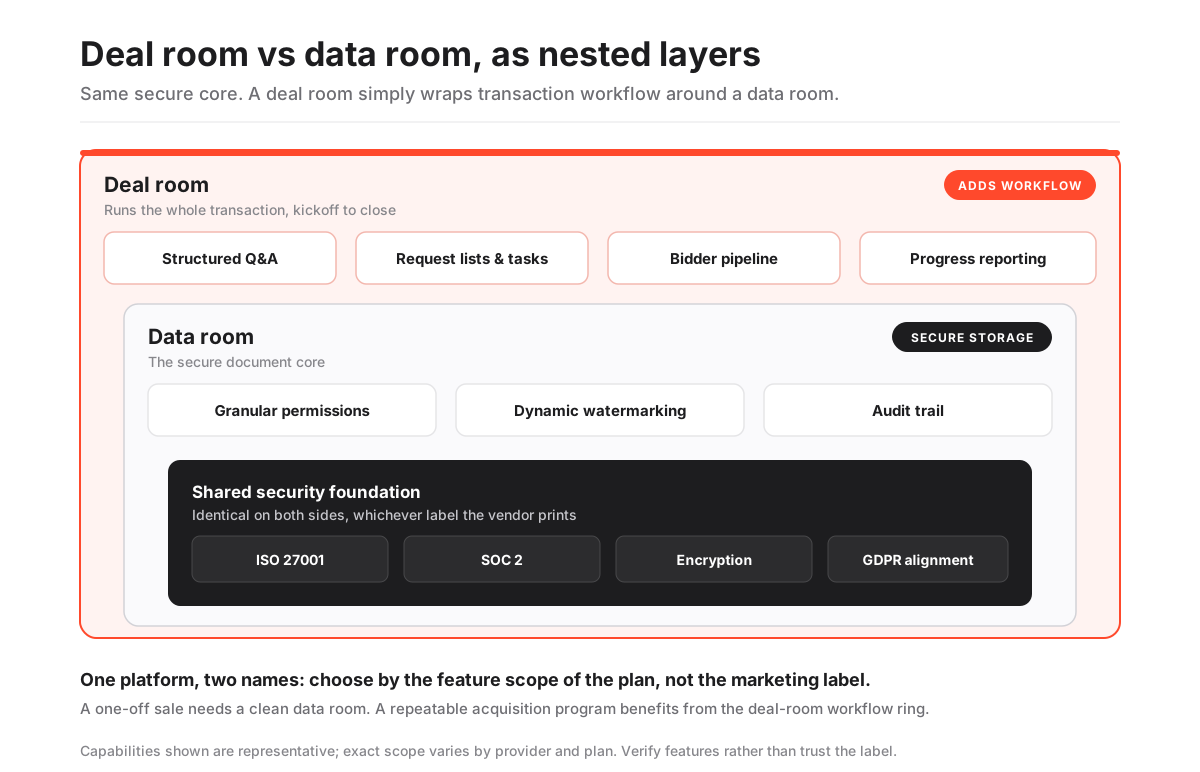
The diagram above is the shape of the thing. A hard security foundation on the bottom. A document core in the middle, which is the data room. A workflow shell wrapped around it, which is what earns the deal-room name.
Peel the shell off and you still have a data room. Leave it on and you have a deal room. The core does not change.
Is it the same as a data room?
For most buyers, yes. Near enough that the distinction rarely earns its keep in conversation.
The two terms are effectively interchangeable in the market, and vendors reinforce that daily by marketing one platform under both names on different pages of the same website. Where a distinction exists at all, it is a matter of emphasis, not a hard product boundary.
A data room foregrounds secure storage, granular permissions and a defensible audit trail. A deal room foregrounds the workflow wrapped around those documents: structured Q&A, task assignment, bidder pipelines and progress reporting.
Because the underlying technology is shared, a single subscription usually delivers both. That is exactly why treating them as rival categories tends to mislead more than it clarifies.
Priya’s two proposals were not two products. They were one kind of product, described by two salespeople who had each been trained to lean on a different word.
If you want the storage side explained in full before the workflow layer, the companion guide on what a virtual data room is and how it works walks through the core in plain English. It is the natural place to start if the whole category is new to you, because the deal-room framing only makes sense once you can picture the room it wraps.
Where each concept puts its weight
The real difference is one of centre of gravity, not a firm dividing line. A data room is organised around documents and who may touch them. A deal room is organised around the transaction and everyone moving it forward.
Same building, different floor plan. The table below maps where each concept concentrates its attention, so you can match the label to your own situation rather than to a vendor’s headline.
| Dimension | Data room | Deal room |
|---|---|---|
| Primary focus | Secure document storage and review | End-to-end transaction management |
| Typical anchor users | Sellers, legal counsel, reviewers | Corporate development, deal leads, advisers |
| Core capability | Permissions, watermarking, audit trail | Q&A, task lists, bidder pipeline, reporting |
| Unit of work | The document set | The deal, tracked stage by stage |
| Lifespan | Open for the diligence window, then archived | Runs across the full deal lifecycle, sometimes reused deal to deal |
| Pricing model | Per room, per page, or flat monthly | Per seat or per program, often subscription |
| Best fit | One-off sale, fundraise, audit | Repeatable or programmatic acquisition activity |
Read that table as a gradient, not a wall. The categories overlap heavily, most virtual data room platforms now deliver both profiles under one roof, and the pricing especially is indicative.
Notice what the “unit of work” row is doing. It is the quiet heart of the whole distinction.
A data room thinks in documents. A deal room thinks in the deal.
When your unit of work is a single document set that a handful of reviewers will read once and then never again, the storage framing fits, and paying for pipeline machinery you will never open is simply waste. When your unit of work is a transaction that moves through stages and involves several counterparties pulling in different directions, the deal framing fits, and the workflow stops being a luxury.
Why there are two words at all
The two terms share a physical origin, drifted apart in software for a while, and then converged again. That is precisely why they now sit on top of each other in the wild.
Before the internet, a sensitive deal ran out of a literal locked room. Bidders and their lawyers travelled to an office, were shown to a supervised space full of paper files, and reviewed them one visitor at a time under the eye of someone whose whole job was making sure nothing left the room.
People called it the data room or the deal room without agonising over which was correct. It was the same physical space doing both jobs at once: it stored the documents and it hosted the deal.
Then the process moved online, through the late 1990s and across the 2000s. The storage layer digitised first, and it inherited the older name in a new form: the virtual data room.
As platforms matured, they bolted collaboration on top, and the older deal-room framing came back into fashion to describe the same tools now doing more than storage.
So the two words really describe two eras of one evolving product, not two competing products. The history guide on the virtual data room versus the physical data room traces that shift if you want the long version of how a locked office became a browser tab.
What the shell adds
Return to Priya for a moment. Her ninety days show exactly what the workflow shell contributes that a storage-first room historically left to email and spreadsheets.
Without a deal room, her forty-one questions would have lived in an inbox, routed by Priya forwarding messages and hoping the accountant replied. The audit trail would have been a folder called “IMPORTANT” and a prayer. The request list would have been a spreadsheet that three people edited and none of them trusted.
The engagement question, is buyer two reading or leaving, would have been unanswerable. Email tells you nothing about whether a PDF was ever opened.
With a deal room, all of that becomes structured. Questions flow through a Q&A module that routes each one to the right owner, records the answer, holds it for review, and logs the whole exchange so a counterparty’s counsel can audit it end to end months later.
Request lists track what each side still owes. A deal lifecycle view shows which party is standing at which stage. And an engagement heatmap tells Priya, in colour, that buyer two has opened the financials nine times in two days, which is not the behaviour of someone walking away.
Nothing there is exotic. A deal room simply replaces four or five side tools with one system of record.
That is the whole reason the deal-room framing exists, and it fits in two short lines. A data room proves who saw what. A deal room adds who owes what to whom, and by when.
The floor is the same on both sides
Here is the thing that never changes, whichever word is printed on the box. The security foundation is identical.
Whether a vendor calls its product a data room or a deal room, the controls that make the workspace defensible rest on the same independently audited standards. Encryption in transit and at rest. Access governance with permissions granular enough that Priya can show the glaze patent to one buyer and hide it from another.
Certifications such as ISO/IEC 27001 for information security management sit alongside SOC 2 reporting from the AICPA for service controls. Where personal data crosses borders, and in an M&A process it usually does, the room also has to respect privacy law such as the GDPR, which governs how EU personal data is processed no matter what the software is called.
This matters for a practical reason. If two rooms carry the same certifications and the same encryption, the security question is settled before you even reach the storage-versus-workflow question.
You do not trade safety for features. A room with a lighter workflow layer is not a less secure room; it is simply a room that does fewer things above the security floor.
If those certifications are unfamiliar, the SOC 2 and ISO 27001 explainer unpacks what each one actually proves, and what it does not.
Meanwhile, across town
Priya is one story. To see why the second word exists, you need the other kind of buyer, so meet a fictional counterpart.
Aldergrove Partners is a mid-sized private equity firm. Where Priya will use a room once in her life and hopes never to repeat the experience, Aldergrove runs six diligence processes at a time and closes perhaps a dozen deals a year.
For Aldergrove, the transaction is not an event. It is a production line, and a production line has needs a one-off seller does not.
Aldergrove wants templates, so the folder structure and request list that worked on the last acquisition can be cloned onto the next one in an afternoon rather than rebuilt from nothing. It wants a pipeline view across all six live deals at once, so a partner can see which target is stalled in legal review and which is racing toward signing. It wants the Q&A history from a dead deal preserved, because a target that walked away this year sometimes walks back next year.
For Aldergrove, the deal-room workflow is not overhead. It is the difference between a team that scales and a team that drowns.
This is the honest split. Priya needs a clean, well-audited data room and would find a full deal room’s machinery faintly oppressive. Aldergrove needs the machinery and would find a bare data room maddening.
Both are buying from the same shelf of platforms. They are just switching on different amounts of the same product.
Who uses which, and for what
Deal rooms show up wherever confidential documents and a live negotiation move together under time pressure. That is why the heaviest users look far more like Aldergrove than like Priya.
Corporate development groups, private equity funds, investment banks and M&A advisers lean hardest on deal-room workflow, because they juggle several counterparties and several stages at once and cannot hold it all in their heads.
The transactions themselves span a familiar set: acquisitions and divestitures, fundraising rounds, refinancings, joint ventures, licensing arrangements and asset sales.
A few of the most common patterns are worth naming, because the same platform behaves differently in each.
- Mergers and acquisitions. Multiple bidders review the same document set while the seller tracks questions, tasks and stage progress across all of them at once. This is the workflow at its most demanding, and the VDR for M&A guide goes deeper on how a seller keeps several buyers in parallel without letting any of them see each other.
- Private equity and portfolio deals. Funds like the fictional Aldergrove reuse room templates and request lists deal after deal, which is exactly where the deal-room shell earns its keep. The roundup of the best rooms for private equity is built around that repeat-use pattern rather than the one-off.
- Fundraising and investor diligence. A founder curates a single room for a syndicate of investors and watches the engagement signals to see who is genuinely serious and who is politely browsing.
- Board, legal and asset transactions. Counsel and directors work sensitive papers under view-only rights, leaving the clean audit trail that later scrutiny will inevitably demand.
Where the naming stops mattering
By now the pattern should be visible, and it points at a slightly deflating conclusion. For most people, most of the time, the label is not the decision.
Match the word to the job and let frequency drive the choice more than deal size does.
If you are running a single, time-boxed event whose main task is letting outsiders review a curated document set safely, a storage-first data room is the cleaner and cheaper fit. Priya is your model.
If you run acquisitions regularly, manage several bidders at once, or need diligence, request tracking and integration planning to live in one auditable place, the deal-room workflow pays for itself. Aldergrove is your model.
And if the deal is straightforward and your chosen platform already bundles both profiles, which most now do, then either word describes what you will actually be using, and arguing about the label is time you could spend indexing folders.
The trade-off underneath all of this is capability against complexity and cost. A full deal room concentrates the whole transaction in one system, which is genuinely powerful for teams that run deals often. That same breadth can feel heavy for a one-off seller who wanted a tidy folder and got handed a cockpit.
The reusable templates that save Aldergrove a week save Priya nothing, because she has no next deal to template for. More features can carry higher per-seat or per-program pricing. Onboarding occasional or external users into a busy workflow takes longer than pointing them at a folder.
And because the naming varies by vendor, you have to verify the features rather than trust the word. That is the one piece of homework nobody can skip.
Some platforms, Ellty among them, pair diligence-grade storage with a modern, full-featured workflow, so a team gets the deal-room controls that M&A and due diligence demand within a clean, current interface. Whether that middle is the right place for you depends entirely on your volume: weigh it against dedicated pipeline tools if your deal flow is genuinely high, and against a lean room if it is not.
Choosing without being sold to
So how would Priya actually decide, and how would Aldergrove? The same way, working from the transaction outward rather than from the feature list inward.
Name the transaction honestly first. Priya writes down “one sale, one buyer likely, maybe two, done inside a quarter.” Aldergrove writes down “a dozen deals a year, several live at any moment, indefinitely.”
That single sentence does most of the work, because frequency, far more than deal size, is what separates the two profiles. A hundred-million-dollar one-off sale still behaves like Priya’s problem; a string of small bolt-on acquisitions still behaves like Aldergrove’s.
Then separate the storage jobs from the workflow jobs, and mark only the ones the deal genuinely requires. Permissions, watermarking and an audit trail are storage jobs, and everyone needs them. Q&A routing, request lists and pipeline tracking are workflow jobs, and only some deals need them.
The trap is marking a job as required because it sounded useful in a demo rather than because your actual transaction will use it.
After that, ignore the label and read the feature matrix. A room marketed as a data room may quietly include full deal-room workflow, and one sold as a deal room may not deliver anything Priya could not get from a plain repository.
Check the security floor, which is non-negotiable on both sides: ISO 27001 and SOC 2, encryption in transit and at rest, and privacy-law alignment such as GDPR wherever personal data is in play.
Then price it against real usage rather than the headline, since a per-room price can beat per-seat for Priya’s single deal while the arithmetic flips for Aldergrove’s program. The fuller framework in how to choose a virtual data room applies this same logic across every buying criterion.
What it costs, honestly
Pricing overlaps almost entirely between the two, for the reason that should now be familiar: they are usually the same platforms sold under different headlines.
Indicative entry pricing starts around $100 per month for lean rooms of the kind Priya would take. Mid-market plans commonly land in the low-to-mid hundreds of USD per month once several bidders and a real workflow are involved.
Enterprise or high-volume programs, the Aldergrove tier, are typically quoted per engagement or per seat and rarely carry a public price at all.
Deal-room workflow can nudge the cost upward where a vendor packages it as a premium tier, but the ranges sit close enough that price alone almost never decides which of the two words applies to you.
Every one of those figures is indicative and changes often, so confirm current pricing, seat counts and included storage directly with the provider before you build a budget on it.
Where a platform leads with deal-project management, as the ones covered in the DealRoom review do, it tends to price around the workflow. Where a platform leads with document handling at volume, like those in the Datasite review, it tends to price around scale and page count.
Neither model is inherently cheaper. They simply reward different shapes of buyer. For the mechanics behind all of this, the guide on VDR pricing models explained compares per-page, flat-rate and per-seat billing head to head, and it is the right next read if the pricing tables you are being sent do not line up.
Back to the harbour
Ninety days later, Priya sells Northwind Ceramics.
Buyer one closes. Buyer two, it turns out, really was reading the financials, and their late offer nudged the price up by a margin that paid for the room several hundred times over.
Priya used, in the end, a data room. The word on the invoice happened to say deal room, because that was the vendor’s house style, and it made no difference to a single thing she did.
That is the honest resolution of the whole question, worth holding onto once the vocabulary stops feeling slippery.
A deal room and a data room are not two products locked in a category war. They are two views of one evolving thing: a secure repository at the core and a transaction workflow wrapped around it, sitting on a security foundation that does not change whichever name a marketing page chooses.
The label tells you where a vendor is pointing your attention. It does not tell you what you are buying.
What you are buying is a plan, defined by the features switched on inside it, and the only reliable way to choose is to describe your own transaction plainly, decide how often you will do it, and then read the matrix instead of the banner.
Priya needed a filing cabinet with a good lock and a good memory. Aldergrove needs a machine. Both walked into the same room, used different amounts of it, and neither, in the end, needed to win the argument about what to call it.
When you are ready to stop reading about the distinction and start comparing the actual plans behind it, the shortlist below is the place to begin.
Frequently asked questions
Is a deal room just a rebranded data room?
Not quite, but close. A deal room describes a virtual data room used with its transaction-workflow features switched on: Q&A, request lists, bidder tracking and reporting. The underlying platform and security are the same, so many vendors use both terms for one product. Judge by the feature scope of the plan, not the word on the marketing page.
Do I need deal-room workflow for a single sale?
Usually not. For a one-off sale, fundraise or audit, a clean, well-organised data room with strong permissions and an audit trail covers the need, which is Priya's case in this guide. Deal-room workflow earns its cost when you run deals frequently, manage several bidders at once, or want diligence and task tracking in one auditable place.
Are deal rooms secure enough for M&A?
A reputable deal room is built for exactly this. Look for ISO 27001 and SOC 2 certification, encryption in transit and at rest, granular permissions, dynamic watermarking and a complete audit trail. Where EU personal data is involved, confirm GDPR alignment. Those controls are identical whether the vendor calls it a data room or a deal room.
Do deal rooms offer a free trial?
Many providers offer a free trial so you can test the interface, workflow and controls before committing. Trial length and included features vary by vendor, so check current terms with each provider before you rely on them.
Can one platform serve as both a data room and a deal room?
Yes, and most now do. The leading virtual data room platforms ship storage-first controls and transaction workflow under one subscription, so you can run a simple room today and switch on Q&A, request lists and pipeline tracking when a deal needs them. That is why the feature scope of the plan matters more than which of the two names the vendor prints.
