
Who needs a virtual data room? 8 situations that call for one
On this page
- The principle underneath every situation
- The four-test filter
- A field guide to the eight situations
- Selling a company or a business unit
- Raising a funding round
- Running diligence as the buyer
- Preparing for an IPO or public listing
- Governing a board that handles sensitive papers
- Licensing IP or entering a partnership
- Facing audits in a regulated industry
- Handling real estate and asset portfolio deals
- The eight situations at a glance
- A five-step process for the borderline cases
- When a data room is overkill
- Choosing the room once you have decided
A buyer asks to see the accounts. An investor wants the cap table. An auditor requests three years of contracts.
You reach to email a zip file, and something stops you. It feels reckless.
Trust that hesitation. It is registering a real change in the risk profile of the documents, not a change in the documents themselves. The files were sensitive yesterday too. What changed is that people outside your walls are about to open them, form judgements from them, and sometimes act on them in ways you cannot undo.
This guide takes that instinct apart and rebuilds it into a decision you can defend.
“Who needs a virtual data room?” usually gets answered with stereotypes: big corporations, investment bankers, law firms. That framing hides the mechanism. The need comes from a specific configuration of circumstances, and once you can name it, you can spot it in a two-person startup and miss it in a thousand-person enterprise.
Below are the eight situations where it reliably shows up, the four tests that detect it anywhere else, and an honest account of when the whole apparatus is overkill.
The principle underneath every situation
Strip the eight scenarios down and the same shape appears every time.
Confidential material has to leave the organisation. It gets examined by people you do not employ and cannot fully trust. The examination happens under time pressure, with money or reputation riding on the outcome. And throughout, you are expected to keep control: to see who touched the material, limit what they do with it, and take it back the moment the relationship changes.
When those conditions hold together, ordinary file sharing becomes a liability. It was never built to keep you in control after the file leaves your hands.
Notice what is missing from that description. No mention of revenue, headcount, sector or deal size.
A seed-stage founder handing a financial model to a venture fund faces the same control problem as a listed company running a carve-out. The numbers differ by orders of magnitude; the exposure is structurally identical.
Size-based rules of thumb mislead because the real variable is the boundary. As soon as sensitive documents cross the line between people you control and people you do not, control becomes a live question, and a virtual data room exists precisely to hold that boundary open without letting it leak.
A shared drive holds that boundary badly. Grant someone a link and, in practice, you have granted them a copy they can forward, screenshot and keep after the deal collapses, with you none the wiser.
A data room inverts those defaults. Every view, download and print is logged against a named person. What each person can do is set by permission rather than trust. Access is revocable in a single action. And the security certifications regulated counterparties treat as table stakes sit underneath.
If those three capabilities, provable access, granular control and instant revocation, would materially change your position in a dispute or a deal, you are in data-room territory. If they would not, you are probably not. Readers still weighing whether the category earns its cost will find that argument made in full in our piece on whether a data room is worth it.
The four-test filter
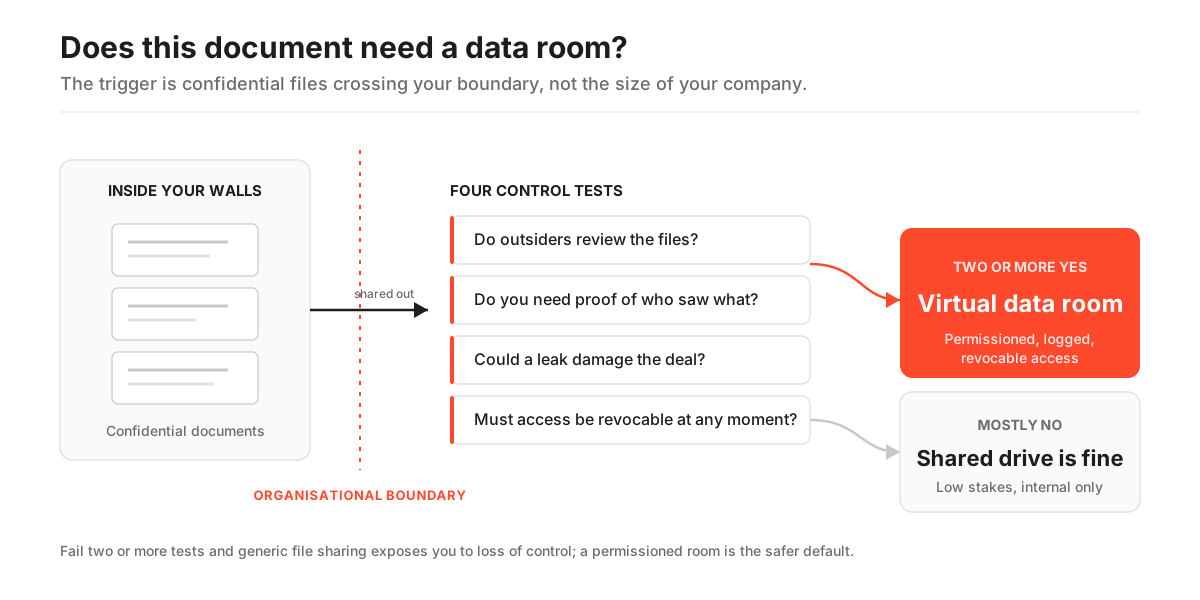
Before the specific situations, arm yourself with a portable test. Take any confidential document you are about to share and run it past four questions.
They point at the audience, not the file, and deliberately so. Control problems come from who is looking, not from the format. A spreadsheet is harmless until a rival bidder opens it.
Four tests: data room or shared drive?
| The question | Points to a data room | A shared drive is fine |
|---|---|---|
| Do outsiders review the files? | Yes, external parties | Internal only |
| Do you need proof of who saw what? | Audit trail required | No record needed |
| Could a leak damage the deal or the business? | High sensitivity | Low stakes |
| Must access be revocable at any moment? | Access must be pulled | Access can persist |
Two or more failures is the threshold, and it is deliberately blunt.
A single failure can often be managed by other means: a strong non-disclosure agreement, a trusted counterparty, a document dull enough that a leak would embarrass no one.
Two failures start to compound. Outsiders reviewing high-sensitivity files with no audit trail is not a gap you can paper over with a signature, because a signature tells you what someone promised, not what they did. The whole value of an audit trail is that it replaces trust with a record.
The economics behind that caution are stark. IBM’s Cost of a Data Breach research puts the global average cost of a breach at roughly USD 4.9 million, and that headline number understates the risk that matters most in a deal.
A transaction does not need a nine-figure breach to be destroyed. A single leaked customer list, a premature salary schedule, or an unsigned term sheet circulating among rival bidders can reprice or collapse a deal on its own.
Set that against the cost of a room, which for most situations starts in the low hundreds of dollars a month, and the asymmetry does the arguing for you. Cheap prevention against expensive, often irreversible exposure is the entire logic of the four tests.
A field guide to the eight situations
The four tests tell you whether you have a problem. The eight situations below tell you what it looks like in the wild.
The configuration recurs in a few recognisable shapes, each with its own reason a room is needed and its own features that matter most.
Selling a company or a business unit
Sell-side mergers and acquisitions is the original use case, and it remains the most common for a structural reason rather than a historical one.
When you sell a company, you are usually running several bidders in parallel, and those bidders are frequently your competitors. They need to inspect financials, customer contracts, employee records and intellectual property in depth, because no one commits real money on the strength of a pitch.
So you face a genuinely hard problem. You must expose your most sensitive material to the people best placed to exploit it, for all of them at once, without letting any single party see more than you intend.
A data room resolves that tension cleanly. You present each bidder a curated, watermarked set, run a structured question-and-answer process, and watch which documents draw the most scrutiny.
Control here is not a comfort feature. It is leverage. Grant one bidder read-only access to the customer contracts while withholding them from a rival, then revoke everything the instant a party drops out.
The activity log serves a second purpose founders rarely anticipate. It becomes part of your defensible record if the transaction is ever litigated or unwound, an objective account of exactly what each buyer was shown and when.
The full mechanics are laid out in our guide to data rooms for mergers and acquisitions, and if this is your first sale, the question of whether you need a data room to sell your business is worth reading first. When you reach the shortlisting stage, the best data rooms for M&A ranks the platforms built for competitive, multi-bidder processes.
Raising a funding round
Founders raising a seed, venture or growth round cross into data-room territory at a precise moment: the transition from pitch to diligence.
Early conversations run happily on a deck and a story. Then an investor commits to real diligence, the request list arrives, and it is invariably your most sensitive material: the cap table, the financial model, key contracts, IP assignments, and the corporate records that prove you own what you claim to own.
Email scatters those documents across dozens of investor inboxes, associates and analysts, with no way to know who forwarded what and no way to pull anything back if a conversation goes cold. For a company whose entire value is its future, that loss of control is a strategic risk, not merely an administrative one.
A room keeps the raise disciplined and signals that you run a tight operation. You share one curated link, watch engagement to tell the investors genuinely working through your numbers from the ones who opened the deck once, and close access to the funds that pass.
Because a raise is time-boxed, often live for only a few months, the billing question matters. Many providers offer a free trial, and our note on free trial versus paid rooms marks exactly where the trial ends and paid features begin.
Indicative entry pricing around $99 per month is common at startup scale, though you should confirm current USD figures with the provider. The best data rooms for fundraising shortlist and the deeper startup fundraising guide narrow the field to rooms that suit a lean, fast-moving raise.
Running diligence as the buyer
Every acquisition has two sides of the room. The buy-side lives inside the seller’s data room and, increasingly, runs one of its own alongside.
As the acquirer, your legal, financial and commercial teams are not browsing. They are verifying, checking every claim in the seller’s marketing against the source documents that either support it or quietly undercut it.
That work is only as good as the tools underneath it. Reviewers need full-text search to find the one indemnity clause that matters across thousands of pages, a clean folder structure so nothing is missed, and a way to raise and track questions.
When the room supports due diligence properly, it compresses weeks of scattered email into a structured, auditable process, and the audit trail of what you reviewed before signing becomes your own protection if the deal later goes wrong. Sophisticated buyers extend this by keeping a private, logged room for their own memos, red-flag reports and valuation models, because acquisition post-mortems and disputes turn on what the buyer knew and when.
Preparing for an IPO or public listing
Going public is a document-heavy, intensely scrutinised process in which a data room is close to mandatory in practice, even where no rule names it.
The cast is large and the coordination demands are unforgiving. Underwriters, auditors, exchange reviewers and multiple legal teams all need synchronised access to prospectus drafts, historical financials, governance records and material contracts, and regulators expect a precise, tamper-evident record of who accessed what.
The volume and sensitivity of the material sit far beyond anything informal sharing can hold together, and the cost of a misstep, a delayed listing or a regulatory query, dwarfs the cost of the room.
The other defining feature of a listing is duration. These processes run for many months, sometimes well over a year, and the teams rotate as advisers cycle on and off.
Managing users by group, revoking a departed banker’s access cleanly, and producing a complete history of access on demand stop being niceties and become operational necessities. This is where enterprise-grade rooms, typically quoted per engagement, plainly earn their cost.
The data room for IPO guide walks the workflow end to end, and the best data rooms for an IPO shortlist points to the platforms banks and counsel actually deploy on live listings.
Governing a board that handles sensitive papers
The first four situations are deals, with a beginning and an end. Board and committee governance is different. It is ongoing and non-transactional, and that difference reshapes what you should want from a room.
Directors receive board packs, financial results, litigation updates and strategic plans quarter after quarter, capturing decisions before they are public and problems before they are resolved. The company secretary needs to distribute those papers to a fixed group without the documents being forwarded to an assistant, printed and left in a taxi, or leaked to the press.
View-only rendering, dynamic watermarking and per-director granular permissions are built for exactly that job.
Because this room never closes, the buying calculus tilts away from raw deal-workflow power and toward what matters over years: reliability, ease of use for directors who will not tolerate friction, and a clean experience on a tablet in a boardroom.
A room that is superb for a competitive M&A auction can be needlessly complex for quarterly governance. The best data rooms for board management shortlist filters specifically for the traits a permanent, director-facing room needs.
Licensing IP or entering a partnership
Any arrangement that requires you to expose patents, source code, formulations, trade secrets or clinical data belongs in a data room, because these deals contain a contradiction ordinary file sharing cannot manage.
Licensing negotiations, joint ventures and technology partnerships all depend on the other side inspecting your crown-jewel assets closely enough to value them. Yet the commercial logic collapses if inspection becomes acquisition. You need them to look without letting them take.
Dynamic watermarking, view-only access and download restrictions hold precisely that line, letting a prospective partner study a document while making it materially harder to walk away with a usable copy.
The audit trail carries unusual weight here. If a partnership sours and you suspect your technology has been misused, a precise record of who accessed which technical document, and when, can be the difference between a provable claim and a hunch.
Life-sciences and biotech deals are the sharpest version of this pattern, where a single data package can carry years of research and a decade of value. Our data room for life sciences guide covers the handling rules, and the best data rooms for life sciences shortlist identifies the platforms built for that level of sensitivity.
Facing audits in a regulated industry
Organisations in healthcare, finance, legal services and other regulated fields reach for data rooms to share records with auditors, regulators and counsel under handling rules that leave no room for improvisation.
Where personal or health data is involved, the obligation is not merely to keep the data safe but to demonstrate that you did. The EU GDPR requires appropriate technical and organisational measures under Article 32, and US healthcare data falls under the HIPAA Security Rule, both of which turn on provable, controlled access rather than good intentions.
A room certified to recognised standards, such as ISO 27001 published by the International Organization for Standardization, meets those obligations by design rather than by scramble. Our glossary entries on GDPR and ISO 27001 unpack what each actually requires.
The value here is proof, a stronger currency than assurance. When a regulator asks how a particular sensitive file was handled, an immutable log of every interaction is far more persuasive than a statement that it was kept secure. The first is evidence; the second is a claim.
If certifications are the factor that will decide your choice, our piece on whether virtual data rooms are secure breaks down what each standard covers and, just as usefully, what it does not.
Handling real estate and asset portfolio deals
Property transactions and asset sales generate a different kind of pressure: not the extreme sensitivity of a biotech package, but sheer volume reviewed by many parties at once.
A single commercial real estate deal can involve stacks of leases, titles, valuations, surveys and loan documents, and a portfolio sale multiplies that by every asset in the book. Buyers, lenders, valuers and lawyers all review simultaneously, each seeing only the slice relevant to their role.
A room keeps hundreds or thousands of documents indexed, searchable and permissioned by party, so a lender sees the financing package, a valuer sees the surveys, and no one wades through material that is not theirs. The same coordination on a shared drive becomes either a permissions tangle no one trusts or a free-for-all that leaks.
These deals also have an afterlife that rewards good record-keeping. A portfolio may be refinanced or re-traded years later, and a well-maintained room shortens the next round of diligence dramatically, because the documentation is already organised, indexed and access-controlled.
The data room for real estate guide covers the document-heavy workflow, and the best data rooms for real estate shortlist highlights the platforms that handle high volumes without slowing reviewers to a crawl.
The eight situations at a glance
Held side by side, the eight cases sort along three axes: who opens the room, why a shared drive fails, and how long the room stays live. The last matters more than newcomers expect, because it drives the billing decision.
Eight situations that call for a virtual data room
| Situation | Who opens the room | Why a shared drive fails | Typical room life |
|---|---|---|---|
| Selling a company or unit | Seller and advisers | Rival bidders need curated, revocable access | 3 to 9 months |
| Fundraising round | Founders | Sensitive files scatter across investor inboxes | 1 to 4 months |
| Buy-side diligence | Acquirer's deal team | No search, structure or question workflow | 1 to 3 months |
| IPO or listing | Company, banks, counsel | Regulators demand a precise audit trail | 6 to 18 months |
| Board governance | Company secretary | Board packs get forwarded or printed | Ongoing |
| IP and licensing | IP owner | Crown-jewel assets need look-not-take control | Deal length |
| Regulated audits | Compliance and legal | Handling rules require provable access logs | Ongoing or per audit |
| Real estate and asset sales | Seller and lenders | Hundreds of files, many parties at once | 2 to 6 months |
A few figures worth carrying away, each a reason the decision leans toward caution rather than convenience:
- USD 4.9 million is the rough global average cost of a data breach in IBM’s research, and a deal can be destroyed for a small fraction of that.
- ~$99 per month is common indicative entry pricing for a lean startup-scale room; set that against what a single leaked document could cost.
- Two of four tests is the threshold at which generic file sharing stops being defensible and a permissioned room becomes the safer default.
- Weeks to never is the span of room lifespans, from a short raise to a board room that never closes, which is why timeline drives the billing choice.
A five-step process for the borderline cases
Most situations resolve themselves against the list above. The hard ones are the borderline cases: a sensitive but small deal, a single trusted counterparty asking for more than usual, a project that could go either way.
For those, work through the sequence below in order. A single strong yes at any high-stakes step is enough to settle the matter in favour of a room. You do not need every factor to point the same way, only one that would hurt badly if it went wrong.
How to decide whether you need a virtual data room
A five-question check to settle the shared-drive versus data-room decision.
Estimated time: 10min
-
Identify the audience
List everyone who will see the documents. If anyone sits outside your organisation, control becomes a real concern and a shared drive weakens immediately, because you can no longer rely on employment and internal policy to govern behaviour.
-
Rate the sensitivity
Judge the concrete damage a leak would cause to a deal, a valuation, a negotiating position or the business itself. High sensitivity points firmly to a permissioned room; genuinely low stakes do not.
-
Check the proof requirement
Decide whether you will ever need to show who accessed each file. If an audit trail could matter to regulators, buyers, partners or a court, only a data room produces one you can stand behind.
-
Test for revocability
Ask whether access must be withdrawn the instant a party leaves the process. Shared drives make clean revocation slow and unreliable; a data room makes it a single action with an immediate effect.
-
Weigh the timeline and cost
Estimate how long the room must run, because timeline drives the billing decision. Short, high-stakes projects suit a free trial or a monthly plan; permanent needs such as board governance favour an annual room.
Run those five in order and the answer usually declares itself by step three.
The common mistake is to stop at step one, conclude an outside party is trustworthy, and skip the rest. Trust guards only against deliberate misuse, not accidental forwarding, and not the day a trusted party becomes an adversary.
When a data room is overkill
Honesty about when you do not need a room is what makes the rest of this guide trustworthy, and plenty of the time you do not.
You do not need one when files stay inside your organisation, when the documents are not confidential, or when a single trusted party reviews a handful of low-risk items with nothing much riding on the outcome.
Sharing a marketing brief with a freelancer, sending a countersigned contract to a long-standing supplier, or collaborating on internal drafts are tasks ordinary cloud storage handles well and far more cheaply. Reaching for a data room there adds cost and friction while solving a problem you do not have.
If you want the boundary between everyday tools and a room drawn precisely, our comparisons of a data room versus Dropbox and a data room versus Google Drive mark it clearly, as does the broader look at virtual data room alternatives.
The governing principle is proportion. A data room is insurance, and like any insurance it is worth buying only against losses you genuinely could not absorb.
When the four tests come back low-stakes across the board, over-engineering the problem is its own mistake, wasting money and slowing a process a shared link would have handled fine.
The reckless-feeling instinct that opened this guide is a good detector. It fires when the stakes are real and stays quiet when they are not. Trust it in both directions.
Choosing the room once you have decided
Deciding that you need a room is the easy half. The field of providers is large and their strengths diverge sharply, so the right question is never “which is the best data room” but “which is the best room for this situation”.
A fundraise rewards speed and a short billing commitment. A regulated audit rewards certifications and airtight logging, because proof is the whole point. A large M&A process rewards a serious question-and-answer module and fine-grained user-group management.
Weigh security certifications, permission granularity, ease of setup and honest pricing against the shape of your own case, and let the mismatch between a room’s strengths and your needs drive the choice. Our guide to how much a data room costs sets realistic USD expectations, and the current pricing overview shows how the platforms we track compare on headline rates.
Individual reviews are where the trade-offs become concrete. Read our assessments of iDeals, Datasite and Ansarada to see how three established, deal-focused providers handle the tension between control and usability, and put two head to head, for instance iDeals versus Datasite, when your choice narrows to a final pair.
Modern, full-featured rooms such as Ellty pair a clean interface with published pricing across M&A, due diligence, real estate and fundraising. Whatever you shortlist, treat every published price as indicative and confirm current USD figures with the provider, since headline rates rarely tell the whole story once storage caps and per-page charges are added.
Frequently asked questions
Is a virtual data room only for large companies?
No. The trigger is confidential documents crossing an organisational boundary, not company size. A two-founder startup raising a seed round needs the same control over its cap table and contracts that a listed company needs in a carve-out; the exposure is structurally identical even though the numbers differ enormously. Small teams simply choose leaner, lower-cost rooms rather than enterprise deployments.
Do I need a data room for a single small deal?
It depends on sensitivity and proof, not on the deal being small. If one trusted party reviews a few low-risk files, a shared drive is fine. If the documents could damage the business in the wrong hands, or you will later need a record of who saw them, a room is worth the modest setup even for a single deal, and many providers offer a free trial that comfortably covers a short project.
Can I use Google Drive or Dropbox instead?
For internal, low-stakes sharing, yes. For confidential files reviewed by outsiders, consumer storage lacks the document-level permissions, dynamic watermarking, complete audit trail and security certifications regulated counterparties expect. That gap is not an oversight; it is simply not what those tools were built for, and it is the whole reason data rooms exist as a separate category.
How long do I actually need the room?
It varies by situation, and the timeline should drive your billing choice. A fundraise or single acquisition may run one to four months, an IPO can run well over a year, and board or compliance use is ongoing. Match the term to the timeline: short projects suit monthly plans or a free trial, while permanent needs suit annual contracts.
Which situation is the most common reason to open one?
Sell-side M&A remains the classic use case, closely followed by fundraising and buy-side due diligence. Those three transaction types account for the majority of data-room activity between them. Board governance and regulated audits drive a growing share of ongoing, non-deal usage, which is why several providers now market rooms specifically for permanent governance.
How much should I budget for the room itself?
Indicative entry pricing starts around $99 per month for lean rooms, mid-market rooms land in the low hundreds, and enterprise deployments are usually quoted per engagement rather than by a public rate. Storage caps and per-page charges can move the real figure well beyond the headline, so read each number as a planning figure and verify the live USD rate with the provider directly.
Start from the four tests, place yourself among the eight situations, and the answer usually becomes obvious well before you reach the pricing page.
