
Do I need a data room to sell my business?
On this page
- The real question is control, not compliance
- Where the threshold actually sits
- What the room does that a folder cannot
- Whether it is worth the money
- What a buyer expects to find inside
- How the room protects the price, not just the file
- Setting one up is faster than sellers fear
- The room outlives the sale
- Choosing the room, and where the cheap options fit
- The honest bottom line
Short answer: usually yes, though not always. One trusted buyer and a handful of documents can run on a shared folder and a real NDA. The moment a sale draws a second bidder, an adviser or sensitive customer data, you want a room.
Every sale of a business eventually arrives at the same uncomfortable moment. A buyer you have known for a few weeks, whose real intentions you cannot fully see, asks to look at the file that explains how your company actually works.
Not the marketing version. The real one: the accounts with the awkward months in them, the customer list you have spent a decade building, the supplier contracts, the leases, the one legal matter you would rather not talk about, the payroll.
You either hand that over in a way you can control and later account for, or you hand it over and hope. The question of whether you need a data room sounds like a question about software. It is really a question about that moment, about how much of your company’s private life you are willing to expose without a record of who saw it and when.
For most sellers the honest answer is that the informal approach stops being enough sooner than they expect. A shared folder and a signed non-disclosure agreement feel proportionate when there is one buyer and a handful of documents, and for that narrow case they genuinely are.
What tends to happen, though, is that the sale grows past that case without anyone deciding it should. A second buyer appears. A broker joins and wants to run a proper process. The financials turn out to contain more sensitive customer data than you remembered.
So the useful way to think about a data room is not as a purchase you either make or skip. It is a threshold your sale either stays below or crosses, usually on its way to something larger than you planned.
The real question is control, not compliance
Nothing in company law or contract law says that the confidential file behind a business sale must live in a virtual data room. There is no statute you are breaking by emailing a spreadsheet, no regulator who will refuse to recognise a sale conducted over a shared drive.
That is worth saying plainly, because a lot of writing on this topic implies a rule that does not exist. A tiny sale of a single asset to one buyer you already trust can run perfectly well on a carefully structured cloud folder, a good index and an NDA that means something. If that is your situation, the rest of this guide will mostly confirm your instinct while showing you where its limits are.
What actually changes the calculation is not the law but the shape of the process, and two forces in particular.
The first is competition. The instant two or more buyers are reviewing the same confidential documents, you have a control problem a folder cannot solve. Each party needs to see the same underlying file without seeing each other, and you need to revoke a departing buyer’s access the moment they walk, cleanly, in a way you can prove.
The second is sensitivity. When the file contains regulated personal data about customers or staff, or commercial secrets like pricing and margins, you need to disclose at the document level, deter leaks, and keep a defensible record of exactly what left your control.
Those two forces are what a data room is built for, and precisely what a shared drive was never designed to handle.
The stakes here are not abstract, and they cut against the seller more than the buyer. A frequently cited Harvard Business Review analysis puts the share of acquisitions that fail to deliver their expected value at somewhere between 70% and 90%, and a recurring reason that deals stall, drag or die outright is disclosure that is disorganised, incomplete or slow.
A buyer who cannot find the answer to a reasonable question, who is made to feel that the seller is either hiding something or simply does not have its house in order, is a buyer whose enthusiasm cools and whose lawyers grow cautious.
A data room does not guarantee that a sale closes. But a chaotic disclosure process actively raises the odds of losing a deal that should have completed. That asymmetry, a small monthly cost against the possibility of a broken sale, is the entire argument in miniature.
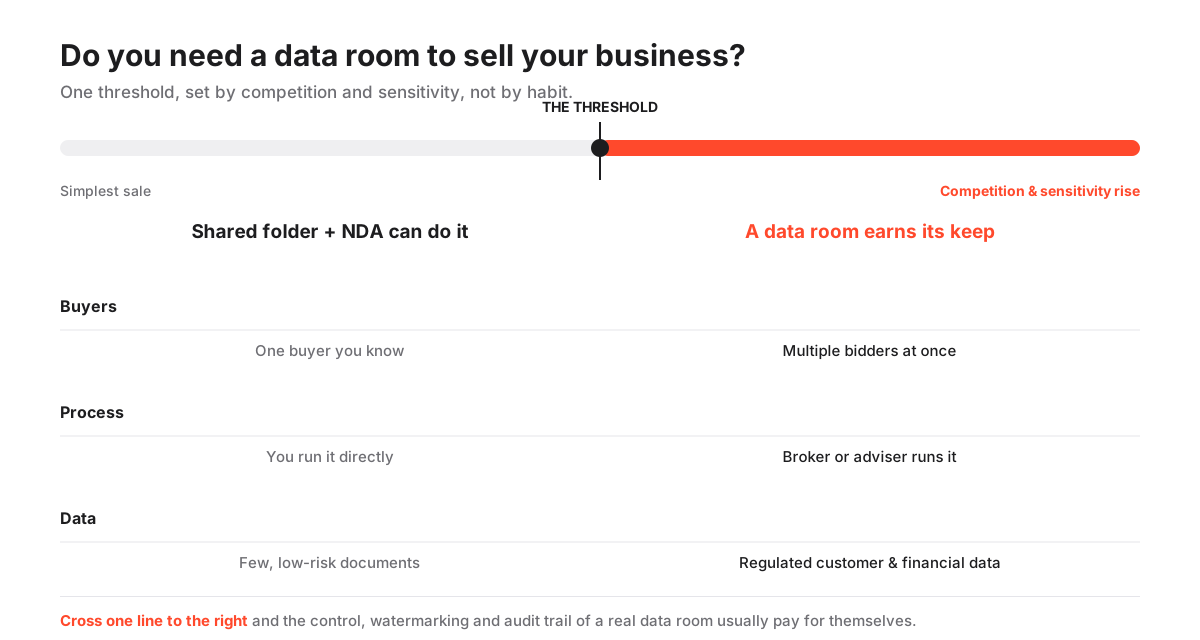
Where the threshold actually sits
It helps to be concrete about the line, because the temptation is to treat every sale as either trivially small or fully institutional. Most real sales sit awkwardly in between.
Picture the genuinely small case first. You are selling a single-location business, or one asset, to a buyer you already know and have some reason to trust, under an NDA, with a document set you could count on two hands.
In that world the leak risk is low, the competitive tension is nil because there is only one party, and the audit requirement is modest. A well-organised folder, sensibly named, with a short index at the top, does the job, and paying for a room would be spending money to solve a problem you do not have. This is the case where the answer to the guide’s title is a calm no.
Now hold that picture steady and change one variable at a time, because that is how sellers actually cross the threshold, rarely all at once.
Add a second interested buyer and you have lost the ability to control who sees what, without either duplicating the whole file or letting parties glimpse each other’s presence.
Bring in a broker or an M&A adviser and you have introduced someone who expects a room as a matter of course. Staging disclosure and tracking buyer engagement is simply how they run a process; ask them to work off a shared drive and you have signalled, before you mean to, that the sale is being run on the cheap.
Discover that the financials carry health data, or payment details, or a customer database, and you have taken on a legal obligation to secure personal data that an unlogged link cannot satisfy. Anticipate that the deal will close on warranties or an earn-out, and you may need to prove, years later, exactly what you disclosed before signing.
Any one of these tips the balance. In combination they end the debate.
The pattern worth internalising is that these triggers are cumulative and quiet. Nobody sends you a memo announcing that your sale has become a data-room sale. You simply find, halfway through, that a process you thought was simple now involves three buyers, an adviser and a customer list you are being asked to hand over.
By then, retrofitting control onto a mess of email threads is far harder than starting clean. The cheap insurance is to recognise which way your sale is likely to drift and set up for the version it is becoming, not the version it started as.
What the room does that a folder cannot
Strip the marketing language away and a data room does three concrete things a folder does not. Together they are the whole point.
It controls access at the level of the individual document rather than the whole share. It records every action anyone takes, permanently and in a form you can later produce. And it holds a competitive process in an orderly shape, so many parties can review the same sensitive material in parallel without the whole thing dissolving into chaos.
When you sell, you are not merely storing files somewhere convenient. You are disclosing them to people whose interests are, by definition, opposed to yours on the central question of price. Everything the room does flows from taking that reality seriously.
The access control is the visible part. You can decide that an early-stage bidder sees the high-level financials but not the customer contracts, that the contracts open only once a buyer is serious, that the single most sensitive folder never opens to anyone until an exclusivity agreement is signed.
You can watermark every page with the identity of the person viewing it. That does not make a leak impossible, but it makes one traceable, and therefore far less likely, because a document that carries the leaker’s own name is a document most people will not forward.
If a buyer withdraws, you cut their access in a single action while everything they saw remains on the record. None of that has an equivalent in a shared drive, where a link, once sent, has effectively left your control for good.
The part sellers consistently underrate is the record itself, the audit layer that sits quietly under everything. Every view, every download, every print is logged against a person and a time. That lets you see at a glance which buyer is genuinely engaged, but its deeper value is evidentiary.
If a buyer later claims they were never shown a particular liability, the audit trail settles the argument without a swearing contest, because the record shows the document, the viewer and the timestamp.
A clean, logical data room index does something subtler still. It signals to a cautious buyer that this is a business run by people who keep their affairs in order, and that impression, hard to quantify but real, quietly supports the price rather than eroding it.
For the mechanics of the underlying tool, our explainer on what a virtual data room is covers the fundamentals. The concern of this guide is narrower, which is how to bend that tool toward the specific job of getting a company sold.
In a contested sale, the seller who can prove exactly what was disclosed, and when, negotiates from a stronger position than the one who only remembers it.
Whether it is worth the money
For a small-business sale the cost question usually answers itself. A room sized for a small sale is inexpensive relative to the transaction it protects.
The downside it insures against, a leaked customer list that walks straight to a competitor, or a buyer who loses confidence because diligence felt shambolic, dwarfs the subscription many times over. You are not buying software so much as buying down the probability of the specific failure that most often kills a sale. Seen that way, the monthly figure is close to a rounding error against the deal.
Still, it helps to see indicative ranges, if only to size the decision and to know when a quote is out of line. The table below maps deal profiles to rough pricing tiers. Treat every figure as indicative rather than a quote, and confirm current numbers with the provider directly, because plans, included storage and the definition of a “user” all change often and vary between vendors.
| Deal profile | Typical room tier | Indicative price (USD) | What you get |
|---|---|---|---|
| Micro or single-asset sale | Entry | $99 to $150 per month | One project, core permissions, a basic audit log, modest storage |
| Small business, a few bidders | Small-business | $150 to $300 per month | Group permissions, watermarking, Q&A, engagement tracking |
| Lower mid-market with an adviser | Professional | $300 to $1,000 per month | Multiple projects, deeper analytics, granular controls, support |
| Larger or auctioned sale | Enterprise | Custom quote | High storage, deep audit, integrations, dedicated support |
The one number that can genuinely surprise you is not the headline tier but the pricing model beneath it. Some vendors charge per page, which is fine for a thin file and punishing for a fat one, and a business sale is almost always a fat file: years of accounts, stacks of contracts, employee records, property documents, the lot.
If budget is the deciding factor, a flat-rate small-business plan will almost always beat a per-page one for a sale, precisely because a sale generates so many pages. Our guide on per-page versus flat-rate pricing works through the arithmetic, the cheapest virtual data rooms roundup is the deeper read if cost is your first constraint, and the pricing view lines the providers up head to head.
What a buyer expects to find inside
A buyer’s expectation is simple to state and demanding to satisfy. They want the full evidence base for every claim you have made about the business, laid out so they can find it without having to ask.
Every question a buyer is forced to email is a small delay and a small erosion of confidence, so the aim of a well-built room is to answer the obvious questions before they are put. At a minimum that means the financial statements and tax filings, the corporate and ownership records that prove you are entitled to sell what you are selling, the material customer and supplier contracts, the employee and payroll details, the leases and property records, and the intellectual property or licence documentation that underpins the business.
Getting that right before buyers arrive is very often the difference between a two-week diligence and a two-month one.
Rather than reproduce the whole checklist here and pretend it is universal, lean on the two guides built for the job. Our due diligence checklist sets out the standard document families a buyer will work through, and the companion piece on what documents go in a data room translates that into the folder structure a room actually wants.
The rule of thumb behind both is worth carrying in your head: if a buyer would reasonably ask for a document, it belongs in the room before they ask, indexed where they would instinctively look for it. Anticipation, not responsiveness, is what makes disclosure feel fast, and a diligence that feels fast is one that keeps a buyer committed.
How the room protects the price, not just the file
It is tempting to file confidentiality under risk management and stop there. But in a sale the two are the same subject, because the way you protect your sensitive information is also the way you protect what the business is worth.
The mechanism is staged, tracked, revocable disclosure. High-level financials opened early to establish credibility. The crown-jewel contracts and customer data sealed until a buyer has proven serious. Every page watermarked. Access pulled back the moment a party drops out. Control is never surrendered in a single gesture; it is meted out.
There is a legal edge to this as well, and it becomes sharp the moment the file touches personal data. Where you are disclosing information about identifiable customers or staff, keeping it secure stops being a matter of good hygiene and becomes an obligation.
Under the EU General Data Protection Regulation, to take the most widely echoed example, controllers must apply appropriate technical and organisational measures to secure personal data (Article 32), and broadly equivalent expectations now sit in most modern privacy regimes.
Sharing a customer database over an unlogged link, with no permissions and no way to know who downloaded it, is close to a textbook illustration of the exposure that a permissioned, audited room exists to prevent. So the same features that reassure a nervous buyer also keep you the right side of the law: the tool that protects your price and the tool that protects your compliance are the same tool.
The trade is real, if one-sided. A room carries a monthly cost a folder does not, it asks for an hour or two of setup discipline, and for the smallest single-buyer sale it is frankly overkill.
Set against document-level permissions, watermarking, an audit trail that both proves disclosure and reads buyer engagement, and a Q&A that keeps questions inside the record rather than scattered across three inboxes, that is a lopsided bargain for any sale that has crossed the threshold. The comparison with a shared drive like Dropbox shows exactly where consumer file sharing runs out of road once a transaction turns competitive.
Setting one up is faster than sellers fear
The single most common misconception among first-time sellers is that standing up a data room is a project. It is not.
Getting a sale-ready room live is usually a matter of hours once the documents are gathered, because the software is the easy part and modern rooms are built to be populated in bulk. The real work is organising the file and setting the permissions so that buyers find their answers without emailing you.
The sequence below is the essential path, and following it in order matters more than doing any single step perfectly.
How to set up a data room to sell your business
A first pass that gets a sale-ready, defensible room in front of buyers.
Estimated time: 3h
-
Build the index from a diligence checklist
Map your folder tree to a standard due-diligence checklist before a single file goes in, so buyers meet financials, contracts and IP exactly where they expect them.
-
Gather and load the file in one pass
Pull together the records a buyer will ask for, import them together, then arrange them under the index and switch on full-text search so a reviewer can find any clause in seconds.
-
Set staged permissions by buyer group
Create groups such as early-stage bidders, shortlisted buyers and advisers, and grant folder-level rights so sensitive files unlock only as a buyer earns them.
-
Turn on the leak controls first
Switch on per-viewer watermarking, view-only rendering and login verification before you invite any outside party, so customer and financial data is protected the instant it is exposed.
-
Invite buyers and route every question through Q&A
Bring reviewers in, keep their questions inside the room's Q&A module instead of your inbox, and read the activity log to see which buyer is genuinely working the file.
The ordering carries a lesson of its own.
Index first. Building the folder tree against a checklist before a single file is uploaded forces you to notice the gaps while you still have time to fill them, quietly, rather than having a buyer’s lawyer find them loudly.
Turn the security controls on before the first external invitation, never after, so no document is ever exposed unwatermarked.
And once buyers are in, push every question through the room’s Q&A rather than answering the friendly ones by email, because the moment the record splinters across inboxes you have lost the single clean account you may later need. For a fuller walkthrough that applies beyond a sale, our step-by-step guide on how to set up a virtual data room goes deeper on each stage.
The room outlives the sale
Here is the step almost everyone forgets, and it is the one with teeth. The moment the deal signs, the room stops being a disclosure tool and quietly becomes an insurance policy, which is exactly why you should not delete it the day the ink dries.
Most business sales close on a set of representations and warranties, backed by a disclosure schedule that carves out the specific issues you flagged, and that structure creates a long tail of potential dispute.
If a buyer comes back months or years later arguing that some liability was concealed, the fight will turn entirely on what was actually in the room and when each party could see it. A dated export of the file, paired with the audit trail, is the cleanest evidence you can hold that a matter was disclosed before signing rather than sprung afterwards, and it is the difference between a defensible position and a memory contest you may well lose.
So keep the room live through any agreed warranty period, or take a full archived copy at completion. And before you sign, confirm how long your provider retains data and logs once the subscription ends, because a provider who deletes your audit trail the week you stop paying has quietly destroyed your best evidence.
Treating the room as a permanent record rather than a throwaway staging area is a small shift in mindset with a large payoff, and the cost of the difference is close to nothing.
Choosing the room, and where the cheap options fit
When it comes to picking a provider, the instinct to sort by sticker price is at best incomplete. The features that decide a sale are the ones that let you disclose safely and prove it afterwards: granular permissions so you can slice access to the document, dynamic watermarking, a complete audit trail, a clean Q&A workflow, and independent security certification that a buyer’s lawyers will actually recognise.
On that last point, look specifically for SOC 2 and ISO 27001, the latter being the international standard for information security management systems published by the International Organization for Standardization. Those certifications tell a cautious buyer the platform has been independently audited rather than merely described as secure in its own brochure, and in a diligence process where trust is the scarce commodity, that distinction carries real weight.
For a sale specifically, weight the speed and ease of setup heavily, because you may well be racing a buyer’s timetable and a room you cannot populate in an afternoon is a room working against you. Confirm too that the pricing model suits a document-heavy process, which loops back to the flat-rate point made earlier.
Our how to choose a virtual data room guide runs the full set of criteria, and the shortlist of the best data rooms for a small business narrows the field to the sale-friendly end of the market. Among the value-focused options, Ellty is one worth a look, a modern, full-featured room with a clean, buyer-facing interface that handles a business sale alongside wider M&A and due diligence work; judge it, as with any provider, against the alternatives on the same criteria, which is what the head-to-head comparison view is for.
The honest bottom line
So, do you need a data room to sell your business? Not always, but usually, and the threshold is lower than most sellers assume before they are in it.
One trusted buyer and a short stack of documents can run on a folder and an NDA, and if that is genuinely your sale you should not be spending money to solve a problem you do not have.
The moment a second buyer appears, or an adviser takes the reins, or the file starts carrying sensitive customer and financial data, you have crossed into wanting the control, the watermarking and the provable audit trail that only a real room delivers.
Decide by the three variables that actually matter: deal size, buyer count and data sensitivity. And keep the one framing that outranks all the others. The cheapest sale is not the one that skimped on tooling; it is the one that did not fall apart in diligence.
If you are still weighing whether the tool earns its place at all, our broader take on whether a virtual data room is worth it pushes on the same trade-off from a different angle.
