
Virtual data rooms for life sciences and biotech
On this page
- What exactly is a virtual data room for life sciences?
- Why can’t a biotech just use a shared drive or email?
- What makes it different from a standard M&A room?
- Which capabilities actually matter, and where?
- Which life sciences transactions actually rely on a room?
- What documents go into a life sciences data room?
- How do data rooms handle HIPAA, GDPR and clinical trial data?
- Can a virtual data room be HIPAA compliant?
- How does a room protect intellectual property during licensing talks?
- What features matter most for a biotech company?
- What mistakes do biotech teams make with a data room?
- How do you set up a room for a life sciences deal?
- What does a life sciences data room cost?
- Is a room worth it for an early-stage biotech?
- How do you choose the right VDR for a life sciences company?
In life sciences the most valuable thing a company owns is often a folder. A molecule’s mechanism. A trial’s safety data. A patent estate. A manufacturing recipe.
Sharing any of it with a prospective pharma partner, an investor or an acquirer means handing the crown jewels to people who might walk away, or who might compete. A virtual data room is how biotech and pharma teams do that on their own terms.
This guide runs as a set of questions, the ones teams actually ask before they open a licensing or diligence room, answered in order. Skip to whichever one is yours.
What exactly is a virtual data room for life sciences?
It is a secure, access-controlled online repository, configured for the confidential document exchange that runs through drug development, partnering and dealmaking.
The core technology is the same one used in any M&A process: granular permissions, watermarking, audit trails, certified security. What makes it a life sciences room is how that technology is set up.
So the distinction is context, not category. A generic room stores documents.
A life sciences room is arranged so a clinical data package, a regulatory dossier and a patent estate can each be released to a different audience under different rules, with every view logged.
That configuration discipline, more than any single feature, is what separates a room built for biotech from a bare file share. If the format itself is new to you, what is a virtual data room covers the fundamentals before you apply them here.
Why can’t a biotech just use a shared drive or email?
Because a shared folder cannot do the three things a life sciences deal depends on.
It cannot watermark every page with the viewer’s identity. It cannot show a partner’s counsel a clean, timestamped log of exactly what was disclosed. And it cannot pull one lapsed counterparty’s access without breaking links for everyone else.
Biotech and pharma firms live by repeated, high-stakes disclosure of irreplaceable IP to outside parties who are not yet, and may never be, on the same side.
A licensing negotiation, an investor round and an acquisition each require sharing sensitive science with a defined group, proving who accessed it, and revoking that access cleanly when a party drops out. Email and cloud drives were never built for that.
The stakes here are unusually asymmetric. A single leaked preclinical dataset or an exposed manufacturing process can erode a patent position, or a negotiating stance, that took years and hundreds of millions to build.
The room replaces guesswork with a defensible record. That matters most at the worst moment: when a deal collapses, a partnership sours, or a dispute over what was disclosed surfaces years later.
In a licensing negotiation the room is not a filing cabinet; it is the record of exactly what you disclosed and when. If a partnership sours two years later, that audit trail is the one version of events both sides already agreed to.
What makes it different from a standard M&A room?
Two things: the sensitivity of the content, and the number of overlapping audiences and rules it has to serve at once.
A corporate seller usually runs one room, for one sale, to one pool of bidders. A biotech typically keeps several confidential exchanges live in parallel.
A licensing talk with one pharma company. A raise with several investors. A partnering conversation with a third party. Each touches the same underlying science, but each is entitled to a different slice of it, under different confidentiality terms.
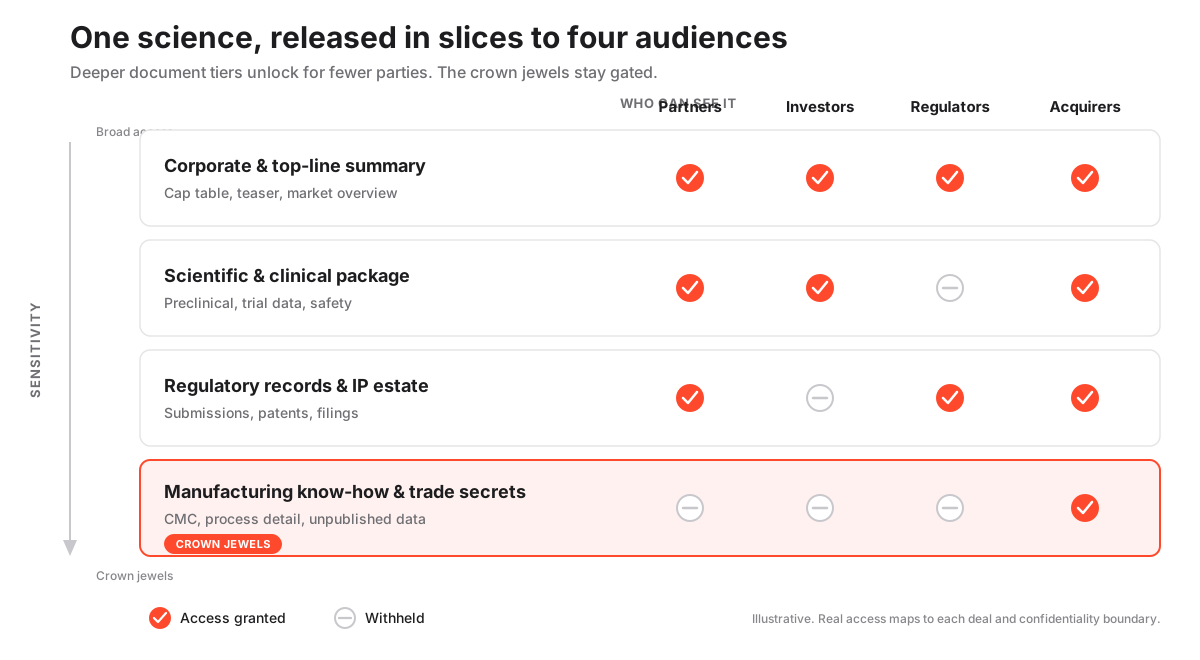
That changes what “good” looks like. The firm cares about IP-level permission granularity, so a licensing partner sees the clinical package but not the manufacturing know-how.
It cares about phased release, as talks move from teaser to full data. And it cares about compliance-grade audit depth, because the counterparties are regulated and the data may include patient information.
Both of those sit on top of the general M&A workflow covered in virtual data room for mergers and acquisitions.
Which capabilities actually matter, and where?
Not all features carry equal weight across every context. The compact matrix below shows where each capability is decisive rather than merely nice to have.
Which VDR capabilities matter across life sciences contexts
| Capability | Licensing / partnering | Clinical data sharing | M&A / asset sale | Investor raise |
|---|---|---|---|---|
| IP-level, folder-scoped permissions | Yes | Yes | Yes | Yes |
| Dynamic watermarking and view-only rendering | Yes | Yes | Yes | Yes |
| Full audit trail and engagement analytics | Yes | Yes | Yes | Yes |
| Phased, gated document release | Yes | Often | Yes | Rarely |
| Data-residency and GDPR / HIPAA-aware hosting | Sometimes | Yes | Often | Less |
| Structured Q&A with expert routing | Yes | Rarely | Yes | Sometimes |
Two features punch above their weight for biotech specifically.
The first is IP-level permissioning, because a single mistake that lets a would-be partner glimpse the manufacturing process behind the science can compromise a licensing position outright.
The second is compliance-grade audit depth, since a room holding clinical or patient data has to prove, not merely assert, that only invited, qualified people ever touched it.
Which life sciences transactions actually rely on a room?
Almost every confidential exchange in the sector runs through one, but the room plays a different part in each.
In a licensing deal it is the partner’s diligence window onto the asset. In a raise it is the investor’s. In an M&A or asset sale it is the buyer’s. In a clinical or manufacturing collaboration it is a controlled channel for sharing sensitive data with a CRO, CDMO or academic partner.
The practical takeaway is that a life sciences company should rarely think in terms of one room. It should think in terms of several confidential exchanges running in parallel, each with a different audience and a different confidentiality boundary.
That is why permission granularity and cross-room administrator tooling matter as much as any single feature. Here is how the common transactions map:
- Out-licensing or partnering. The room holds preclinical and clinical data, the IP estate, regulatory status and deal terms, opened to a prospective pharma or biotech partner, usually for weeks to months per counterparty.
- Venture or crossover raise. It holds the pipeline, the data package, the cap table and corporate and financial records, opened to investors and their advisers, and reopened each round.
- M&A or asset sale. It holds the full diligence set across science, legal, regulatory, commercial and manufacturing, opened to bidders and their advisers, typically for six to twelve weeks.
- Clinical or manufacturing collaboration. It holds protocols, safety data and quality records, shared with a CRO, CDMO or academic partner for the life of the collaboration.
- Regulatory and quality diligence. It holds submissions, agency correspondence and GxP records, opened to technical teams and tied to the parent deal.
For the underlying diligence workflow, our due diligence checklist and how long does due diligence take guides go deeper, and if you want the provider ranking for this exact use case, best virtual data room for due diligence scores the field.
What documents go into a life sciences data room?
The full evidence base a partner or buyer needs to verify the science, the protections around it, and the path to market. Organised to a diligence checklist, not dumped as a flat pile.
The exact index depends on the asset’s stage, but the room should mirror the questions reviewers will ask, so they find each document where they expect it.
- Scientific and clinical: preclinical study reports, trial protocols and results, safety and pharmacovigilance data, the investigator’s brochure.
- Regulatory: submissions and approvals, agency correspondence, orphan or fast-track designations, GxP and quality-system records.
- Intellectual property: patent filings and grants, freedom-to-operate analyses, licences-in and licences-out, trade-secret and know-how documentation.
- Manufacturing and quality: process descriptions, CMC data, supply agreements, batch and stability records, CDMO contracts.
- Corporate and commercial: cap table, material contracts, financials, market analysis, reimbursement and pricing strategy.
Because much of this is irreplaceable know-how, the permission structure should mirror the sensitivity gradient. Broad access to the corporate and top-line scientific summary. Tightly gated access to manufacturing detail and unpublished trade secrets.
For how to order it all, see data room index best practices and what documents go in a data room.
How do data rooms handle HIPAA, GDPR and clinical trial data?
Through certified platform security, controlled access, and hosting that respects the applicable privacy and records rules.
The key point is that responsibility is shared between the provider and the company running the room. The software supports compliance; it does not deliver it on its own.
Three layers stack up depending on the data:
- US patient data. Where a set includes identifiable patient information covered by US health-privacy law, the provider must be willing to act as a business associate under HIPAA, as administered by the US Department of Health and Human Services, and to sign the corresponding agreement.
- EU or UK data. Where the data concerns EU or UK individuals, the room and its hosting must respect the General Data Protection Regulation, which makes data-residency options a genuine selection criterion rather than a checkbox.
- Regulated electronic records. Where documents are electronic records or signatures tied to a regulated submission, US rules can bring in the FDA’s electronic-records rule, 21 CFR Part 11, which sets expectations for audit trails, access controls and record integrity.
Underneath all of it, the platform itself should be independently certified. Look for information-security management certified to ISO 27001 and a current SOC 2 report, both of which regulated partners increasingly treat as baseline rather than a differentiator.
Our GDPR and virtual data rooms, data residency in virtual data rooms and virtual data room certifications explained guides cover the practicalities.
Can a virtual data room be HIPAA compliant?
The platform can support HIPAA compliance, but no product is “HIPAA compliant” on its own.
Where a room holds identifiable patient data, two things have to be true. The provider must be willing to act as a business associate and sign a business associate agreement. And the company must still configure access and handle the data correctly on its side.
So the practical rule is simple. Confirm the provider’s willingness to sign, and check its certifications, before you upload any protected health information.
Loading patient data first and sorting the paperwork later is the classic compliance failure that the software cannot undo for you.
How does a room protect intellectual property during licensing talks?
Through layered controls that work together rather than any single lock.
- IP-level permissions release only the folders a counterparty is entitled to see, so a licensing partner gets the clinical package while the manufacturing know-how stays dark.
- Phased release holds trade secrets and manufacturing detail until a partner clears a gate, preserving your leverage.
- Dynamic watermarking and view-only rendering stamp every page with the viewer’s identity and stop clean copies leaving the room.
- A complete audit trail records exactly what was shown, to whom, and when.
And if a conversation ends, access can be revoked instantly, which is the part a shared drive can never match.
For the mechanics, data room permissions explained and dynamic watermarking and fence view go deeper, and VDR security features checklist gives a provider-agnostic view of the whole security layer.
What features matter most for a biotech company?
The control-and-accountability layer, not the storage layer.
IP-level permissions decide who sees the clinical package versus the manufacturing know-how. Dynamic watermarking and view-only rendering deter the leaks that erode a patent or a negotiating position.
A complete audit trail turns disclosure into a defensible record and shows which counterparty is genuinely engaged. Certified security satisfies the regulated partners and investors on the other side of the table.
Put plainly, headline capacity is close to irrelevant here. Here is how a configured life sciences room compares with a generic file share:
A configured life sciences room vs a generic file share
Pros
- IP-level permissions keep manufacturing know-how separate from the shared clinical package
- Dynamic watermarking and view-only rendering deter leaks of irreplaceable science
- A complete audit trail proves exactly what each partner or regulator was shown
- Certified security and residency options satisfy pharma partners and regulated investors
Cons
- Costs more than consumer file sharing, and compliance-grade plans cost more again
- Rooms need careful permission design to avoid exposing sensitive IP by mistake
- HIPAA business-associate terms and residency options may narrow the provider shortlist
What mistakes do biotech teams make with a data room?
The most damaging ones are permission errors and lapses in disclosure discipline, not software choice.
Because a biotech room mixes audiences and sensitivity levels that no ordinary sale ever has to, a single misconfigured folder can hand a would-be partner the exact know-how a licensing deal was meant to protect.
The five below recur across licensing rooms, raises and asset sales, and each is avoidable at setup.
- Granting access to individuals instead of groups. Editing people one at a time makes it almost impossible to prove, later, who could see what. Grant folder rights to defined groups, so the audit trail stays legible and revocation is one action.
- Uploading full data before the counterparty clears a gate. Publishing manufacturing detail and unpublished trade secrets on day one throws away the leverage of phased release. Stage the room so the crown jewels appear only after a partner earns them.
- Leaving watermarking and view-only rendering off to move faster. The convenience is never worth an unwatermarked page circulating outside the room. Turn these on before the first external invitation.
- Forgetting to revoke access when a party drops out. A lapsed counterparty with a live login is a standing risk. Close access the moment a conversation ends, and confirm the log shows it.
- Skipping the business-associate agreement before loading patient data. Uploading protected health information before HIPAA terms are signed is a compliance failure the software cannot fix.
For the wider list and how to recover from each, see data room mistakes to avoid and, for the access mechanics, how to grant and revoke data room access.
How do you set up a room for a life sciences deal?
A disciplined setup is the difference between a room that advances a partnership and one that leaks the very IP it was meant to protect.
The path below gets a defensible licensing or M&A room ready before any external reviewer is invited, with the sensitivity gradient built into the permission model from the start.
How to set up a life sciences data room
A repeatable setup for a biotech licensing or diligence room, from index to invitations.
Estimated time: 2h
-
Map the index to the diligence checklist
Structure folders around the scientific, regulatory, IP, manufacturing and corporate categories reviewers expect, so nothing sensitive lands in a broadly shared folder by accident.
-
Classify by sensitivity
Tag each folder by how exposed it can be, from corporate summary to gated manufacturing know-how, before you set a single permission.
-
Define audience groups
Create groups for each counterparty and role, licensing partner, investor, technical adviser, internal team, and grant folder rights to groups rather than editing individuals.
-
Stage a phased release
Publish a top-level teaser and summary first, and hold unpublished data, trade secrets and manufacturing detail for later rounds once a counterparty clears a gate.
-
Apply security and compliance controls
Turn on dynamic watermarking, view-only rendering and two-factor authentication, confirm the audit log is capturing views and downloads, and put any required HIPAA or data-processing terms in place before inviting anyone.
-
Invite, then watch engagement
Send group invitations, open a routed Q&A if the deal needs it, and use the engagement analytics to read which counterparty is serious and where attention concentrates.
For a general walkthrough see how to set up a virtual data room; for keeping bidder questions orderly once reviewers are in, running data room Q&A covers the workflow.
What does a life sciences data room cost?
Costs span a wide range, because a biotech buys across a spectrum, from a single lean licensing room to a multi-programme platform. As a rough map:
- Lean, single-room setup: indicative entry pricing starts around $99 per month.
- Mid-market rooms: commonly land in the low hundreds per month.
- Compliance-grade platforms: carrying several programmes, heavy user counts and advanced admin, these often run $1,000 or more per month, or are quoted as per-project or annual contracts.
Treat every figure as indicative and confirm current pricing with the provider, because plans, storage and user tiers change often, and HIPAA or residency requirements can move you to a higher tier.
The pricing model matters as much as the sticker. Per-page pricing can punish a document-heavy clinical or regulatory room, while flat-rate or per-project pricing gives budget certainty for a known process.
A company running one licensing conversation at a time often prefers paying per room; one running several programmes in parallel usually favours an annual platform deal.
For the full breakdown see VDR pricing models explained, the trade-offs in per-page vs flat-rate pricing, and the traps in hidden costs of virtual data rooms before you compare live pricing.
Is a room worth it for an early-stage biotech?
For any company sharing irreplaceable science with outside parties, yes.
The cost of a room is small next to the price of a leaked dataset or an exposed process that erodes a patent or a negotiating position. An early-stage firm can start with a single-room plan and move up to a multi-programme platform as its partnering and fundraising activity grows, so the entry cost need not match the eventual footprint.
The judgment is really about exposure, not stage. If the science is being shown to anyone outside the company, the question is not whether you can afford a room, but whether you can afford to be wrong about who saw what.
How do you choose the right VDR for a life sciences company?
Choose on the criteria that break under pressure in a regulated, IP-heavy process:
- Permission granularity down to the folder and the document.
- Audit depth that will satisfy a partner’s counsel, not just your own team.
- Security certification to ISO 27001 and SOC 2 as a baseline.
- HIPAA and data-residency support where patient or EU data is in scope.
- A pricing model that fits your deal pattern rather than fighting it.
Rank those against your firm’s real workflow, then shortlist two or three providers and put each through a live, deal-style test rather than a feature demo. A room that looks clean when empty can crawl when a full clinical package and a dozen concurrent reviewers hit it.
Run the shortlist through a genuine trial before you commit. Several providers, including Ellty and others in our comparison, offer a free trial, so you can upload a representative pack, invite a test group, and watch how the permissions, watermarking and audit trail hold up.
For a structured scoring approach, how to choose a virtual data room walks through weighting the criteria, and if you are moving off an incumbent, how to migrate to a new data room covers a clean cutover.
For provider-level detail, our reviews of Datasite, iDeals, Ansarada, Intralinks and Firmex go feature by feature, and the head-to-head Datasite vs Ansarada comparison is a useful starting point for regulated deal work.
Frequently asked questions
Do life sciences companies need a special kind of data room?
Not a different product, but a carefully configured one. The technology is the same VDR used in any M&A process; what changes is the configuration. A life sciences room needs IP-level permissions to separate manufacturing know-how from the shared clinical package, compliance-grade audit depth, and hosting that can support HIPAA or GDPR requirements when patient or EU data is involved.
Can a virtual data room be HIPAA compliant?
The platform can support HIPAA compliance, but responsibility is shared. Where a room holds identifiable patient data, the provider must be willing to act as a business associate and sign a business associate agreement, and the company must still configure access and handle the data correctly. Confirm the provider's willingness to sign, and its certifications, before uploading any protected health information.
How does a data room protect intellectual property during licensing talks?
Through layered controls. IP-level permissions release only the folders a counterparty is entitled to see, phased release holds trade secrets and manufacturing detail until a partner clears a gate, dynamic watermarking stamps every page with the viewer's identity, and the audit trail records exactly what was shown and when. Access can be revoked instantly if a conversation ends.
How much does a life sciences data room cost?
Indicative pricing runs from roughly $99 per month for a single lean room to $1,000 or more per month, or per-project and annual contracts, for compliance-grade multi-programme platforms. HIPAA or data-residency requirements can move you to a higher tier, and per-page pricing can penalise document-heavy clinical rooms. Treat all figures as indicative and confirm current pricing with the provider.
What documents should go in a biotech data room?
The evidence base a partner or buyer needs to verify the science and its protections: preclinical and clinical data, regulatory submissions and correspondence, the patent and IP estate, manufacturing and quality records, and the usual corporate, financial and commercial documents. Organise them to a diligence checklist and gate the most sensitive folders, especially unpublished data and manufacturing know-how.
Is a virtual data room worth it for an early-stage biotech?
For any company sharing irreplaceable science with outside parties, yes. The cost of a room is small next to the price of a leaked dataset or an exposed process that erodes a patent or a negotiating position. An early-stage firm can start with a single-room plan and move to a multi-programme platform as its partnering and fundraising activity grows.
