
Virtual data rooms for an IPO
Months before anyone rings a bell, a room fills up. Not a boardroom. A digital one.
Inside it, a syndicate of banks, several law firms and an audit team stand behind every figure that will land in a registration statement. Going public is a document exercise first, and a market event second.
That room is not a fast M&A auction. It runs for months. It answers to a securities regulator, not one buyer.
The room, in one line
An IPO data room is the controlled space where an issuer discloses its records to the people taking it public. They use it to verify every claim that will reach the prospectus.
It does three jobs at once.
- It is the single audited source for the due diligence that underpins underwriter and counsel liability.
- It holds the working files behind the registration statement as it is drafted, commented on and revised.
- It preserves a defensible record of who saw what, and when.
Put simply: it is where a private company assembles the evidence that it is ready to be a public one.
An IPO faces ongoing regulatory review, not a single closing. So the room is less a snapshot and more a living workspace. A file that was current at kickoff can be superseded twice before pricing.
Version discipline is not housekeeping here. It is what stops a bank or a lawyer certifying disclosure against a stale document.
Why not email and a shared drive?
Because the volume, the party count and the legal stakes all exceed what consumer tools can safely carry.
An IPO commonly involves dozens of people. The issuer, two or more law firms, a bank syndicate and an audit team all need different slices of a large, sensitive dataset over many months.
Email scatters versions and leaks confidential figures. An open shared-drive link gives no reliable audit trail and no way to segment the most market-sensitive material.
A data room fixes the structural problems a public offering creates. One canonical set of documents. Permissions that separate a syndicate bank from the lead’s counsel. A complete log that outlives the deal.
There is a confidentiality dimension too. Around a securities offering, information flow is constrained by law. A leak of financial data before the right moment can create real regulatory exposure. A room built for control is the baseline, not a luxury.
The scale below is why the software is the easy part. The governance around it is the hard part.
Who works inside it
Many teams. Each with a distinct role and a distinct need for access.
An M&A room splits broadly sell-side versus one bidder. An IPO room serves a standing cast of advisers who all pull from the same records but should not all see everything.
Set boundaries by group, not by person. That is what keeps a large working party manageable. When a new associate joins issuer counsel, you add them to a group that already has the right folder rights. You do not rebuild permissions by hand.
The matrix below shows the typical parties and how their access usually differs.
| Party | Financials | Legal file | Board and cap table | Most sensitive |
|---|---|---|---|---|
| Issuer and finance team | Yes | Yes | Yes | Yes |
| Lead and syndicate banks | Yes | Yes | Yes | Lead only |
| Underwriter counsel | Yes | Yes | Yes | Yes |
| Issuer counsel | Yes | Yes | Yes | Yes |
| Auditors | Yes | Scoped | Scoped | Scoped |
| Financial printer | As needed | As needed | No | No |
That split is illustrative. The exact model depends on the deal, the counsel structure and the syndicate; confirm the plan with your advisers.
The mechanics are covered in data room permissions explained. For adding and removing advisers cleanly as the working party changes, see how to grant and revoke data room access.
What goes in
Everything that supports a claim in the prospectus, organised by workstream.
The dataset runs broader and deeper than a typical M&A room. Underwriters and counsel are certifying disclosure to the market, not just pricing a purchase.
The core workstreams:
- Financial. Audited statements, interim numbers, the model, revenue recognition policies, MD&A support. This underpins the financial disclosure and the auditor’s comfort letter.
- Corporate. Charter, bylaws, board and committee minutes, cap table, prior financing docs. This confirms clean corporate history and authority to issue.
- Commercial. Material customer, supplier and partner contracts, backlog, concentration data. This tests the durability of the revenue story.
- Legal and litigation. Litigation summaries, regulatory correspondence, permits, insurance. This surfaces contingencies that must be disclosed as risk factors.
- Intellectual property. Patents, trademarks, licences, IP assignment agreements. This validates that the assets the story relies on are actually owned.
- People and governance. Employment and equity agreements, related-party dealings, governance policies. This supports compensation disclosure and public-company readiness.
Scope varies by sector, jurisdiction and offering size, but the shape holds.
For a fuller inventory that carries over from private diligence, see what documents go in a data room and the broader due diligence checklist.
A clean index matters even more here than in a smaller deal. The room gets worked over for months by people who rotate in and out. Our data room index best practices guide covers naming that stays legible at scale.
A useful test: a lawyer who joins in month four should find the support for any prospectus statement without asking where it lives.
Mapping the room to the timeline
It opens at kickoff and stays live through drafting, regulatory review and pricing.
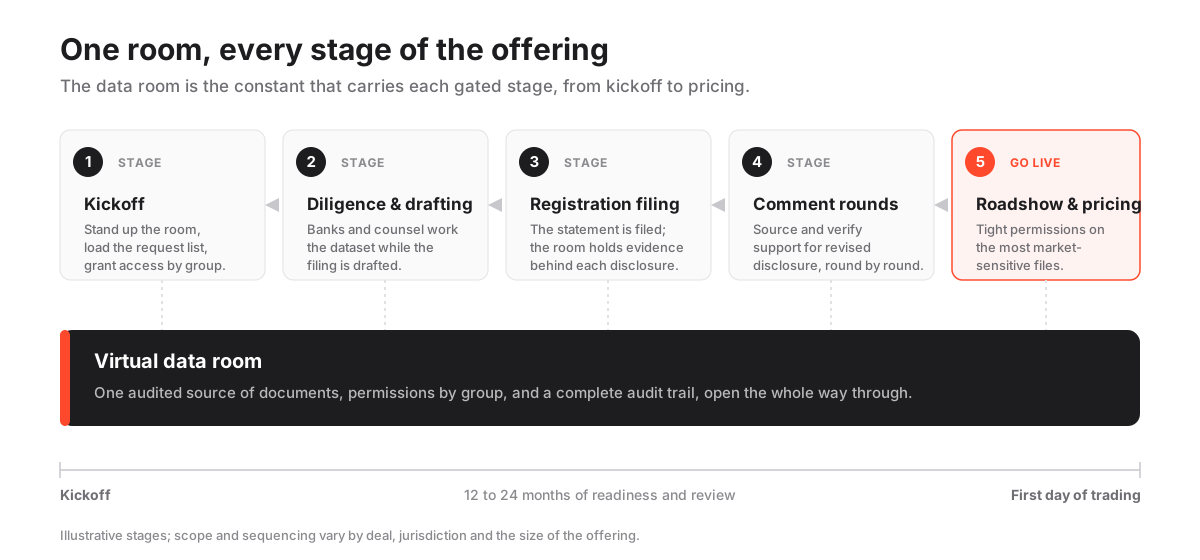
An IPO is not a single closing. It is a sequence of gated stages, and the room is the constant that carries each one.
Preparing to file commonly takes 12 to 24 months of readiness work. Once a registration statement is submitted, the regulator reviews it and issues comments over one or more rounds.
In the United States, the SEC’s staff generally aims to provide its first comments within about 30 days of a filing, per the guidance the U.S. Securities and Exchange Commission publishes for companies going public. Each comment round can send the working party back into the room to source and verify support for revised disclosure.
How an IPO data room supports each stage of the offering
The room as the working party moves from kickoff to a live offering.
Estimated time: p365d
-
Organisational kickoff
Stand up the room, load the initial document request list, and grant the working party access by group so diligence can start on day one.
-
Diligence and drafting
Underwriters and counsel work through the dataset while the registration statement is drafted, with the room as the source for every supporting document.
-
Confidential or initial filing
The registration statement is filed with the regulator; the room continues to hold the evidence behind each disclosure as review begins.
-
Comment rounds
Respond to regulator comments by sourcing and verifying additional support in the room, then updating the filing across successive rounds.
-
Roadshow and pricing
Keep the room controlled through the marketing period and quiet-period constraints, with tight permissions on the most market-sensitive files.
Because the timeline stretches across many months and several revisions, the audit trail becomes a genuine asset. It lets counsel show precisely when each supporting document was available, and to whom.
Teams that treat the log as an afterthought regret it later. Our VDR audit trails explained guide covers what a defensible log should capture, from views and downloads to permission changes.
Non-negotiable controls
Independent certification. Granular permissions. Controls that make sensitive files traceable.
An offering concentrates highly market-sensitive information, and the consequences of a leak are legal as well as commercial. Selective disclosure of material non-public information is restrained by rules such as the SEC’s Regulation FD. That is one reason the room has to segment access tightly and log every view.
At minimum, look for dynamic watermarking and view-only rendering on the most sensitive material, granular permissions that separate a syndicate bank from the lead, two-factor authentication, and a complete audit trail.
The platform under all of that has to earn trust another way, since no issuer can inspect a vendor’s code directly. Two external attestations do that work.
A SOC 2 report, produced by an independent CPA firm against the AICPA Trust Services Criteria, records that a vendor’s controls were tested in operation rather than merely described. An ISO 27001 certificate, awarded under the standard maintained by the International Organization for Standardization, confirms a documented security-management system that an outside body rechecks on a cycle.
For a process this exposed, those certifications are a floor, not a differentiator. Our VDR security features checklist sets out what else to verify, and are virtual data rooms secure covers how the underlying protections work.
Containing the most sensitive material
Wall it off from the general working party. Do not trust everyone with everything.
Some material is sensitive enough that even most of the deal team should not see it until the right moment: unreleased results, forward projections, a live pricing view.
The standard mechanism is a clean team. A small, named group gets access to a restricted folder under a specific undertaking, while everyone else works from a redacted or higher-level view. A capable room expresses this with folder-level rights, fence view, watermarking on the tightest documents, and a log that proves the wall held.
In an offering the hard part is never locking a file away. It is being able to demonstrate, long after pricing, that the circle around your most sensitive numbers stayed as narrow as the rules demanded, and that you can still name everyone who was ever inside it.
Getting this right is also a rehearsal. The habits an issuer builds around containment during the IPO, tight circles, view-only sensitive files, an unbroken log, are the same habits it will need every quarter as a public company handling material non-public information.
Whose room is it?
Usually the issuer’s. That distinction matters more than first-time teams expect.
On many offerings a bank or law firm offers to host the room on their subscription. Convenient at kickoff. But it leaves the issuer without direct control of its own diligence record, and without an easy way to carry it forward after the deal.
An issuer-controlled room costs a line item. It also keeps ownership of the audit trail, the index and the platform relationship in the company’s hands.
Running your own issuer-controlled IPO room
Pros
- You own the audit trail and the index, which stays useful long after pricing
- Permissions and the working-party structure are yours to adjust without a gatekeeper
- The room can transition cleanly into ongoing board and governance use as a public company
- No dependency on an adviser's account if counsel or the syndicate changes
Cons
- It is a direct cost the issuer carries, on top of everything else in the process
- Someone in-house has to own room administration and permission hygiene
- First-time teams may lean on advisers who already run rooms daily
Whichever way you go, agree it early and in writing. Migrating a live IPO dataset mid-process is exactly the disruption a disciplined room is meant to avoid. If a handover is unavoidable, our guide on how to migrate to a new data room covers doing it without breaking the chain of custody.
IPO room versus M&A room
It runs longer, serves more standing parties, and answers to a regulator rather than a single counterparty.
An M&A data room is often a sprint. One seller discloses to competing bidders, the process is adversarial, and the room closes when the deal signs.
An IPO room is a marathon. A fixed working party of banks, lawyers and auditors builds disclosure for the public market, and the room stays open through multiple filing and comment rounds.
The permission problem shifts. In M&A you wall bidders off from each other. In an IPO you give each advisory team its correct, persistent slice over a long engagement.
The security fundamentals carry across, though. Whether the reader is a bidder or an underwriter, the same machinery applies: rights scoped by group, watermarks on the material that must not walk, and a log that captures every open. What changes is duration, the number of concurrent teams, and the regulatory weight behind every disclosure. Teams that ran a tight investment-banking-grade room for an earlier deal usually find the muscle memory transfers.
What it costs
More than a lean fundraising room. The dataset is large and the engagement is long.
Pricing is driven by data volume, the number of users across a wide working party, and how many months the room stays live. As an order of magnitude, rooms in this tier commonly run from a few hundred to a few thousand USD per month. Some vendors bill by data volume or per page rather than a flat fee, which matters when you are loading years of financials and thousands of documents.
The main levers:
- Data volume. IPO datasets are large. Check whether storage is included or metered, and watch for per-page charges.
- User count. A wide working party needs access. Check whether users are unlimited or a cost that climbs with the syndicate.
- Engagement length. The room stays open for months. Check monthly versus per-project pricing and any early-termination terms.
- Support and setup. A long, high-stakes process benefits from responsive help. Check whether onboarding, migration and support are included.
Treat every figure as indicative and confirm current pricing with the provider. Plans and included storage change often, and the room is a small line item against the total cost of going public.
For how these levers work in general, see how much a virtual data room costs and the breakdown of per-page vs flat-rate pricing, worth understanding before you load a large dataset onto a metered plan. If document creation and secure sharing in one place is useful during the preparation phase, Ellty is one option to weigh, though the right pick depends on the scale and length of your process.
Setting it up
Start early. Structure the room the way underwriters and counsel will diligence it. Build in the discipline a long engagement demands.
The path below gets a credible IPO-readiness room live. The slow part is gathering and verifying documents, not the software.
How to set up an IPO-ready virtual data room
A first pass that gets a room ready for underwriter and counsel diligence.
Estimated time: 4h
-
Map the index to the diligence request list
Build top-level folders around the workstreams underwriters and counsel will request, financial, corporate, commercial, legal, IP and governance, before uploading anything.
-
Gather and version-control the documents
Pull audited financials, corporate records, material contracts and board minutes, using clear dated file names so nobody diligences a superseded version.
-
Model access by working-party group
Create groups for the issuer, lead and syndicate banks, each counsel team and the auditors, then assign folder rights at the group level instead of tuning each person's access by hand.
-
Apply confidentiality controls
Turn on view-only rendering and dynamic watermarking for the most sensitive files, enable two-factor authentication, and confirm the audit trail is capturing every action.
-
Invite, then run Q&A in the room
Bring the working party in by group and keep diligence questions inside the room's Q&A rather than email, so every answer is tracked and auditable.
If this is your first room, the general how to set up a virtual data room guide covers the mechanics in more depth, and running data room Q&A explains keeping a large working party’s questions orderly.
Start the index months before diligence begins. Building it early is what surfaces the gaps, an unsigned assignment, a missing board consent, while there is still time to fix them.
After pricing
It does not switch off. It transitions.
Once the offering prices and trades, the immediate diligence room can be archived. But the underlying need for controlled document sharing continues.
Newly public companies keep sharing sensitive material with their board, audit committee and advisers. Many carry that into a governance or board-portal use of the same controls.
Preserving the diligence room’s audit trail as a closed archive is prudent too, given how long questions about an offering’s disclosure can linger. If your platform will outlive the IPO, weigh that ongoing governance use when you pick one; our how to choose a virtual data room guide covers selecting for the long term rather than a single event.
Frequently asked questions
Do I really need a virtual data room for an IPO?
In practice, yes. An IPO involves a large working party of banks, lawyers and auditors reviewing a big, sensitive dataset over many months, under confidentiality rules that ordinary file sharing cannot safely honour. A data room gives you one audited source, permissions segmented by team, and a complete access log.
How long does an IPO data room stay open?
Usually months, and often longer than an M&A room. Preparation commonly runs 12 to 24 months, and once a registration statement is filed the room stays live through one or more regulator comment rounds, the roadshow and pricing. Many companies then archive it and move to a governance or board-portal use of similar controls.
How is an IPO data room different from an M&A data room?
It runs longer, serves more standing teams at once, and supports disclosure to a securities regulator rather than a sale to one buyer. The permission challenge is giving each advisory team its correct persistent slice over months, and the value of a clean audit trail rises because the output is a regulated public document.
An IPO data room is where a private company rehearses being a public one. Disciplined disclosure. Controlled access. A defensible record of every step.
Set it up early. Structure it the way underwriters and counsel will diligence it. Keep the most sensitive material inside a tight clean team. When you are ready to choose a platform that can carry a process this long and this exposed, the comparison hub and our ranking of the best VDRs for an IPO line up security, features and pricing across every provider we score.
