
How long does due diligence take?
There is a short answer and an honest one.
The short answer: four to twelve weeks for a mid-market deal. The honest answer: it depends far more on you than on the buyer’s diligence team.
Due diligence is the investigation a buyer runs before it commits. The reviewing part is fast. What stretches the calendar is everything around it. A room that fills up late. Questions that sit for days. Workstreams queued instead of stacked. And a regulator whose clock no amount of effort can speed up.
So this guide is built as a set of side-by-side comparisons. Find the row that matches your deal and read across.
The timeline at a glance
Start with the ranges. The table below is the fastest way to place your deal on the map before we pull each factor apart.
| Deal profile | Diligence window | What sets the pace |
|---|---|---|
| Seed / angel investment | 1-3 weeks | Light review, a data room and a few reference checks |
| Series A / B venture round | 2-6 weeks | Cap table, financials, key contracts, IP ownership |
| Small-business acquisition | 3-6 weeks | Quality of earnings and a clean contract set |
| Mid-market M&A | 4-12 weeks | Multiple workstreams, Q&A volume, financing conditions |
| Private equity buyout | 6-16 weeks | Deep commercial and QoE work plus financing diligence |
| Cross-border or regulated deal | 3-6 months+ | Antitrust or sector approval, multi-jurisdiction legal review |
Two rules travel with this table. Smaller and more familiar means shorter. Regulated, cross-border or carve-out-shaped means longer, and those factors do not add up. They multiply.
There is also a distinction people blur. Due diligence is the investigation phase. The wider deal lifecycle, from signed letter of intent to legal close, wraps diligence inside negotiation, documentation and any regulatory approval.
So when an adviser says “three to six months to close”, that is the whole arc, not diligence alone. Getting the two clocks straight kills a lot of misplaced anxiety about a review that is actually right on schedule.
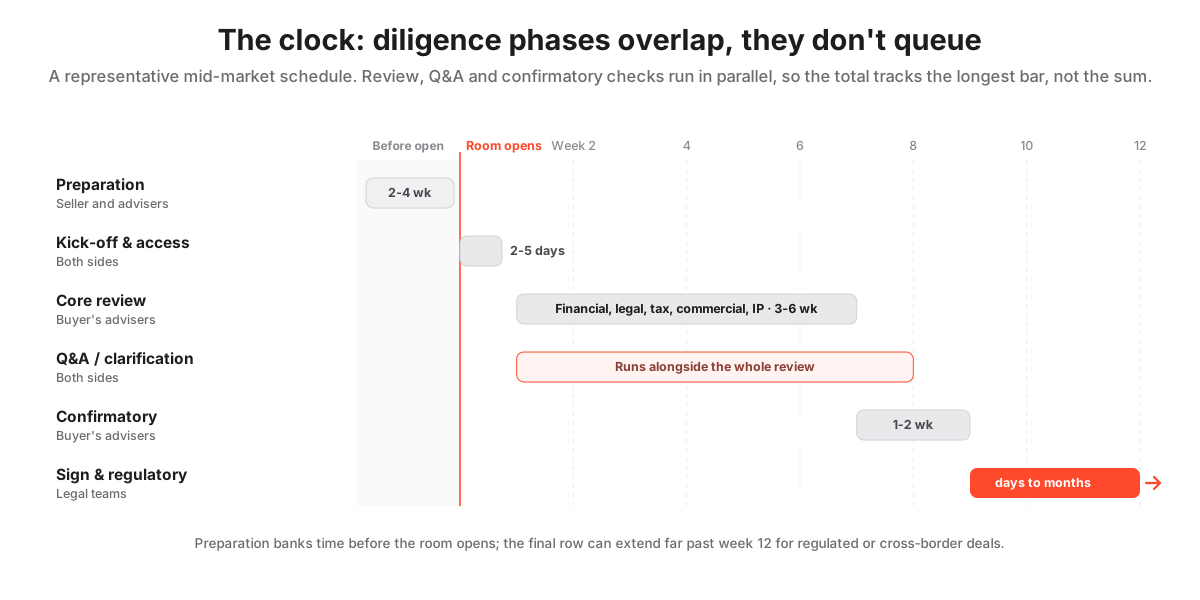
The diagram makes the central point visually. The bars overlap. Total time tracks the longest bar, not the sum of them. Everything below is really one argument: keep those bars parallel.
Phase versus phase
Diligence is not one block. It is a sequence of overlapping phases, each moving at its own pace. Here is how a healthy mid-market deal spends its weeks.
| Phase | Who leads | Typical duration | What has to happen |
|---|---|---|---|
| Preparation | Seller and advisers | 2-4 weeks, before open | Build the index, gather and redact documents, set permissions, brief the team |
| Kick-off and access | Both sides | 2-5 days | Grant reviewer groups, agree the Q&A protocol, confirm checklist scope |
| Core review | Buyer’s advisers | 3-6 weeks | Financial, legal, tax, commercial and IP workstreams examine the room in parallel |
| Q&A and clarification | Both sides | Runs alongside review | Questions logged, routed to owners, answered against the clock |
| Confirmatory diligence | Buyer’s advisers | 1-2 weeks | Final checks, updated financials, closing conditions |
| Sign and regulatory | Legal teams | Days to months | Documentation finalised, any antitrust or sector approval obtained |
Read that table the wrong way and you picture six blocks stacked end to end. That is the trap.
Core review, Q&A and confirmatory checks interleave. A seller who hands over one workstream at a time, relay-race style, turns a six-week process into a four-month one without ever deciding to.
Now stare at the preparation row. It happens before the room opens, before the clock the buyer sees even starts. It is where a disciplined seller banks most of the eventual saving. Deals where the seller opens a complete, well-organised room move roughly twice as fast as deals where documents dribble in on request.
Workstream versus workstream
Zoom in and the “core review” bar splits into parallel lanes. They do not finish together, and knowing which ones run long lets you sequence the rest around them.
| Workstream | Typical duration | Runs in parallel | Usual bottleneck |
|---|---|---|---|
| Financial / quality of earnings | 3-6 weeks | Yes | Adjusted earnings, working capital, revenue concentration |
| Legal | 3-6 weeks | Yes | Material contracts and change-of-control clauses |
| Tax | 2-4 weeks | Yes | Prior positions and multi-jurisdiction filings |
| Commercial | 2-5 weeks | Yes | Customer references and pipeline validation |
| Corporate / cap table | 1-2 weeks | Yes | Undocumented share transfers or option grants |
| IP and technology | 1-3 weeks | Yes | Confirming the company, not a founder, owns core IP |
Financial and legal are the longest poles in the tent. Corporate and IP checks are quick when the paperwork is clean, and painful when it is not.
Because these lanes run together, the total sits closer to the longest single workstream than to their sum. That is exactly why one missing folder is so expensive.
A gap in a single lane does not just delay that lane. It can hold the entire close, because a buyer rarely signs with a known gap open. That is why the folder structure and permissions you set before opening matter out of all proportion to the effort they take. Get them right and every lane stays unblocked at once. Get them wrong and one stalled folder freezes everything downstream.
Speeds it up versus slows it down
Most delay is self-inflicted, and it lands on your side of the table. The useful way to see this is two columns: the moves that pull time out, and the habits that put it back in.
Pulls time out of the review
- A complete, indexed room that is open on day one, not filling as it goes.
- An index built from the buyer’s checklist, so reviewers find each document where they expect it.
- Group-level permissions, so a new adviser starts reviewing in minutes.
- Pre-answered obvious questions: revenue concentration, key-person risk, change-of-control clauses.
- A named owner and a response deadline for every Q&A workstream.
Puts time back in
- A disorganised or half-empty room that signals bigger problems and invites deeper probing.
- Questions that sit unanswered for days while nobody owns the reply.
- Workstreams run one after another instead of together.
- Missing or unsigned key contracts discovered mid-review.
- Buyer financing that is not yet secured, surfaced late instead of early.
Now sort those same bottlenecks by who controls them and whether preparation removes them. A pattern jumps out.
| Bottleneck | Seller-controlled | Fixable before open | Delays the whole deal |
|---|---|---|---|
| Disorganised or incomplete data room | Yes | Yes | Yes |
| Slow answers to bidder questions | Yes | Partly | Yes |
| Workstreams run in sequence, not parallel | Yes | Yes | Yes |
| Missing or unsigned key contracts | Yes | Yes | Yes |
| Buyer’s financing not yet secured | No | No | Yes |
| Regulatory or antitrust review | No | Start early | Yes |
Nearly everything you control is also fixable before the room opens. That overlap is the whole argument for front-loading the work.
Slow Q&A is the one seller-side item you cannot fully pre-empt, because you do not know the questions yet. But you can shorten it hard by assigning owners and a deadline in advance. The two rows outside your control, financing and regulatory review, are precisely the ones to surface and de-risk early rather than discover late.
Regulated versus unregulated
Here the two clocks pull apart completely. You can run a flawless four-week diligence process and still wait three months on a regulator, because the approval clock is set by law, not by how fast your team works.
| Factor | Unregulated deal | Regulated / cross-border deal |
|---|---|---|
| Clock that governs close | Commercial review only | Commercial review plus a mandatory approval window |
| Who controls the pace | Mostly the seller’s preparation | Partly a regulator, on a fixed statutory timeline |
| Typical extra time | None | Weeks to many months |
| Can effort compress it | Yes | No, only early filing helps |
| Documents to stage early | Standard checklist | Plus market-share and competitive-overlap material |
The mechanics are concrete. In the United States, deals above a size threshold trigger a filing under the Hart-Scott-Rodino Act and an initial 30-day waiting period before the parties may close, a rule administered by the US Federal Trade Commission. If regulators open a “second request”, that timeline can stretch by many months.
The European Union runs a similar two-stage regime. The European Commission has 25 working days for its initial Phase I merger review, extending to a 90-working-day Phase II investigation when a deal raises competition concerns. Sector rules add further reviews in healthcare, financial services and defence.
The planning lesson is blunt. Treat regulatory approval as a parallel, largely fixed cost you cannot work off. Start the filing early. Keep the antitrust workstream out of the critical path of commercial review. Make sure the room already holds the material regulators will ask for.
If your deal has a data-protection dimension, the same discipline applies to privacy diligence under regimes like GDPR, covered in our guide to GDPR and virtual data rooms.
Confirmatory versus full diligence
Many deals contain both, and they sit at opposite ends of the range. Confirming what you already believe is fast. Building the belief from scratch is not.
| Confirmatory diligence | Full diligence | |
|---|---|---|
| Purpose | Verify the picture still holds | Build the picture in the first place |
| When it runs | Buyer knows the target, or between sign and close | Unfamiliar target, before signing |
| Typical duration | 1-2 weeks | 4-12 weeks |
| Scope | Narrow, focused on what changed | Broad, every workstream |
| Trigger for delay | A material change since signing | Any gap in any workstream |
A confirmatory review is common when a buyer knows the business well or is topping up an earlier round. It can close in one to two weeks. Full diligence on an unfamiliar target is the four-to-twelve-week exercise the ranges describe.
If your deal splits sign and close by weeks or months, budget for a second short window. An initial full review runs before signing, then a brief confirmatory pass verifies nothing material changed before closing, for instance updated management accounts or a newly signed contract.
Assume the review ends at signing and that second pass will ambush your calendar.
What an overrun costs
Time in a deal is rarely neutral. Every extra week the room stays open is another week for the buyer to find a reason to pay less.
The longer a room stays open, the more time a buyer has to erode the price, and the higher the chance that trading numbers, financing terms or market conditions move against the seller before signing.
The specific risks of a slow process cluster into a short, predictable list:
- Re-trading: a buyer who uncovers a gap late, or simply loses momentum, reopens price and terms already thought settled.
- Exclusivity expiry: many letters of intent grant a fixed exclusivity window; overshoot it and leverage swings back to the seller, but the deal can also stall.
- Deal fatigue: enthusiasm on both sides has a half-life, and a review that grinds on for months is the classic way a live deal quietly dies.
- Information leakage: the longer sensitive documents circulate, the greater the risk a competitor, employee or the market learns of the process.
- Management distraction: every week the founders spend answering questions is a week not spent running the business, which can dent the very numbers the buyer is diligencing.
None of this argues for cutting corners. It argues for finishing on time, which is a preparation problem, not a shortcut.
Room versus room
A virtual data room shortens diligence by more than most first-time sellers expect, and not because of the storage. The saving comes from the workflow: parallel review, structured Q&A, and visibility into where bidders are stuck. Match the tool to the deal, not the deal to the tool.
| Heavyweight platforms | Leaner rooms | |
|---|---|---|
| Example providers | iDeals, Datasite | Ellty and similar |
| Built for | Large, high-Q&A, multi-bidder processes | Smaller deals live and searchable fast |
| Strength | Depth of Q&A, granular controls, scale | Speed to open, simplicity, lower cost |
| Best-fit deal | Cross-border, PE, regulated | Seed, venture, small-business M&A |
| Watch-out | Setup overhead on a small deal | Fewer controls on a very large process |
Three features do the real work, whichever tier you pick. Bulk upload and full-text indexing turn a week of manual organisation into an afternoon. Group-level permissions let a new adviser start the moment they are invited, with no bespoke setup. And a structured Q&A workflow keeps every question, owner and answer in one auditable thread through the Q&A module, so nothing stalls in an inbox. An engagement heatmap then shows which folders bidders are stuck in, so you fix a blind spot before it becomes a delay.
Each of those removes a specific source of delay: sequential access, lost questions, and not knowing where attention is going. For a wider view of the field, our ranking of the best VDRs for M&A scores each provider on setup speed, Q&A and security, and how to choose a virtual data room walks the trade-offs in full.
The five moves that pull weeks off the clock
Everything above points the same direction. The fastest processes are won before the buyer arrives. These are the preparation steps that move the timeline most, done before the first bidder is invited.
How to shorten a due diligence timeline as a seller
The preparation that reliably compresses a review, done before the first buyer is invited.
Estimated time: p21d
-
Build the room from the buyer's checklist
Structure your index to mirror a standard due diligence checklist, so reviewers find each document exactly where they expect it. Match the folder logic to the diligence checklist rather than to your internal filing system.
-
Gather and redact before you open
Collect every document, redact personal and commercially sensitive data, and resolve missing signatures now. A room that fills up mid-review signals disorganisation and invites deeper questions.
-
Set permissions by group, not by person
Create reviewer groups for legal, financial and commercial teams and grant folder-level rights up front, so onboarding a new adviser takes minutes, not a renegotiation.
-
Pre-answer the predictable questions
Write a short cover memo for the folders buyers always probe: revenue concentration, key-person risk, change-of-control clauses. Answering early kills whole rounds of Q&A.
-
Assign Q&A owners and a response clock
Name a person accountable for each workstream and set an internal turnaround target for questions. Slow answers are the most common avoidable delay in any deal.
None of the five is technically hard. They are organisational, and they compound. A room built from a solid data room index makes permissions simpler, which makes Q&A faster, which shortens the review.
Starting cold? How to set up a virtual data room covers the mechanics, data room index best practices gives the folder logic, and the due diligence checklist gives you the index to build against.
One trade-off is worth naming so you time the work well. Front-loading buys a review that runs weeks not months, fewer bidder questions, a stronger negotiating position with no last-minute gaps to re-trade on, and a clean audit trail that regulated buyers expect. Against that: real upfront effort before you know a buyer is serious, documents that can go stale if the process slips and need refreshing, and an over-disclosure risk if permissions are set loosely. Stage access deliberately and the downside all but disappears.
The verdict
Stop treating diligence duration as a fixed cost handed down by the buyer. It is a variable, and most of the variance is yours.
The review itself is rarely the constraint. Preparation, question turnaround, and any external approval decide the pace, and two of those three sit squarely in your hands. Build the room from the checklist. Staff the Q&A with named owners and a clock. Start the regulatory filing early and keep it off the critical path. Do those three things and a process that could have sprawled across months settles into a matter of weeks.
Then pick the tier of room that fits the deal, not the biggest one on the market. A seed round does not need a platform built for cross-border carve-outs, and a regulated buyout is not the place to economise on Q&A controls. Match the tool to the shape of the deal and the timeline follows.
Frequently asked questions
How long does due diligence take for a small acquisition?
For a small-business or confirmatory acquisition where the buyer already knows the target, due diligence often finishes in two to three weeks. The pace depends almost entirely on whether the seller's data room is complete and indexed when the buyer arrives. A room that fills up mid-review is the most common reason a small deal drags.
Why does due diligence take so long sometimes?
Most avoidable delay comes from the seller side: a disorganised or incomplete data room, slow answers to bidder questions, and workstreams run one after another instead of in parallel. External causes like unsecured financing or a regulatory review add time you cannot compress by working harder, which is why experienced teams start those clocks early.
Can due diligence be done faster?
Yes. The biggest lever a seller controls is preparation: open a complete, well-indexed room built from the buyer's checklist, pre-answer the predictable questions, and assign owners with a response deadline for Q&A. Sellers who do this routinely halve the elapsed time of a review without cutting any corners on scope.
How long is due diligence after a letter of intent?
The letter of intent usually marks the start of exclusive, in-depth due diligence, which then runs the typical four to twelve weeks for a mid-market deal. The wider timeline from letter of intent to legal close is longer, commonly three to six months, because it also covers final negotiation, documentation and any regulatory approval.
Does a data room speed up due diligence?
It does, mainly by enabling parallel review, structured Q&A and clear permissions rather than by storage alone. Multiple buyer teams can review at once, questions stay in one auditable thread instead of email, and new advisers start immediately. Providers vary, so match the platform's Q&A and setup speed to the size and complexity of your deal.
