
What is a data room index and why it matters
On this page
- The index is the first thing a stranger reads about your company
- Why retrieval speed, not file count, is the number that matters
- What actually lives inside an index
- Why an index is not the same as a folder structure
- The index sets the tempo of diligence
- How to build one, and why the order is everything
- What the software owns, and what stays yours
- What a weak index actually costs
- Does the platform change the index? Less than its marketing implies
Early in every serious deal, someone from the other side logs into your data room for the first time. The thing they meet is not a document.
It is the index. The column of numbered folders down the left of the screen, quietly promising that everything a reviewer needs is here, arranged in an order a stranger can follow.
Most guides rush past that moment to reach the mechanics: naming templates, decimal numbering, the filing chores. Slow down instead. That first screen does more work than any single file behind it, and understanding why is the difference between a room that earns trust and one that leaks it from the opening minute.
The index is the first thing a stranger reads about your company
Picture the buyer’s lawyer when your room opens. They do not know your business yet. They have a checklist, a deadline, and a screen full of folders.
Within seconds, they form an impression that is almost impossible to reverse. Either this is a well-run process, or it is going to be a slog. That verdict is not built on any document, because they have not opened one. It is built on the structure, the labels, and the order. It is built on the index.
A data room index is the ordered map of every folder and file in a virtual data room, numbered and grouped so its shape mirrors the buyer’s due-diligence checklist. In that sense, it is the closest thing a deal has to a first handshake.
Think of the printed deal book of the paper era, with its tabbed dividers and its typed table of contents up front. The tabs told a reviewer where a section began; the contents page showed the whole shape at a glance.
The modern index does both jobs at once. It renders as a live, collapsible outline that the software builds from the way you arranged your files, so the contents page is never stale and the tabs sit exactly where the folders are. What changed is not the purpose but the stakes. A paper deal book sat in one room and was read by a handful of people over weeks. A data room is opened by every reviewer on every side, at any hour, from anywhere, and each of them forms the same snap judgement alone.
Two ideas hide inside the definition, and pulling them apart explains most of what follows.
The first: an index is a map, not a pile. It imposes a deliberate order, corporate first, then financial, then legal, and down a logical spine, rather than listing files in the accidental sequence they were uploaded.
The second is subtler. An index is a contract of expectation. When a reviewer reads a section that is numbered and labelled, they expect the documents inside to match the label. A mismatch is worse than an empty folder. A gap merely signals unfinished work; a mislabelled section teaches a reviewer to distrust every other label in the room. The index is what turns a heap of files into a record instead of a shared drive, and the promise it makes is one you keep folder by folder.
Why retrieval speed, not file count, is the number that matters
Watch how a reviewer actually measures your preparation, and the weight of the index makes sense.
They do not count your files. Volume does not impress them. A room stuffed with a thousand documents is not more credible than one with two hundred, and it may be less so if the extra bulk is duplication and noise. What they measure, minute by minute, is retrieval speed: the time it takes to jump from a line on their checklist to the folder that answers it.
When that jump is instant, when a request drops them straight into a folder whose label plainly matches, your side reads as people who know exactly where their own documents live.
When they have to hunt, resubmit the same question twice, or find a key contract filed under the wrong heading, the doubt does not stay contained. It spreads to the business behind the room. A buyer who cannot navigate your files quietly starts to wonder what else about the company is a mess. That is precisely the thought you cannot afford while someone is deciding what you are worth.
That is the outward half of the job. The inward half gets far less airtime and matters just as much. On the sell side, the index is your instrument panel, the surface from which you run the room.
It is how you assign granular permissions by folder, handing a commercial reviewer their section while walling off the sensitive personnel files until a later round. It is how you track completeness against the diligence list, so the empty sub-folders stand out as a visible to-do list instead of hiding as an omission you discover only when a bidder asks.
And it is how a small team keeps pace at all. A busy mid-market room can hold several thousand documents, and the gap between a two-person crew staying ahead of the questions and one drowning in them is very often nothing more than whether the structure lets them find things as fast as the reviewers do. A well-kept index answers “what still needs to go in?” before anyone on the other side gets to ask, and that head start is worth more than any single feature a platform can advertise.
What actually lives inside an index
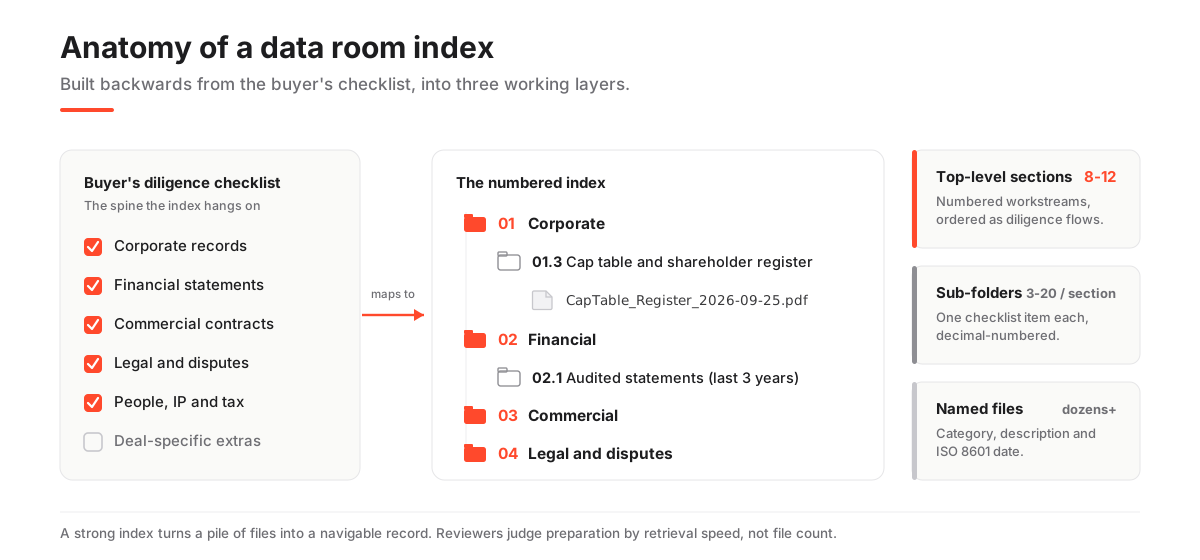
Under the single word “index” sit three working layers. Seeing them separately is the fastest way to grasp why the structure is not arbitrary.
At the top are the sections: a shallow set of roughly eight to twelve numbered categories that name each workstream and follow the order diligence naturally flows. Corporate, financial, commercial, legal, people, intellectual property, tax, and whatever else the deal demands. These serve the lead adviser routing each reviewer to their area, and their whole virtue is that a stranger takes in the entire top level in one glance.
Below the sections sit the sub-folders. Each maps to a single line of the checklist and is numbered decimally under its parent, so 03.2 and 03.2.1 tell a reviewer exactly where they are and how deep. These serve the specialist verifying one narrow question who needs the answer without opening five folders to find it.
At the bottom are the files themselves. Named by category and description, dated in a consistent pattern so they sort in reading order rather than in the scramble of upload time. These are what every reviewer touches and what the audit trail silently logs.
The exact taxonomy shifts with the transaction, and it should. A fundraising round compresses the legal and tax sections a full acquisition would expand. A real estate deal pulls property, title and lease documents into their own numbered blocks that a software acquisition would never need. So the layers are a skeleton, not a template. The discipline lies in matching your sections to the buyer’s checklist rather than to any list you found online, including this one.
One convention is worth locking down before you touch a single folder, because it is genuinely hard to reverse once bidders are inside: the date format.
Name your files with an ISO-style date, 2026-09-25, not a locale-specific one. Two useful things happen at once. The files sort chronologically on their own, and you kill the ambiguity of a date like 09/10, which means one month to a reviewer in New York and a different month to a reviewer in London. In a cross-border room, that single rule prevents a surprising amount of confusion, and unlike most naming decisions it is painful to change halfway through. Get it right at the start.
A working index reads almost like a sentence. A reviewer scans the numbered spine, recognises their workstream at once, and drills straight in without a click of guesswork. The sample below shows the common acquisition shape, with one representative sub-folder and its primary reader under each heading. Keep the table light and read it for the pattern, not the specifics, because the value is in seeing how each section points to a person and a question.
| No. | Section | Representative sub-folder | Primary reviewer |
|---|---|---|---|
| 01 | Corporate | 01.3 Cap table and shareholder register | Corporate counsel |
| 02 | Financial | 02.1 Audited statements, last three years | Financial due-diligence team |
| 03 | Commercial | 03.4 Top-20 customer contracts | Commercial and strategy lead |
| 04 | Legal and disputes | 04.2 Litigation and threatened claims | Litigation counsel |
| 05 | People | 05.1 Key employee agreements | Employment counsel |
| 06 | IP and technology | 06.3 Registered trademarks and patents | IP specialist |
| 07 | Tax | 07.2 Corporate tax filings and rulings | Tax adviser |
Notice what the skeleton refuses to do as much as what it does. It does not nest six levels deep, and it does not sort documents by whoever happened to supply them.
Depth is the most common way a well-intentioned index goes bad. Every extra level feels like tidiness to the person building it and reads like a maze to the person navigating it. If a reviewer has to expand four folders to reach a single agreement, the index has stopped being a map. The fix is almost always to flatten the tree and let full-text search carry the long tail rather than bury documents in ever-finer sub-folders. Shallow and searchable beats deep and precise, every time, because the reviewer’s patience runs out long before your taxonomy does.
Why an index is not the same as a folder structure
It is easy to treat “index”, “folder structure” and “table of contents” as three words for one thing. In casual talk, nobody minds. The distinction is worth holding, because it explains why a room full of correctly named files can still fail.
The folder structure is the physical arrangement of directories, the literal tree of nested folders on the platform. The table of contents is the human-readable summary of what the room holds, the thing a person reads to understand the shape. The index is the numbered system that binds the two together, giving every folder and file a stable address that people and permissions can point at, so “section 04.2” means the same thing to a reviewer, to the seller, and to the access rules governing who may open it.
A good data room collapses all three into one artifact, which is why the software renders your table of contents automatically from your folders. But the fact that they usually arrive fused should not hide that they are three different jobs. Understanding that is what lets you see why an unstructured file dump fails even when every required document is technically present.
The failure of the dump is not missing documents. Very often they are all there.
The failure is that identical files, sitting in a room with no index, produce a completely different experience. A reviewer cannot find a document without asking. The arrangement does not map to their checklist. Files sort by upload date instead of any logical order. Permissions have to be granted painfully file by file rather than by section. The seller cannot see completeness at a glance. And the buyer, taking all of that in, reads it as a poorly run process regardless of how complete the underlying record actually is.
The documents are the same. The index is the entire difference between a navigable record and a pile that happens to contain the right things. That gap, between having the files and having them findable, is the whole reason the index earns its attention, and it is why “we uploaded everything” is never the same claim as “we prepared the room”.
The index sets the tempo of diligence
Once bidders are inside, the index quietly decides how a reviewer’s hours are spent: how much goes to reading versus searching. That split shapes the tone of the entire process.
When a buyer’s due-diligence checklist lines up cleanly with your section numbers, each reviewer works their own workstream in parallel, and the questions that come back arrive as substance rather than logistics. Instead of “where is the shareholders agreement?”, you get “clarify this clause in the shareholders agreement”. That shift is the whole point of good structure. A navigation question makes you look disorganised at exactly the wrong moment; a content question moves the deal forward. An index that turns the first kind of question into the second is doing more for the transaction than any single document in the room.
A room where every reviewer has to ask where things are is not a data room. It is a help desk, and every ticket is a chance to look unprepared at exactly the moment you cannot afford to.
There is a bandwidth argument here too, and it cuts closest for the small teams who most need the help. The question-and-answer workflow that runs alongside a data room drowns the moment reviewers cannot serve themselves, because every misfiled or unfindable document becomes a ticket a human on your side has to receive, interpret, hunt down and answer, often more than once.
A clean index is the cheapest possible way to keep that queue short. And a short queue is precisely what lets a two-person deal team run a genuinely competitive process without falling behind the questions. The link between structure and speed is not decorative; it is mechanical. Shorten the search and you shorten the deal, because every hour a reviewer does not spend hunting is an hour they spend evaluating, and a deal that is evaluated quickly is a deal that closes.
How to build one, and why the order is everything
Here is the single most important thing about building an index: you build it backwards. From the buyer’s checklist, not forwards from the files you happen to have on hand.
You write the structure first, decide where every kind of document belongs, and only then start uploading. That feels counterintuitive to anyone whose instinct is to get the files into the room and sort them out later.
That instinct is the trap. Teams who upload first and organise afterwards almost always end up re-filing hundreds of documents, because the shape that felt natural while dumping files rarely matches the shape a reviewer reads in. The cost of fixing it lands on a live tree where every change is an afternoon of drag-and-drop, rather than on a checklist where a change is a line of text. The path below is short, but the value is entirely in doing the steps in order.
How to build a data room index
The conceptual path from a blank room to a navigable, checklist-mapped index.
Estimated time: 2h
-
Start from the diligence checklist
List the questions a buyer will ask, grouped by workstream. The checklist is the spine the index hangs on, so build it before you touch a single folder.
-
Draft the top-level taxonomy
Turn each workstream into a numbered top-level section (01 corporate, 02 financial, and so on), keeping the level shallow and ordering it the way diligence actually flows.
-
Break sections into checklist-sized sub-folders
Give each checklist item its own decimal-numbered sub-folder so a reviewer can go straight from list item to folder without guessing.
-
Map documents and mark the gaps
Place every file you have, then flag the empty sub-folders. Those gaps are your upload to-do list and a preview of the questions a bidder will ask.
-
Name files consistently and freeze the index
Apply one naming pattern with ISO-style dates, then lock the structure once bidders are inside so that numbered references stay stable through the deal.
Want the exact naming templates and the full decimal numbering scheme? There is a deeper companion piece in the index naming and numbering guide. And if you would rather start from something than a blank screen, the folder structure template gives you a ready skeleton to adapt to your own deal.
If your uncertainty is less about structure and more about which documents belong in each section, the document checklist guide pairs naturally with this one and answers the “what goes in” question that the taxonomy assumes you have already settled.
The point of building the structure before the upload is not neatness for its own sake. It is that thinking done on the checklist is cheap, and thinking done on a live tree, with bidders watching, is expensive. The whole discipline is really just a way of moving the hard decisions to the moment when they cost the least.
What the software owns, and what stays yours
A fair question by now: how much of this does the platform simply do for you? The honest answer is that the division of labour is clean once you see it.
Every modern data room auto-generates the visible index from your folder tree, renders it as a numbered, collapsible outline, and keeps it in sync as you add and move files. Nobody hand-maintains a separate contents page. Nobody renumbers anything by hand when a folder shifts. That is the software’s half, and it is genuinely valuable, because keeping a table of contents current is exactly the kind of tedious, error-prone bookkeeping machines should do.
What the software cannot do, and no feature list ever will, is decide the taxonomy, write file names a stranger can read, or judge whether your structure matches the mental model a buyer brings to the room. The rendering and the re-numbering belong to the platform. The judgement belongs to you, and the judgement is the part that decides whether the room works.
That division is also why the choice of platform still matters for indexing, even though every tool “has an index”. The features that decide whether a clean index is cheap to maintain or a constant fight are fairly specific: bulk upload with sensible auto-numbering, drag-to-reorder that does not break your references, full-text search strong enough that you can keep the tree shallow, and permissions you can set at the folder level rather than clicking through file by file.
Check those before you commit. Retrofitting structure into a room that fights you at every step is far more painful than choosing a tool that makes structure effortless from the start. Entry pricing across the category tends to begin around ninety-nine US dollars a month for lean rooms and climb to custom enterprise quotes for large, heavily permissioned deals. Any figure like that is indicative rather than fixed, so confirm current pricing directly with the provider or compare the published tiers side by side on our pricing overview before you plan around a number.
What a weak index actually costs
Be concrete about the price of getting this wrong, because a poor index is expensive in ways that never appear on an invoice and are therefore easy to underrate.
It slows diligence. Reviewers spend hours searching where they should be reading, and a slow diligence gives a hesitant buyer more time to talk themselves out of the deal.
It multiplies the Q&A load. Every misfiled document becomes a manual question someone on your side has to answer, often while three other reviewers wait.
And it plants doubt, the most expensive cost of all. A buyer who cannot navigate your room starts to generalise from the mess in front of them to the business behind it, and that suspicion is exactly the frame you least want a buyer holding while they decide what your company is worth. The single most common mistake, worth naming plainly, is not a missing document. It is a document filed by upload date or by whoever supplied it rather than by the checklist a reviewer follows. The rest of the ways rooms go wrong are catalogued in the guide to data room mistakes to avoid.
There is a governance layer on top of the deal-hygiene one, and it shows up the moment anyone needs to reconstruct who saw what. The audit trail that records who opened each file is only as trustworthy as the structure around it. When documents are misfiled or quietly duplicated across two folders, a question as basic as “who accessed the employment contracts” becomes genuinely unanswerable, because the contracts were never in one addressable place to begin with.
Keeping information organised and access controllable is a core expectation of the recognised information-security standards that buyers increasingly ask about, and a coherent index is part of how a room lives up to that expectation in practice rather than just on a certificate; the logging layer that makes it real is covered in the audit trails guide. A tidy index is not only a courtesy to reviewers. It is what makes the room’s own records mean anything after the fact.
Does the platform change the index? Less than its marketing implies
When comparing tools, it is tempting to believe a more expensive or better-known platform will produce a better index. That belief is worth dismantling, because it is almost exactly backwards.
The software does not change what belongs in the index. The corporate section holds the same documents whether you are on the priciest enterprise suite or a lean challenger. What the software changes is how much effort a clean index costs to build and hold. A room with strong bulk upload, reliable auto-numbering and true folder-level permissions lets a two-person team keep a large, tidy index almost without thinking about it, while a clumsy tool turns the identical job into a weekend of manual re-filing.
When you weigh options, put indexing ergonomics on the scale alongside security and price rather than treating it as an afterthought. Read the hands-on notes in our provider reviews, from established names like iDeals and Datasite through to modern, full-featured rooms such as Ellty, to see how each one actually handles structure once a room fills up. If you want two of them held against each other on exactly these points, the iDeals versus Datasite comparison is a useful place to start.
The blunt conclusion, and the one worth carrying away: indexing discipline outranks brand. The best-organised room on a mid-tier platform beats a sloppy room on the most expensive tool in the category every single time, because the reviewer never sees your logo and never learns what you paid. They see your structure, and they judge you by it.
That is oddly liberating. The thing that most shapes a buyer’s confidence is entirely within your control and costs nothing but discipline to get right. If you would rather skip straight to the platforms that make that discipline cheapest for document-heavy, diligence-heavy transactions, our best rooms for due diligence shortlist is scored on precisely this: how easily a clean index stays clean when the deal gets busy.
Step back far enough and the data room index reveals itself as a small artifact with wildly outsized influence over a transaction. It is read before your financials, judged faster than your pitch, and remembered longer than most of the documents it points to.
Get the structure right and it recedes into the background and quietly does its job, letting reviewers move through diligence at speed and letting your side field questions of substance instead of directions. Get it wrong and no amount of good content fully recovers the first impression, because the impression was formed on the folders before anyone reached the content.
If you are setting up a room now, pair this with the full setup guide and the deeper naming and numbering system, then compare the platforms that make a tidy index easy to keep. The one thing a stranger judges you by should be the one thing you have already gotten right.
