
Virtual data rooms for real estate transactions
On this page
- The deals that actually use a real estate data room
- 1. Single-asset sales and acquisitions
- 2. Portfolio and fund transactions
- 3. Development and construction finance
- 4. Real estate fundraising and JV formation
- 5. Refinancing and loan servicing
- 6. Asset and property management handover
- What goes in the room: the document set
- Leases are not documents; they are the asset
- Abstracts and estoppels earn their keep
- The finance folder is the one to fence off
- Environmental reports move lenders and insurers
- Real estate vs M&A: where the room differs
- Segmentation is the property-specific stress test
- The document mass skews larger and heavier
- The takeaway: configuration, not a niche tool
- How to set up the room, step by step
- Step two is where professional rooms are made
- Permission last, never first
- The Q&A and disclosure process
- Questions attach to documents, not inboxes
- Routing by category keeps advisers in their lane
- Answers publish to one group only
- The audit trail ties answers to versions
- Security and compliance: the points that matter for property
- Personal data is baked into the document set
- GDPR applies whenever Europe is in the deal
- Certifications you can verify beat claims you cannot
- The trade-off, weighed honestly
- What a real estate data room costs
- The entry point: around $99 a month
- The middle: low-to-mid hundreds per month
- The top: custom quotes
- The one cost trap to watch: per-page pricing
- The mistakes that quietly cost you leverage
- How to choose a VDR for real estate
- 1. Permission depth (weight it first)
- 2. Document handling
- 3. Security certification
- 4. Pricing model
- Where the providers land
Real estate still runs on paper, or at least on the digital ghost of it. One commercial building sale can carry hundreds of leases, decades of title history, environmental surveys, zoning permits, loan documents and years of tenant correspondence.
A buyer and its lenders have to read all of it before they wire the money.
A virtual data room turns that pile into one searchable, permissioned space. This guide walks the whole thing, built to scan: which deals use a room, exactly what goes in it, how property diligence differs from corporate M&A, how to stand a room up, what it costs in USD, and the mistakes that quietly cost sellers leverage.
The deals that actually use a real estate data room
Not every property transaction needs a room. A single flat sold between two people with one lawyer each does fine on email.
The threshold is roughly this: more than one professional adviser per side, or an asset valuable enough that a leak or a disclosure gap would hurt. Above that line, a room earns its keep fast. Here are the six scenarios where one shows up most.
1. Single-asset sales and acquisitions
An office, a retail park, a hotel or a logistics shed changes hands. The buyer’s lawyers review title and leases, its surveyor reads the condition report, and its lender underwrites the income. Everyone works from the same folders instead of chasing attachments.
This is the bread-and-butter case, and the fastest to set up. One asset, one bidder group, a clean index.
2. Portfolio and fund transactions
A landlord sells dozens or hundreds of assets at once. Now the room has to do something harder: segment documents asset by asset, and keep competing bidders from seeing each other.
Group isolation stops being a nice-to-have here; it is the whole point. A bidder who can infer who else is at the table has gained pricing information the seller never meant to give away.
3. Development and construction finance
A sponsor raises debt or equity for a scheme that does not exist yet. The room holds planning consents, build contracts, cost plans, drawdown schedules and the development appraisal, shared with lenders and equity partners over a long, staged process.
These rooms live longer than a sale room, and that matters for cost. A monthly fee that looks fine for a 60-day sale adds up across an 18-month build.
4. Real estate fundraising and JV formation
A manager courts limited partners, or two parties form a joint venture. The room carries the investment thesis, the model, the legal structure and the track record.
The audience is investors, not buyers, but the access pattern is identical.
5. Refinancing and loan servicing
A borrower hands a new lender the asset and covenant documents needed to underwrite a facility. Smaller than a sale, but the same disclosure discipline applies, and the finance folder is the star of the show.
6. Asset and property management handover
Management of a building or portfolio moves to a new operator, and the full document record moves with it. Less glamorous than a sale, but a room makes the handover auditable.
The common thread across all six: a group of outsiders needs deep access to sensitive records for a fixed window, then no access at all once the deal closes. That exact pattern is what a data room is built to control, and exactly what email and shared drives handle badly.
What goes in the room: the document set
A property room is organised around the asset, not the company. The index follows the physical and legal reality of the building, so the folder tree reads like the asset itself.
Mirror the standard structure and buyers find the room navigable on their first visit, which is half the battle in a competitive process. Our guide on the data room folder structure goes deeper on naming and numbering; the table below is the top-level skeleton.
Standard folder structure for a commercial real estate data room
| Folder | What it contains | Who relies on it most |
|---|---|---|
| Title & ownership | Title deeds, registered plans, easements, restrictive covenants, ownership history | Buyer's counsel |
| Leases & tenancies | Lease agreements, amendments, side letters, guarantees, estoppel certificates | Buyer, lenders, valuers |
| Rent roll & income | Current rent roll, arrears report, service charge accounts, rent reviews | Buyer, valuers |
| Physical & technical | Building surveys, condition reports, plans, EPC/energy certificates, warranties | Buyer's surveyor |
| Environmental | Phase I / Phase II reports, contamination, flood and asbestos surveys | Lenders, insurers |
| Planning & permits | Zoning, planning consents, building permits, occupancy certificates | Buyer's counsel |
| Financial & operating | Operating statements, budgets, capex history, supplier and management contracts | Buyer, lenders |
| Finance & security | Existing loan documents, charges, insurance policies, guarantees | Lenders |
A few of those folders carry more weight than the rest. Here is what to prioritise.
Leases are not documents; they are the asset
A buyer is not just valuing a building. It is valuing a stream of contractual rights and obligations that live entirely in the lease stack. Get the leases wrong and the valuation is wrong.
So the leases folder is where reviewers spend most of their time, and where the seller earns or loses trust.
Abstracts and estoppels earn their keep
In a multi-tenant building, buyers rarely read every lease in full on the first pass. They read the abstracts and estoppel certificates, then drill into the source document only where something looks off.
Pair each lease with a clean abstract in the same folder and you save reviewers days. Force them to abstract 80 leases themselves and you add a week to your own diligence window.
The finance folder is the one to fence off
Existing loan documents, charges, insurance and guarantees tell a competing bidder exactly how the current owner financed the asset. That is precisely the folder you permission tightest. Lenders see it; bidders never should.
Environmental reports move lenders and insurers
Phase I and Phase II reports, contamination, flood and asbestos surveys rarely change the buyer’s mind. They routinely change the lender’s terms and the insurer’s premium.
Missing or stale environmental documents are a classic source of last-minute repricing. For the wider picture of what belongs in any deal room, our companion guide on what documents go in a data room covers the general case.
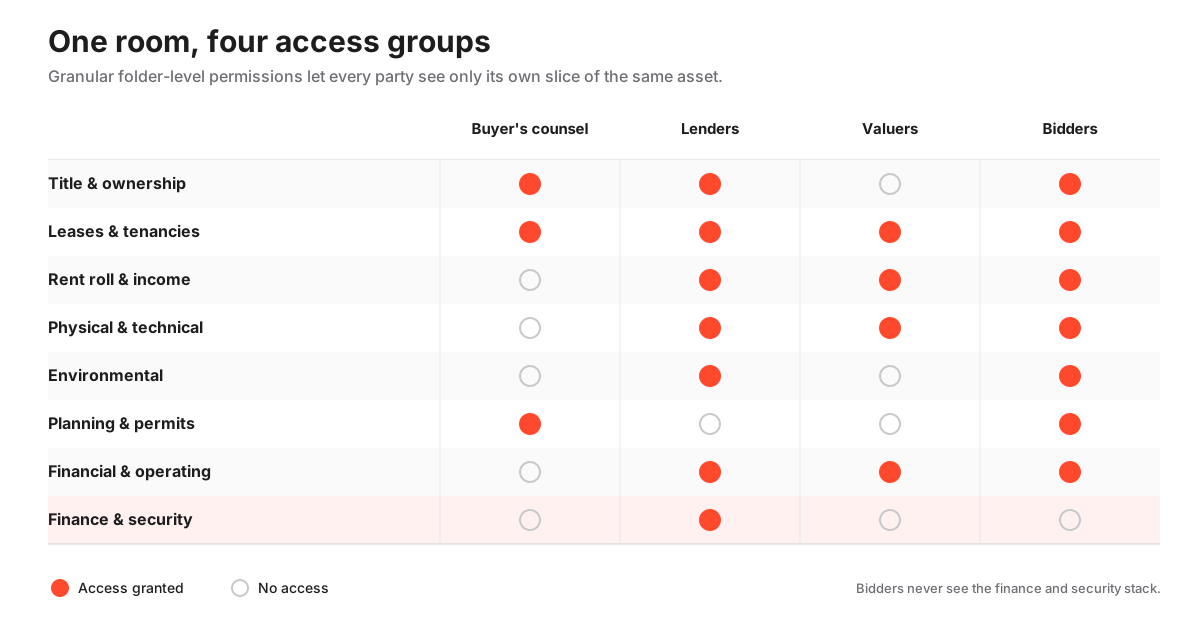
Real estate vs M&A: where the room differs
The mechanics are shared. The emphasis shifts. An M&A room is built around corporate structure, contracts and financial statements. A real estate room is built around the asset and its income.
That shift changes how you configure the room, and it is worth knowing before you pick a provider that suits property rather than generic corporate deals.
Real estate data room needs vs generic M&A and consumer file sharing
| Capability | Real estate VDR | M&A VDR | Generic file sharing |
|---|---|---|---|
| Asset-by-asset folder segmentation | Yes | Rarely | No |
| Bulk upload of large survey/plan PDFs | Yes | Yes | Limited |
| Per-group permissions (tenants, lenders, bidders) | Yes | Yes | No |
| Dynamic watermarking on lease documents | Yes | Yes | No |
| Full audit trail for a defensible sale record | Yes | Yes | Minimal |
| Q&A workflow for buyer queries | Yes | Yes | No |
| Privacy controls for tenant personal data | Yes | Varies | No |
Three practical differences fall out of that table.
Segmentation is the property-specific stress test
M&A rooms rarely need asset-by-asset walls. Portfolio property rooms always do. If a platform cannot cleanly segment access at folder and group level, it is wrong for property, whatever else it does well.
The document mass skews larger and heavier
Scanned leases, high-resolution surveys and building plans run to thousands of pages. Bulk upload and full-text search stop being conveniences and become requirements. A room you cannot search is a room reviewers cannot trust.
The takeaway: configuration, not a niche tool
You do not necessarily need a real-estate-only platform. You need a capable general VDR configured for property: an index built around assets, granular permissions that map to tenants, lenders and bidders, and watermarking on anything a leak would compromise. Our security features checklist covers the controls to insist on.
To put the stakes in scale, MSCI has estimated the professionally managed global real estate investment market at more than USD 13 trillion, a figure published in its annual market size research. Diligence quality on even a single asset in that market moves millions, and the room is where that quality is either delivered or lost.
How to set up the room, step by step
Standing up a real estate room is mostly about sequence: gather and abstract first, structure second, permission last. Do those out of order and you spend the process patching mistakes.
The five steps below take a single commercial asset from a folder of documents to a room reviewers can work in without hand-holding. For portfolios, repeat the structure per asset and add a fund-level layer on top.
How to set up a real estate virtual data room
Taking a commercial property from raw documents to a review-ready room.
Estimated time: 3h
-
Build the index from a diligence checklist
Start from a real estate due diligence checklist and turn it into your folder tree: title, leases, rent roll, technical, environmental, planning, financial and finance. Number folders so the order is stable.
-
Gather, redact and abstract
Collect the source documents, redact personal data that reviewers do not need, and pair each lease with a clean abstract so buyers can scan before they drill in.
-
Bulk upload and index for search
Import large survey and plan PDFs in bulk, then run full-text indexing so a reviewer can search for a tenant name, a covenant or a break clause across the whole room.
-
Create permission groups
Set up groups for buyer's counsel, lenders, valuers and, in a portfolio, individual bidders. Grant folder-level rights so lenders see finance documents and bidders never see each other.
-
Apply security and open the Q&A
Turn on dynamic watermarking, view-only rendering and two-factor authentication, then open a structured Q&A so buyer questions are logged and answered in one place, not by email.
Two things about that sequence are worth underlining.
Step two is where professional rooms are made
Abstracting leases and redacting personal data is the discipline that separates a curated room from a document dump. It also front-loads the privacy work you would otherwise scramble to do mid-process, under time pressure, with a buyer waiting.
Permission last, never first
Set permissions before the structure is stable and every renumbering breaks your groups. Build the index, load the documents, confirm the tree, then layer access on top.
If you want the generic version of this workflow, our step-by-step guide on how to set up a virtual data room strips it back to the fundamentals.
The Q&A and disclosure process
In a property deal the room is not a static archive. It is a live disclosure record, and the Q&A module is where most of the value gets created and protected.
Here is how a well-run process actually flows.
Questions attach to documents, not inboxes
Buyers raise written questions against specific files. The sell side routes each to the right adviser. Every question, answer and follow-up is timestamped and stored in the room.
That thread becomes the seller’s evidence of what was disclosed, which is exactly why it belongs in the room and not in email.
Routing by category keeps advisers in their lane
The valuer’s rent-review query goes to the asset manager. Counsel’s title query goes to the lawyers. Nobody re-keys anything, and no question sits in a shared inbox waiting for someone to claim it.
Answers publish to one group only
Answers go back to the relevant permission group, and no further. In a portfolio process a bidder never learns what a rival asked, because the rival’s thread simply does not exist in their room.
The audit trail ties answers to versions
The audit trail links each answer to the document version it referenced. If a warranty claim surfaces after completion and the parties argue over what the buyer was actually shown, that link is the record that settles it.
In a property sale the audit trail is not paperwork you produce for the deal. It is the deal record itself, and the seller who can show exactly what was disclosed, to whom, and when, is the seller who does not lose the argument two years later.
Our deeper guide on running data room Q&A covers how to structure categories, set response SLAs and close the disclosure gaps that turn into post-completion disputes.
Security and compliance: the points that matter for property
The non-negotiables are certified security, granular permissions, watermarking and a complete audit trail. Real estate adds a privacy dimension that corporate deals sometimes lack, because lease files, tenant correspondence and investor KYC documents all contain personal data.
The moment a room holding that data opens, it is processing regulated information. Here is what that means in practice.
Personal data is baked into the document set
Tenant names, guarantor details, occupier correspondence, investor KYC. You cannot run a real estate room without touching personal data, so plan for it from the index stage rather than treating it as an afterthought.
GDPR applies whenever Europe is in the deal
Where a European asset, tenant or investor is involved, the processing falls under the General Data Protection Regulation. That requires appropriate technical safeguards, a lawful basis for sharing, and control over retention and deletion.
Usefully, those obligations map onto features you should already want: encryption in transit and at rest, access logs that show who opened a tenant file, permission controls that limit exposure to the minimum group, and the ability to purge or expire access cleanly at close. Our guide on GDPR and virtual data rooms unpacks the duties in full.
Certifications you can verify beat claims you cannot
Look for SOC 2 and ISO 27001. Both tell you the platform is independently audited rather than self-declared, which is the difference between a security posture and a marketing line. Our explainer on VDR certifications breaks down what each one actually covers.
The trade-off, weighed honestly
Running a property deal in a VDR: the trade-off
Pros
- One indexed source of truth replaces scattered email attachments and shared drives
- Folder-level permissions let tenants, lenders and bidders coexist safely in one room
- Watermarking and view-only rendering protect sensitive leases and valuations
- A complete audit trail gives the seller a defensible record of the whole disclosure process
Cons
- A large portfolio room takes real setup time to index and permission correctly
- Costs more than consumer file sharing, though far less than a mispriced liability
- Poorly planned permissions can expose the wrong documents, so setup discipline matters
- Personal data in leases and KYC brings privacy obligations you must plan for
What a real estate data room costs
Pricing follows complexity, and complexity in property usually means how many assets and how much data. Read the pricing model as carefully as the headline number.
Here is the shape of it.
The entry point: around $99 a month
A single-asset room can start near $99 per month on an entry plan. Watch the storage and user caps, because entry plans buy the low price by limiting exactly the things a document-heavy property deal consumes.
The middle: low-to-mid hundreds per month
A multi-tenant building with a heavy lease stack and several permission groups commonly runs into the low hundreds per month. More documents, more groups, more room to configure.
The top: custom quotes
Portfolio disposals and development finance are typically quoted per engagement, priced on data volume and user count. Long development rooms also carry a duration cost most sale rooms do not.
Indicative pricing shape by real estate deal type (confirm with the provider)
| Deal type | Typical room | Indicative USD | Pricing watch-out |
|---|---|---|---|
| Single-asset sale | One asset, one bidder group | ~$99-$400/mo | Storage and user caps on entry plans |
| Multi-tenant building | Heavy lease stack, several groups | ~$300-$900/mo | Per-page models inflate on large PDFs |
| Portfolio disposal | Many assets, competing bidders | Custom quote | Priced on data volume and users |
| Development finance | Lenders, construction docs, drawdowns | Custom quote | Longer term inflates total cost |
Treat every figure above as indicative and confirm current pricing with the provider, since plans, storage caps and user limits change often.
The one cost trap to watch: per-page pricing
The single biggest pricing decision in property is per-page versus flat-rate. A folder of high-resolution surveys and scanned leases can run to thousands of pages, and on a per-page plan that arithmetic gets expensive fast.
For most real estate work, a flat-rate room with a generous storage allowance is the safer choice. If budget is the deciding factor, our roundup of the cheapest virtual data rooms benchmarks the value end of the market, and the pricing hub lines up plans side by side.
The mistakes that quietly cost you leverage
The failures that cost property deals time and negotiating room are almost never technical. They are preparation and permission errors a checklist would have caught. These six recur most, drawn from our wider guide on data room mistakes to avoid.
- Uploading source leases with no abstracts. Reviewers drown in full lease text and raise dozens of avoidable Q&A queries. Abstracts up front cut the question load and speed the deal.
- Leaving personal data unredacted. Tenant names, guarantor details and KYC files exposed to a group that does not need them create a privacy problem before the deal even heats up.
- Flat permissions across every group. Give lenders, valuers and bidders the same view and you defeat the point of the room, and you can leak the finance stack to parties who should never see it.
- Letting bidders discover each other. In a portfolio process, weak group isolation lets a bidder infer who else is at the table, which weakens the seller’s negotiating position.
- No stable folder numbering. Renumber mid-process and you break every reference in the Q&A thread and every note a buyer’s counsel has taken. Trust in the room erodes with it.
- Skipping a document freeze at signing. Without a locked, timestamped snapshot of the room at completion, the seller loses the clean disclosure record a warranty dispute later turns on.
Get these six right and the software fades into the background, which is the sign of a well-run room.
How to choose a VDR for real estate
Choose on four things, in this order. Property stresses the first one harder than most use cases, so weight it accordingly.
1. Permission depth (weight it first)
A single room routinely serves tenants, multiple lenders and, in a portfolio, competing bidders who must never see each other. If a platform cannot cleanly segment access at folder and group level, it is wrong for property regardless of its other strengths.
2. Document handling
Bulk upload, full-text search across scanned leases, and stable folder numbering all matter more when the corpus is large. Test these on a realistic document load, not a demo folder of ten clean PDFs.
3. Security certification
Confirm SOC 2 and ISO 27001, and check that watermarking, view-only rendering and detailed audit logs are actually included on the plan you would buy, not reserved for an enterprise tier.
4. Pricing model
Pit the pricing model against your real document volume. For most property work that means favouring flat-rate over per-page, and reading the storage cap closely.
Where the providers land
Among the rooms we review, iDeals, Datasite, Intralinks and Drooms show up often on institutional property deals, while modern, full-featured rooms such as Ellty handle single-asset sales and wider CRE portfolios with a clean interface and published pricing. If you are torn between two of the heavyweights, our head-to-head on iDeals vs Datasite sets them against each other directly.
Weigh them side by side rather than on brand alone. Our how to choose a virtual data room guide sets out the full scoring framework.
Frequently asked questions
Do I need a real-estate-specific data room, or will any VDR work?
Most institutional VDR platforms handle real estate well; the difference is configuration, not usually the software. What you need is a room you can index by asset, permission by group (tenants, lenders, bidders) and search across large scanned documents. A capable general VDR set up for property beats a niche tool with weaker security.
What documents should go in a real estate data room?
Organise around the asset: title and ownership, the full lease stack with abstracts and estoppels, rent roll and income, building and condition surveys, environmental reports, planning and permits, operating financials, and existing finance and security documents. Hotels and development schemes add operational and construction folders.
Is a virtual data room secure enough for tenant and investor personal data?
A reputable VDR is built for exactly this, with encryption in transit and at rest, granular permissions, watermarking and a full audit trail. Where European assets, tenants or investors are involved, that data falls under GDPR, so look for SOC 2 and ISO 27001 certification and controls over retention and deletion.
How much does a real estate data room cost?
Indicative pricing starts around $99 per month for a single-asset room, runs into the low-to-mid hundreds for a multi-tenant building, and moves to custom quotes for portfolios and development finance. Watch for per-page pricing, which can inflate sharply on document-heavy property deals. Confirm current pricing with the provider.
How long does it take to set up a room for a property sale?
A single-asset room can be review-ready in a few hours once documents are gathered, redacted and abstracted. The time-consuming part is preparing the leases and permissions, not the software. A portfolio room takes longer because you repeat the structure per asset and add a fund-level layer.
Can bidders in a portfolio sale see each other?
Not if the room is set up correctly. Folder-level and group-level permissions let you give each bidder access to the same asset documents while keeping their identities and activity invisible to one another. This segmentation is a core reason competitive property processes run in a VDR rather than by email.
