
Virtual data rooms for private equity firms
On this page
- Start with the definition
- The number behind the pressure
- Three rooms, not one
- Why a shared folder is not enough
- How a PE room differs from a one-off M&A room
- The fund lifecycle, stage by stage
- What goes inside a diligence room
- The features that actually decide a deal
- Setting up a deal room
- Permissions and Q&A in a competitive auction
- What it costs
- The room during a fundraise
- Keeping it compliant and audit-ready
- Choosing the right room
Start with the definition
A virtual data room is a secure, permissioned online repository. You put confidential documents inside it. You decide precisely which named people can open each folder. The system logs every view, download and search.
For a private equity firm, that last part is the whole point. The room does not just store files. It produces a record.
Private equity runs on confidential information moving fast between parties who do not fully trust each other yet. A general partner sizing up a target. A limited partner scrutinising a fund. A management team preparing for exit.
Each needs to hand sensitive files to a specific audience, prove who saw what, and pull access the moment the process turns. A shared drive cannot do any of that with a straight face. A data room can. That gap is why VDRs sit at the centre of nearly every serious PE workflow.
If the category itself is new to you, the plain-language contrast in our guide on the virtual data room versus a shared drive is the fastest way in, and the glossary entry on due diligence frames the process the room is built to serve.
The number behind the pressure
One figure frames everything: capital under pressure. Even after a slower cycle, the industry has been sitting on well over a trillion dollars of uncalled buyout capital, according to Bain and Company’s Global Private Equity Report.
That dry powder has to be deployed. It means more competitive processes, tighter timelines and more diligence streams running at once, which is exactly the condition a data room was designed for.
When several bidders chase the same asset, the winner is often the firm that moves through diligence cleanly. The room is where that speed either happens or stalls.
Three rooms, not one
The single most useful thing to understand about PE and data rooms is that a firm never really has “a” room. It has a portfolio of them, and they come in three kinds.
- Deal rooms. Transient. One per live acquisition or disposal, opened for a process and closed when it ends.
- The fund room. Semi-permanent. Reopened for each fundraising close, holding track record, terms and legal documents for prospective LPs.
- Portfolio rooms. Persistent. Quiet governance and reporting spaces that live for the whole hold period of an asset.
Deal rooms are loud and short-lived. Fund and portfolio rooms are quiet and long-lived.
A firm that treats every one of them as a disposable, standalone project ends up rebuilding the same index by hand each time and drifting into inconsistent permissions. That is precisely where leaks and delays begin.
Why a shared folder is not enough
It is worth being concrete about what the room does that ordinary cloud storage cannot.
A shared folder cannot prove that a losing bidder only ever saw the redacted financials. It cannot stamp every page with the viewer’s identity. It cannot show a regulator or an LP a clean log of who accessed what and when.
The room replaces guesswork with evidence. That evidence matters most when a deal breaks or a dispute surfaces months later.
In a competitive process the deal is often won or lost on how confidently you can share. A firm that can open a folder to one bidder and close it to another in seconds negotiates from a position of control. A firm improvising with email and links negotiates from a position of hope.
How a PE room differs from a one-off M&A room
The difference is cardinality and persistence. A corporate seller sets up one room, runs one sale, closes it. A PE firm treats the room as standing infrastructure, spinning up deal rooms continuously while keeping fund and portfolio spaces open for years.
That changes what “good” means. A PE buyer cares about templated room setup so every deal starts from the same index. About administrator controls that span many rooms at once. About per-deal or per-project billing that maps to fund accounting. About user management that scales past a handful of bidders to dozens of advisers, lenders and co-investors.
Capacity is table stakes. The differentiator is how cleanly one small deal team can run several confidential processes without cross-contamination.
The generalist M&A data room guide covers the single-transaction case. A PE buyer should read it as the floor, not the specification.
The fund lifecycle, stage by stage
Almost every stage of a fund’s life leans on the room, but the room plays a different part at each. During fundraising it is the LP diligence window. During execution it is the buy-side or sell-side diligence engine. During the hold it is a reporting and governance space. At exit it becomes a sell-side room again.
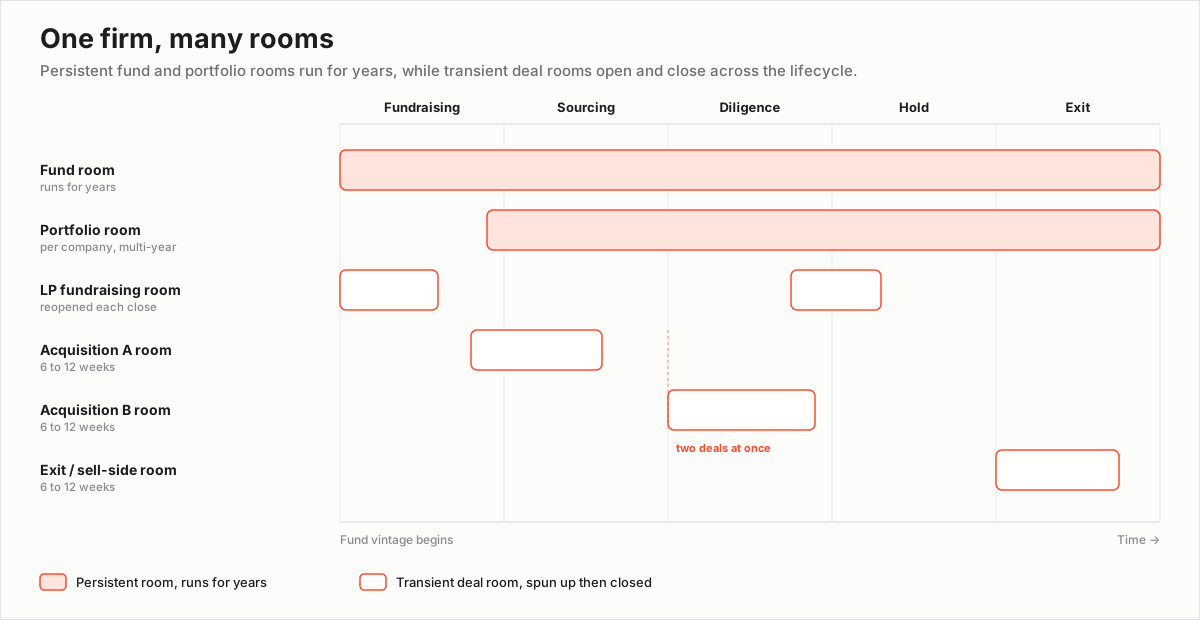
The diagram above shows why the “three rooms” idea matters in practice. The persistent fund and portfolio spaces run as a steady backbone while transient deal rooms open and close on top of them. Mapped to the lifecycle, the pattern looks like this.
| Stage | Primary use of the room | Typical lifespan | Who gets access |
|---|---|---|---|
| Fundraising | LP due diligence on track record, terms and team | Weeks to months, reopened per close | Prospective LPs, placement agents, fund counsel |
| Deal sourcing and screening | Early review of teasers and management materials | Days to weeks | Deal team, select advisers |
| Due diligence | Full buy-side review of the target | 6 to 12 weeks per deal | Bidders, legal, financial and commercial advisers |
| Portfolio monitoring | Board packs, reporting and governance during the hold | Multi-year, persistent | Portfolio management, deal partner, board |
| Exit or sale | Sell-side diligence for buyers of the portfolio company | 6 to 12 weeks | Prospective buyers and their advisers |
Lifespans are indicative and vary by fund strategy and deal size. The practical takeaway is the same across every row: think in terms of many rooms with different audiences and retention rules. That is why administrator tooling across rooms matters as much as any single feature.
What goes inside a diligence room
A PE diligence room holds the full evidence base a buyer needs to test the investment thesis. Organise it to a diligence checklist so reviewers find each document where they expect it rather than hunting through a flat file dump. The exact index shifts by deal, but the room should mirror the questions bidders will ask.
- Financial: audited statements, management accounts, working capital analysis, revenue and cohort data, the quality-of-earnings pack.
- Legal and corporate: cap table, constitutional documents, board minutes, material contracts, litigation and IP registers.
- Commercial: customer contracts, pipeline, pricing, market and competitive analysis.
- Operational and people: org chart, key-employee agreements, benefit plans, IT and systems overview.
- Compliance: regulatory licences, data-protection records, insurance and ESG documentation.
A common mistake is dumping everything in on day one. Experienced deal teams stage the release, holding the most commercially sensitive folders, customer names, detailed pricing, key-employee terms, until a bidder has cleared an earlier gate.
For a stage-by-stage build, our companion guides on the due diligence document checklist and what documents go in a data room go deeper, and data room index best practices covers how to order it all so reviewers move quickly.
The features that actually decide a deal
Here is the part most storage comparisons get wrong. What decides a PE process is the control-and-accountability layer, not the storage layer. Four capabilities carry most of the weight.
Group-level permissions. They let a small team run a competitive auction without leaking one bidder’s questions to another. A permission mistake in an auction is not a nuisance; it can compromise price.
A structured Q&A workflow. It keeps hundreds of bidder questions routed to the right expert instead of scattered across email threads that no one can reconstruct later.
A complete audit trail. It turns raw engagement into intelligence. Seeing that one bidder spent forty minutes in the customer-contracts folder tells the deal team who is real, and that another “interested party” never opened the financials at all.
Dynamic watermarking and view-only rendering. They deter the leaks that quietly kill competitive tension.
These matter unevenly across contexts. Permissions and the audit trail are decisive everywhere: buy-side diligence, portfolio reporting and LP fundraising alike. Structured Q&A is central to diligence, occasional in fundraising, and rare in routine reporting. Watermarking is essential for diligence and fundraising, optional for internal portfolio packs. Multi-room admin matters most when several deals run at once, and least during a single fund raise.
Our guides on data room permissions explained and VDR audit trails explained unpack the two that never stop mattering, and dynamic watermarking and fence view covers the leak controls in detail. The glossary entry on the audit trail is a good one-minute primer if the term is new.
Setting up a deal room
A disciplined setup is the difference between a room that accelerates a deal and one that generates confusion. The path below gets a defensible sell-side or buy-side room ready before any external reviewer is invited. It maps closely to the workflow experienced teams repeat on every transaction.
How to set up a private equity deal room
A repeatable setup for a PE diligence room, from index to invitations.
Estimated time: 2h
-
Clone your standard index
Start from a firm template that mirrors the diligence checklist, so every deal room shares a consistent structure and reviewers always know where to look.
-
Bulk upload and index
Import the financial, legal, commercial and operational packs in bulk, then run full-text indexing so every document is searchable from the first login.
-
Define user groups
Create groups for bidders, buy-side legal, financial advisers and internal team, and grant folder-level rights to groups rather than editing individuals.
-
Stage a phased release
Publish an initial tranche, hold sensitive folders such as customer names for later rounds, and plan when each group graduates to the next data set.
-
Apply security controls
Turn on dynamic watermarking, view-only rendering and two-factor authentication, and confirm the audit log is capturing views and downloads before inviting anyone.
-
Invite by group and open the Q&A
Send invitations to each group, open the structured Q&A workflow, and use the engagement heatmap to read which bidders are serious and where attention concentrates.
For a general, provider-agnostic walkthrough see how to set up a virtual data room. For granting and pulling access cleanly as rounds progress, how to grant and revoke data room access covers the mechanics.
Permissions and Q&A in a competitive auction
Organise both around groups and rounds, never around individuals. That single rule keeps a competitive process fair and controllable.
Assign every reviewer to a group tied to their role and round. Grant folder rights at the group level. Let phased release move a group up to more sensitive data only once it clears a gate. Now you can admit a new bidder or drop a lapsed one by moving a single group membership, not by editing a dozen files.
Q&A follows the same logic. A good workflow lets bidders submit questions inside the room, routes each to the right subject-matter expert on the sell side, and publishes answers to the correct audience without revealing who asked.
In an auction that routing is what stops one party’s curiosity from tipping off another. If bidder A asks a pointed question about a customer contract, bidder B should never be able to infer it from the answer stream. Our running data room Q&A guide details how to staff the module without it becoming a bottleneck.
There is also a buying decision underneath all this: one standing platform for the whole firm, or a fresh room per deal. Most operations teams end up weighing this trade-off.
Standing PE platform vs a fresh room per deal
Pros
- Consistent index and permissions across every deal reduce setup error
- Multi-room admin gives partners one view of all live processes
- Per-deal or annual pricing can beat repeated one-off room fees at volume
- Retained fund and portfolio rooms keep governance records in one place
Cons
- Annual commitments cost more than a single short-term room if deal flow is thin
- Standardising the whole firm on one platform is a real switching decision
- Persistent rooms need a retention and access-review discipline of their own
What it costs
Costs span a wide range, because a PE firm buys across the whole spectrum. Entry pricing for a lean, single-room setup starts around $99 per month. Mid-market rooms commonly land in the low hundreds per month. PE-grade platforms that carry many concurrent deals, heavy user counts and advanced admin often run $1,000 or more per month, or are quoted as per-deal or annual contracts.
Treat every figure as indicative and confirm current pricing with the provider, since plans, storage and user tiers change often.
The pricing model matters as much as the sticker. Per-page pricing can punish a document-heavy diligence room. Flat-rate or per-deal pricing gives budget certainty for a known process. Firms with steady deal flow usually favour an annual platform deal; firms with sporadic transactions often prefer paying per room. Roughly:
| Firm profile | Typical room need | Pricing shape that fits | Indicative USD range |
|---|---|---|---|
| Occasional dealmaker | One room, a few weeks, then closed | Short-term or per-project flat fee | $99 to a few hundred per month |
| Active mid-market fund | Several deals a year plus fund room | Annual platform with per-deal room creation | Low four figures per month |
| Multi-strategy or large-cap firm | Many concurrent rooms, heavy user counts | Enterprise annual contract, quoted | Custom, often $1,000+ per month |
All ranges are indicative; confirm current pricing, storage and user tiers with the provider. For the full breakdown see VDR pricing models explained, the trade-offs in per-page vs flat-rate pricing, and the traps in hidden costs of virtual data rooms.
Watch especially for overage on users and storage, and for charges to keep a room in archive after a deal closes, since PE firms often need read-only access to a closed room long after the transaction. You can also line up current numbers on our pricing overview.
The room during a fundraise
During a raise the data room becomes the general partner’s diligence window for limited partners. It holds the track record, fund terms, team bios, prior fund performance and legal documents that LPs and their consultants scrutinise before committing.
The same controls that protect a deal, granular permissions, watermarking and a full audit trail, let a GP share sensitive performance data with a controlled set of prospective LPs while keeping a clean record of who reviewed what.
The audit trail earns its keep here in two ways. It shows the GP which prospective LPs are actively engaged, so the investor-relations team can prioritise follow-up. And it provides a defensible record that confidential fund materials were only ever available to qualified, invited investors, which matters when a fund faces regulatory scrutiny or an LP later questions what was disclosed.
Because fundraising reopens the room for each close, templated setup and easy user management pay off again. The same fund room can be refreshed and reopened rather than rebuilt for the next vintage.
Keeping it compliant and audit-ready
Compliance rests on three pillars: independently certified platform security, honest data-handling practices, and a complete, tamper-evident audit trail.
Look for a provider certified to ISO 27001 for information security management, and one that holds a SOC 2 report from the AICPA framework. Regulated LPs and corporate buyers increasingly treat both as baseline. Encryption in transit and at rest, plus enforced two-factor authentication, complete the technical floor.
Data protection adds a second layer. Where a deal touches personal data of EU or UK individuals, the room and its hosting must respect the General Data Protection Regulation, which makes data-residency options and processing terms a genuine selection criterion rather than a checkbox.
Our GDPR and virtual data rooms and data residency in virtual data rooms guides cover the practicalities, and the VDR security features checklist lists what to verify before you trust a room with fund-level data.
Audit-readiness is also an operational habit, not just a feature. Persistent fund and portfolio rooms need a periodic access review, removing advisers and former staff who no longer need entry, so the audit trail reflects a genuinely controlled set of users rather than years of accumulated access. Read certifications explained before you sign, so you can tell a scoped, current attestation from a lapsed or partial one.
Choosing the right room
Choose on the criteria that actually break under pressure: reviewer experience with hundreds of files open at once, permission granularity, Q&A discipline, audit depth, security certification, and per-deal economics that fit your deal flow.
Rank those against your firm’s real pattern, then shortlist two or three providers and put each through a live, deal-style test rather than a feature demo. A room that looks clean when empty can crawl when a real diligence pack and a dozen concurrent users hit it.
Many providers, including Ellty and others in our comparison, offer a free trial, so you can upload a representative pack, invite a test group, and see how the permissions and Q&A hold up before you sign.
For a structured scoring approach, how to choose a virtual data room walks through weighting the criteria; if you are moving off an incumbent, how to migrate to a new data room covers a clean cutover. To see the field ranked for this exact use case, our roundup of the best virtual data room for due diligence is the shortest path, and the full provider reviews let you read each one in depth.
Frequently asked questions
Do private equity firms use one data room or several?
Several, almost always. A typical firm runs a separate room for each live deal, plus longer-lived fund and portfolio rooms that persist across the hold period. That is why multi-room administrator tooling and a consistent room template matter as much to a PE buyer as any single feature.
How much does a private equity data room cost?
Indicative pricing runs from roughly $99 per month for a single lean room to $1,000 or more per month, or per-deal and annual contracts, for multi-deal PE platforms with heavy user counts and advanced admin. Pricing model matters as much as the number: per-page pricing can penalise document-heavy diligence, while flat or per-deal pricing gives budget certainty. Treat all figures as indicative and confirm current pricing with the provider.
What security should a PE firm require from a VDR?
At minimum, independent certification to ISO 27001 and a current SOC 2 report, encryption in transit and at rest, enforced two-factor authentication, dynamic watermarking, view-only rendering, and a complete audit trail. Where a deal touches EU or UK personal data, add GDPR-compliant hosting and data-residency options to the list.
Can a losing bidder still access documents after a process ends?
Not if the room is run properly. Group-level permissions let the deal team revoke a bidder's access instantly by removing a single group membership, and view-only rendering with watermarking means no local copies should exist. The audit trail then provides a defensible record of exactly what that bidder saw and when access ended.
