
Virtual data rooms for startup fundraising
On this page
- The two jobs a fundraising room does at once
- Does a startup actually need a data room to raise?
- What belongs inside a startup fundraising room?
- How the room should change by funding stage
- Timing: when in the raise to open the room
- How an investor room differs from an M&A room
- The security controls that actually carry weight
- Keeping investor data compliant across borders
- What a fundraising room costs a startup
- How to build a room for a seed or Series A raise
- Reading the engagement data during a raise
- Mistakes that erode investor confidence
Here is the part of fundraising founders control most and think about least: the data room. Raising a round looks like a story problem. It is really a documents problem.
The pitch earns the first meeting. The narrative carries the second. But the term sheet only arrives after a partner, an associate and often an outside lawyer have worked through your numbers, your contracts and your cap table, line by line. That scrutiny does not happen on a call. It happens in a data room, in the days and weeks after an investor decides you are worth the effort.
So the way you assemble and run that room is real leverage. A room that answers questions before they are asked keeps a deal moving on your timeline. A room that raises a fresh question with every folder hands the initiative, and sometimes the price, to the other side.
This guide treats the room as a working instrument, not a checkbox. What belongs inside, how the depth scales from pre-seed to Series A, when to open access, what it costs in US dollars, and how to read the engagement data the room quietly generates while investors work. Requests vary by investor, sector and geography, so treat every list here as a strong default rather than a universal rule.
The two jobs a fundraising room does at once
Most explanations of data rooms stop at security. That misses half the point.
Yes, a permissioned room protects sensitive files, and that matters. But for a startup the room is also a persuasion surface, and the two functions pull against each other.
On the disclosure side, you give investors and their counsel enough evidence to build conviction: the model that proves the growth story survives contact with reality, the cap table that shows exactly who owns what, the contracts that turn a headline revenue number into something an associate can trust.
On the persuasion side, you curate that evidence so the business reads at its clearest. That means ordering, labelling and framing the documents so a busy partner reaches the conclusion you want without wading through noise.
Founders who treat the room as pure disclosure over-share. They dump every internal file and invite a diligent associate to pull threads that never needed pulling. Founders who treat it as pure marketing under-share, and a sophisticated investor reads the gaps immediately. The skill is holding both jobs at once: complete enough to be credible, curated enough to be persuasive. Everything below is downstream of that balance.
Does a startup actually need a data room to raise?
Not for the first coffee. Yes for real diligence, and the threshold arrives earlier than most first-time founders expect.
Angels writing small pre-seed cheques may decide on a deck and a conversation, and pushing a formal room at them can feel like process for its own sake. The picture changes the moment an institutional investor moves toward a term sheet. Now they will ask for a structured set of documents, and how you deliver it becomes part of the assessment.
Email attachments and open shared-drive links work right up until they do not. A partner asks for the third revision of your model and nobody can say which version is current. An investor forwards a confidential customer contract to the wrong address. You lose track of who has seen your cap table. A permissioned room closes all three gaps at once: one canonical source, controlled access, and a record of who looked at what and when.
There is also a signalling effect founders routinely underrate. A room that is well indexed, complete and internally consistent tells an investor the team is organised, and organisation is a proxy for a dozen things a partner cannot observe in a two-hour meeting.
The inverse is more dangerous than it sounds. A chaotic room, with duplicate files, missing documents and no obvious structure, invites a lawyer to dig harder, because sloppiness in the file reads as a hint of sloppiness in the business. You do not get much credit for a tidy room; you get penalised for a messy one. That asymmetry is exactly why the downside is worth eliminating. For the ground-level definition of what a room is and how it differs from ordinary file sharing, the virtual data room glossary entry sets the baseline, and who needs a virtual data room frames the wider set of situations that call for one.
What belongs inside a startup fundraising room?
At the minimum you need four things: the company story, the numbers behind it, the legal foundation underneath, and proof that the product, the customers and the team are real.
Investors do not want a document dump, and they do not want a treasure hunt. They want a clean, labelled set that answers their standard questions before they have to ask. The table below groups the essentials and explains why each folder earns its place. Read the right-hand column as the question each group silently answers, because that is how an associate will actually use it.
Core folders in a startup fundraising data room
| Document group | What it contains | Why investors want it |
|---|---|---|
| Pitch and vision | Current deck, one-pager, product demo or video | Frames the opportunity and confirms the narrative matches the data |
| Cap table and equity | Fully diluted cap table, option pool, SAFE and note terms | Shows who owns what and how this round dilutes existing holders |
| Financials | Historical P&L, model, monthly burn, runway, key metrics | Tests whether the growth story survives contact with the numbers |
| Corporate and legal | Incorporation docs, bylaws, board consents, IP assignments | Confirms the company is clean, properly owned and free of surprises |
| Customers and traction | Contracts, pipeline, cohort or retention data, references | Validates demand and revenue quality behind the headline metrics |
| Team | Founder bios, org chart, key hires, employment agreements | Assesses the people the capital is actually backing |
Two details separate a room that reassures from one that quietly worries a lawyer. Both are cheap to get right and expensive to get wrong.
The first is version control. Keep exactly one current copy of every file, name it so the date and version are unmistakable, and archive superseded drafts so nobody opens a three-month-old model by accident.
The second is intellectual-property hygiene. Every founder, contractor and early employee who touched the product should have signed an invention or IP assignment. An unassigned founder, or a freelance developer who technically still owns a chunk of your core code, is precisely the kind of latent defect that stalls a term sheet while lawyers untangle it. Neither problem is hard to fix in advance. Both are painful to discover mid-diligence, when a fund’s counsel finds them first.
For a deeper, line-by-line inventory of every folder, the companion guide on what documents go in a data room breaks each group down further, and the due diligence checklist maps the same territory from the investor’s side of the table, which is a useful way to pressure-test whether your room is complete. If the phrase itself is unfamiliar, the due diligence entry explains what investors are actually doing when they ask.
How the room should change by funding stage
The folders stay broadly the same from pre-seed to Series A. What grows sharply is the depth investors expect inside each one.
A pre-seed investor forgives a rough model and a thin legal file. At that stage they are underwriting a team and a market more than a set of accounts. A Series A partner expects something close to audit-quality financials, signed customer contracts rather than letters of intent, and a legal file with no visible gaps, because they are pricing a company with real revenue and real obligations.
Building the wrong depth for the stage cuts both ways. Under-prepare and you stall a deal while you scramble to assemble what should already exist. Over-build and you sink weeks into a room nobody reads at pre-seed. The matrix below shows what most investors expect to find present at each common stage.
What investors typically expect in the room, by stage
| Room contents | Pre-seed | Seed | Series A |
|---|---|---|---|
| Deck, one-pager, cap table | Yes | Yes | Yes |
| Incorporation and IP assignment docs | Yes | Yes | Yes |
| Financial model and runway | Light | Yes | Yes |
| Historical monthly financials | No | Some | Yes |
| Signed customer contracts | No | Some | Yes |
| Cohort / retention analytics | No | Optional | Yes |
| Full legal file (board consents, prior rounds) | No | Partial | Yes |
The practical rule follows straight from that matrix: build the pre-seed room so it can grow into the Series A room.
Use a folder structure a later-stage investor would recognise on sight, then fill it in over time rather than inventing a new layout at each round. Done this way, a follow-on raise means adding files to a familiar skeleton, not rebuilding the whole thing from scratch under deadline pressure while you are also trying to run the company. The naming conventions and folder order that keep a room legible as it expands are worth getting right early, and our data room index best practices guide covers exactly that, while the data room folder structure template hands you a ready starting layout you can adapt. A clear data room index is the single feature that most separates a room investors move quickly through from one they get lost in.
Timing: when in the raise to open the room
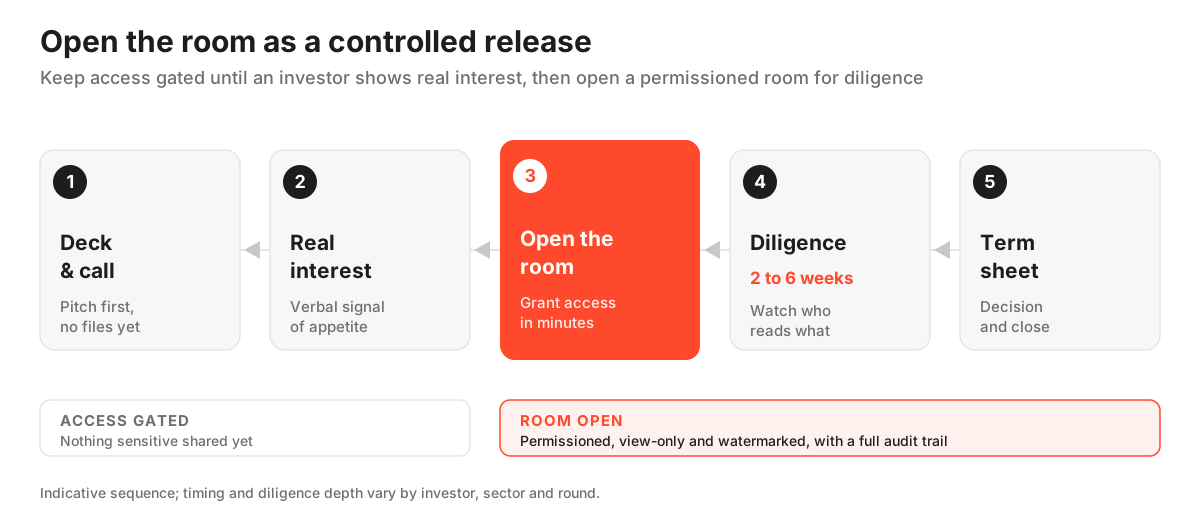
Open the room when a genuinely interested investor asks for diligence, and not a moment before.
Sending a data-room link cold, stapled to your first outreach email, does two things you do not want. It leaks your most sensitive numbers, your model and your cap table, to a wide pool of people most of whom were never going to invest. And it can read as slightly desperate, as though you are pushing detail at investors who have not yet asked for it.
The stronger sequence is deliberate and staged. Lead with the deck, hold a call, and open the room only once there is real interest and, ideally, a verbal indication of appetite. Gating access this way is not only about security. It concentrates your own effort, so you answer detailed questions for the handful of investors genuinely deciding rather than performing full diligence for tourists.
The counterweight to caution is speed, and the two need not conflict. Keep a light version of the room permanently ready so you never lose momentum when interest turns serious. When a partner asks on a Friday afternoon, you want to grant scoped access within minutes, not spend the weekend hunting for files and building folders. The mechanics of granting access cleanly, and just as importantly pulling it back the instant a process goes cold, are covered in our guide on how to grant and revoke data room access.
Treat the room as a controlled release, not a public library. The founders who close fastest are rarely the ones who share the most; they are the ones who share the right documents, with the right investor, at the right moment in the process.
How an investor room differs from an M&A room
A fundraising room and an acquisition room look similar from the outside and behave quite differently in practice.
An M&A room, the kind used inside a deal room during a sale, is often adversarial and encyclopaedic. The buyer is taking on the entire company, every asset and every liability, so their counsel wants every contract, every edge case, every historical filing, because anything they miss becomes their problem after close. Completeness there is defensive. The room exists to prove there are no hidden liabilities, and the volume of documents can be enormous.
A fundraising room is a different animal. The investor is buying a minority stake in a future, not the whole present, so the room is a persuasion tool as much as a disclosure one. You give investors enough to build conviction and get comfortable while presenting the business at its clearest. That pushes you toward tighter curation, a stronger narrative thread running through the folders, and a bias toward the documents that build confidence rather than an exhaustive archive of everything that exists.
The security fundamentals, though, carry straight across. Whether the counterparty is a strategic buyer or a growth-stage fund, you still want granular permissions so different viewers see different files, watermarking on anything sensitive, and a full audit trail that records exactly who accessed what. The difference between the two room types is emphasis, not machinery. An M&A room optimises for airtight, defensible completeness; a fundraising room optimises for a clear, confidence-building story told with fewer, better-chosen documents.
The security controls that actually carry weight
Strip fundraising security down and three things matter more than the rest: control over who can see each file, deterrence against leaks, and independent proof that the platform itself is trustworthy.
Your cap table, your financial model and your customer contracts are commercially sensitive, and in a competitive round the risk is not abstract. A competitor posing as an interested investor, or an investor who also backs a rival, is a genuine hazard, and the damage from a leaked model or customer list can outlast the round.
This is where the mechanics earn their keep. View-only rendering means a file is displayed but never downloaded, and dynamic watermarking stamps each view with the viewer’s own identity, so any screenshot that escapes carries a traceable fingerprint back to the person who leaked it. Granular permissions let you show the full model to a committed lead investor while keeping it hidden from a tyre-kicker who only needs the summary. Layer two-factor authentication on top and casual unauthorised access becomes much harder.
For the platform itself, the recognised bar is independent certification, because you cannot audit a vendor’s security yourself and their marketing claims are not evidence. SOC 2, defined by the American Institute of CPAs, attests that a vendor’s security controls have been examined against the AICPA Trust Services Criteria, and ISO 27001, published by the International Organization for Standardization, certifies that the vendor operates a documented, externally audited information-security management system reviewed on a cycle rather than assembled once and forgotten.
If a room is going to hold diligence for a priced round, treating these certifications as a minimum rather than a nice-to-have is a reasonable posture. But certifications tell you the vendor takes security seriously; they do not tell you how a specific platform implements the day-to-day controls, so read closely before you commit. Our reviews of iDeals and of lighter, pitch-focused tools such as DocSend and Digify note exactly which permission granularity, watermarking behaviour and certifications each one ships, and the VDR security features checklist lists what else to verify before you invite a single investor in.
Keeping investor data compliant across borders
Before you upload anything, assume at least one investor and their counsel sit in a different jurisdiction from you, and choose the room accordingly.
Fundraising is increasingly cross-border, and the moment an overseas investor enters diligence, the personal data sitting in your room comes into scope. That data is easy to forget about because it is incidental to the deal: employee records in your team folder, customer contacts inside contracts, personal details of the references an investor calls. Even when the company itself is not obviously covered by a foreign privacy regime, that personal data can be.
Under the EU General Data Protection Regulation, transfers of personal data outside the European Economic Area require a lawful transfer mechanism, and the European Data Protection Board issues the guidance that national supervisory authorities apply when they enforce it. In practical terms this reduces to two questions you should be able to answer for any platform you shortlist: where is the data physically hosted, and can you pin storage to a specific region if an investor’s counsel insists on it.
Most serious rooms let you choose a hosting region and will sign a data processing agreement, and for a standard raise that is usually enough to satisfy an investor’s legal team. If you have EU-based investors, or you handle EU customer data inside the documents, confirm both the region and the paperwork before anything sensitive goes into the room, because retrofitting compliance after the fact is far harder than configuring it correctly at the start. Our guides on GDPR and virtual data rooms and on data residency in virtual data rooms walk through what to ask for and how to document it, and the GDPR and data residency glossary entries define the underlying terms if either is new to you.
What a fundraising room costs a startup
The cost is lower than most founders fear, and at the earliest stage it can be nothing to start.
The market splits cleanly into two tiers, and the right choice depends on how heavy your diligence is likely to get. The first tier is lightweight document-sharing and pitch-tracking tools, popular for early rounds and warm intros, which run from no cost up to a modest monthly fee and give you view tracking plus basic access control. They are fast to start and fine for a pre-seed conversation, but they lack folder-level permissions and a real question-and-answer workflow.
The second tier is purpose-built virtual data rooms, which add granular permissions, watermarking, a structured Q&A module and a full audit trail. Those commonly land between roughly $99 and $400 per month at the plans a startup would actually use, though some vendors bill by data volume or by number of users rather than a flat monthly rate. Every number here is a moving target: plans, included storage and per-seat rules shift often, so read these as ballpark figures and check the live USD price with the provider before you shortlist on cost.
There is a timing point buried in the cost that changes the arithmetic. For a single seed or Series A raise you are effectively renting the room for the length of the process, so the honest total cost is the monthly fee multiplied by the two to four months the round runs, not an annual commitment you carry forever.
Within that window, two things quietly inflate the bill, and both are worth watching before you sign:
- Per-page or per-gigabyte pricing stays cheap until you load a heavy financial dataset or a folder of scanned contracts, at which point it can climb faster than you expected.
- Per-user seats add up quickly when a single fund sends five people, the partner, the associate, two analysts and outside counsel, into the room at once.
The trade-offs between the two tiers are summarised below.
Light document-tracking tool vs a full data room
Pros
- Document trackers are cheap or no-cost and fast to start, which suits pre-seed and warm intros
- Full data rooms give granular permissions, watermarking and a defensible audit trail
- A proper room scales straight into Series A diligence without a mid-raise migration
- Some providers offer a free trial, so you can test the controls before you pay
Cons
- Trackers lack folder-level permissions and real Q&A, which strains a competitive round
- Full rooms cost more and reward a little upfront setup discipline
- Volume-based pricing can climb once you upload a large financial dataset
- Switching tools mid-raise disrupts investors, so choose for where the round is heading
For a full breakdown of the tiers and what drives the final number, see how much a virtual data room costs and the shortlist in cheapest virtual data rooms. The pricing-model choice itself deserves a moment of thought, since it can swing your bill more than the headline rate does: the per-page versus flat-rate pricing guide explains which structure tends to suit a fundraise, and it is worth scanning the hidden costs of virtual data rooms for the line items that do not appear on the pricing page. Founders who want to build and share pitch materials in the same place sometimes look at tools like Ellty, but the right fit ultimately depends on how heavy your diligence will get and how much permission control the round demands.
How to build a room for a seed or Series A raise
Start from the investor’s checklist and work backwards, so the room answers questions before an associate has to raise them.
The sequence below gets a credible fundraising room live quickly. Be honest about where the time actually goes: the software setup takes an afternoon, while gathering, labelling and sanity-checking the documents is the slow part that rewards starting early. Follow the steps in order, because getting the structure and permissions right before you invite anyone is far easier than reorganising a live room with investors already inside it.
How to build a startup fundraising data room
A first pass that gets an investor-ready room live for a seed or Series A raise.
Estimated time: 2h
-
Map the index to investor questions
Create top-level folders for pitch, financials, cap table, legal, customers and team before uploading anything, so the structure mirrors how investors evaluate the deal.
-
Gather and label the documents
Pull the current deck, model, cap table, incorporation and IP docs, and key contracts. Use clear, dated file names so nobody opens an old model by accident.
-
Set access by group
Create groups such as lead investor, other investors and internal, then grant folder-level rights rather than editing permissions person by person.
-
Protect the sensitive files
Apply view-only rendering and dynamic watermarking to the model, cap table and contracts, and turn on two-factor authentication before inviting anyone external.
-
Invite, then watch engagement
Share access only with investors in active diligence, then use the activity log to see who is genuinely reading and where they linger.
If this is the first room you have ever assembled, the general how to set up a virtual data room guide walks through the mechanics in more depth, and best virtual data rooms for startups narrows the platform choice down to the tools founders actually use in practice. When you get to the shortlisting stage, how to choose a virtual data room lays out the criteria that separate a good fit from an expensive mismatch, and you can line up specifics across every provider in our comparison.
Reading the engagement data during a raise
Read the activity log as a signal, not as gospel, and it becomes one of the more useful advantages a data room quietly hands you.
Unlike a shared drive, a proper room records which investors actually opened the model, how long they spent on the financials, whether the associate finished the deck or bailed at slide six, and how many times someone came back. Interpreted sensibly, that turns a fundraising process from a series of polite emails into something you can read.
A partner who returns three times and lingers on the cohort data is progressing, whatever their inbox tone suggests. An investor who has opened nothing in a week is very likely a soft pass, no matter how warm the last call felt. Use that to sequence your follow-ups, decide where to spend scarce founder time, and manage the whole process toward a competitive close rather than reacting to whoever emails last. The engagement heatmap and activity tracking entries explain what the underlying analytics actually capture.
Handle the inbound questions inside the room as well, rather than letting them scatter across a dozen email threads. A structured Q&A module keeps every investor question and your answer in one auditable place, which matters more than it sounds when several investors independently ask variations of the same question about your churn or your contract terms. Answer it once, publish the response to everyone in that group, and you keep the process both fair and fast while avoiding the trap of telling three investors three subtly different things. Keeping that orderly under time pressure is its own small discipline, and our guide on running data room Q&A covers how to do it without letting the thread sprawl.
Mistakes that erode investor confidence
The confidence-killers in a fundraising room are almost all avoidable, and almost all of them trace back to a room that was rushed, leaky or over-stuffed.
A messy index that makes an associate hunt for basic documents. An out-of-date model sitting next to the current one, with no way to tell which is which. Missing incorporation documents or an unsigned IP assignment that a fund’s counsel finds before you do. Granting a competitor full access because you never set permissions by group.
Any one of these can slow a deal, and in a competitive round it can hand a lead investor leverage on price, since a sloppy file gives them a reason to negotiate. Over-sharing is the same failure from the opposite direction: dumping every internal document, including half-finished plans and old board decks, gives a diligent associate more threads to pull and more reasons to hesitate, without adding anything to the case for investing.
The fixes are cheap, which is what makes the mistakes so frustrating to watch. Keep exactly one canonical version of every file. Maintain a clean, logical index. Set permissions by group before anyone is invited, rather than scrambling after. And make a deliberate decision about what belongs in the room at all, rather than defaulting to everything. A little discipline here protects two things at once, your timeline and your valuation, and neither is something you want to leave to chance during a raise. The complete catalogue of what to avoid lives in data room mistakes to avoid.
Frequently asked questions
When should I send investors my data room link?
After there is genuine interest, usually following the first or second meeting, not stapled to the cold outreach. Sending it too early exposes your financials and cap table to people unlikely to invest, and it can read as slightly desperate. Lead with the deck, then open the room once an investor signals real appetite for diligence.
Do I need a paid data room for a pre-seed round?
Often not. Many pre-seed founders start with a low-cost or no-cost document-tracking tool that offers view tracking and basic access control, which is plenty for a warm conversation. Move to a full permissioned room with watermarking and Q&A once diligence gets heavier, typically at seed or Series A, so you are not migrating tools in the middle of a raise.
What is the single most important document for investors?
The financial model and the cap table, treated as a pair. The model tests whether your growth story holds up in numbers, and the cap table shows who owns the company and how the new round dilutes everyone already on it. Both need to be current, internally consistent and immediately findable in the room.
How do I stop a competitor from seeing sensitive files?
Use granular, folder-level permissions plus view-only rendering and dynamic watermarking on the model, cap table and contracts, so any leaked screenshot is traceable back to the viewer. Grant access strictly by group, vet who you invite, and revoke access the moment an investor drops out of the process.
Can I see which investors are actually engaged?
Yes, and it is one of the more useful things a room gives you. The audit trail and engagement analytics show who opened each document, how long they spent and how often they returned. That lets you prioritise investors who are genuinely progressing and read a silent room for what it usually is, a soft pass in polite clothing.
How long does fundraising diligence usually take?
For a priced round it commonly runs two to six weeks from term sheet to close, though it varies by investor, sector and how prepared your room is. A complete, well-indexed room is the single biggest lever you control for keeping that window short and the momentum on your side.
A fundraising data room will not rescue a weak business, and it is worth being clear-eyed about that. What it can do is make a strong deal slower, cheaper or more fragile if you run it badly, and keep the momentum on your side if you run it well.
The pattern that works is consistent across stages. Build the room so it can grow with the round. Open it only to investors genuinely in diligence. Protect the sensitive files properly. Let the engagement data tell you where to push and where to let go. Do that, and the room stops being administrative overhead and starts being one of the quiet advantages you carry into every investor conversation.
